Thank you for visiting SNEWPapers!
Sign up free
Editorial
November 27, 1790
Gazette Of The United States
New York, New York County, New York
What is this article about?
This essay, continued from prior issue, analyzes Rome's rise via conquest and fall into vice from ill-gotten wealth, contrasting it with benefits of commerce and industry for the US, arguing such pursuits enhance rather than threaten liberty and happiness.
Clipping
OCR Quality
98%
Excellent
Full Text
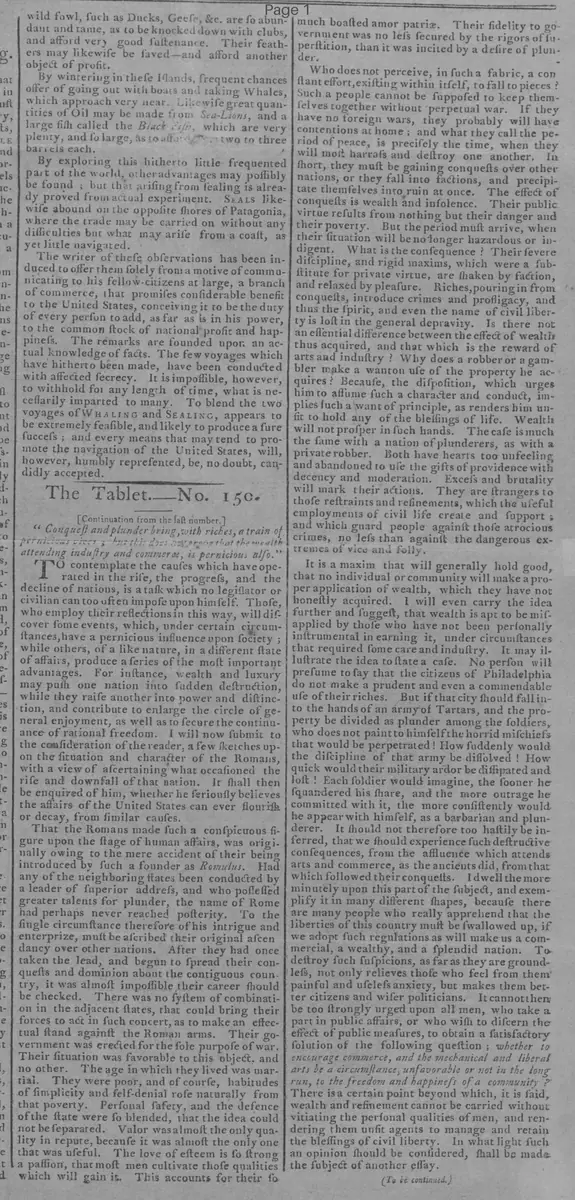
The Tablet. No. 15.
[Continuation from the last number.]
"Conquest and plunder bring with riches, a train of pernicious vices; but this does not prove that the wealth attending industry and commerce, is pernicious also."
Stated in the rise, the progress, and the decline of nations, is a task which no legislator or civilian can too often impose upon himself. Those, who employ their reflections in this way, will discover some events, which, under certain circumstances, have a pernicious influence upon society; while others, of a like nature, in a different state of affairs, produce a series of the most important advantages. For instance, wealth and luxury may push one nation into sudden destruction, while they raise another into power and distinction, and contribute to enlarge the circle of general enjoyment, as well as to secure the continuance of rational freedom. I will now submit to the consideration of the reader, a few sketches upon the situation and character of the Romans, with a view of ascertaining what occasioned the rise and downfall of that nation. It shall then be enquired of him, whether he seriously believes the affairs of the United States can ever flourish or decay, from similar causes.
That the Romans made such a conspicuous figure upon the stage of human affairs, was originally owing to the mere accident of their being introduced by such a founder as Romulus. Had any of the neighboring states been conducted by a leader of superior address, and who possessed greater talents for plunder, the name of Rome had perhaps never reached posterity. To the single circumstance therefore of his intrigue and enterprise, must be ascribed their original ascendancy over other nations. After they had once taken the lead, and begun to spread their conquests and dominion about the contiguous country, it was almost impossible their career should be checked. There was no system of combination in the adjacent states, that could bring their forces to act in such concert, as to make an effectual stand against the Roman arms. Their government was erected for the sole purpose of war. Their situation was favorable to this object, and no other. The age in which they lived was martial. They were poor, and of course, habitudes of simplicity and self-denial rose naturally from that poverty. Personal safety, and the defence of the state were so blended, that the idea could not be separated. Valor was almost the only quality in repute, because it was almost the only one that was useful. The love of esteem is so strong a passion, that most men cultivate those qualities which will gain it. This accounts for their so much boasted amor patriae. Their fidelity to government was no less secured by the rigors of superstition, than it was incited by a desire of plunder.
Who does not perceive, in such a fabric, a constant effort, existing within itself, to fall to pieces? Such a people cannot be supposed to keep themselves together without perpetual war. If they have no foreign wars, they probably will have contentions at home; and what they call the period of peace, is precisely the time, when they will most harass and destroy one another. In short, they must be gaining conquests over other nations, or they fall into factions, and precipitate themselves into ruin at once. The effect of conquests is wealth and insolence. Their public virtue results from nothing but their danger and their poverty. But the period must arrive, when their situation will be no longer hazardous or indigent. What is the consequence? Their severe discipline, and rigid maxims, which were a substitute for private virtue, are shaken by faction, and relaxed by pleasure. Riches, pouring in from conquests, introduce crimes and profligacy, and thus the spirit, and even the name of civil liberty is lost in the general depravity. Is there not an essential difference between the effect of wealth thus acquired, and that which is the reward of arts and industry? Why does a robber or a gambler make a wanton use of the property he acquires? Because, the disposition, which urges him to assume such a character and conduct, implies such a want of principle, as renders him unfit to hold any of the blessings of life. Wealth will not prosper in such hands. The case is much the same with a nation of plunderers, as with a private robber. Both have hearts too unfeeling and abandoned to use the gifts of providence with decency and moderation. Excess and brutality will mark their actions. They are strangers to those restraints and refinements, which the useful employments of civil life create and support; and which guard people against those atrocious crimes, no less than against the dangerous extremes of vice and folly.
It is a maxim that will generally hold good, that no individual or community will make a proper application of wealth, which they have not honestly acquired. I will even carry the idea further and suggest, that wealth is apt to be misapplied by those who have not been personally instrumental in earning it, under circumstances that required some care and industry. It may illustrate the idea to state a case. No person will presume to say that the citizens of Philadelphia do not make a prudent and even a commendable use of their riches. But if that city should fall into the hands of an army of Tartars, and the property be divided as plunder among the soldiers, who does not paint to himself the horrid mischiefs that would be perpetrated! How suddenly would the discipline of that army be dissolved! How quick would their military ardor be dissipated and lost! Each soldier would imagine, the sooner he squandered his share, and the more outrage he committed with it, the more consistently would he appear with himself, as a barbarian and plunderer. It should not therefore too hastily be inferred, that we should experience such destructive consequences, from the affluence which attends arts and commerce, as the ancients did, from that which followed their conquests. I dwell the more minutely upon this part of the subject, and exemplify it in many different shapes, because there are many people who really apprehend that the liberties of this country must be swallowed up, if we adopt such regulations as will make us a commercial, a wealthy, and a splendid nation. To destroy such suspicions, as far as they are groundless, not only relieves those who feel from them painful and useless anxiety, but makes them better citizens and wiser politicians. It cannot then be too strongly urged upon all men, who take a part in public affairs, or who wish to discern the effect of public measures, to obtain a satisfactory solution of the following question; whether to encourage commerce, and the mechanical and liberal arts be a circumstance, unfavorable or not in the long run, to the freedom and happiness of a community?
There is a certain point beyond which, it is said, wealth and refinement cannot be carried without vitiating the personal qualities of men, and rendering them unfit agents to manage and retain the blessings of civil liberty. In what light such an opinion should be considered, shall be made the subject of another essay.
(To be continued.)
[Continuation from the last number.]
"Conquest and plunder bring with riches, a train of pernicious vices; but this does not prove that the wealth attending industry and commerce, is pernicious also."
Stated in the rise, the progress, and the decline of nations, is a task which no legislator or civilian can too often impose upon himself. Those, who employ their reflections in this way, will discover some events, which, under certain circumstances, have a pernicious influence upon society; while others, of a like nature, in a different state of affairs, produce a series of the most important advantages. For instance, wealth and luxury may push one nation into sudden destruction, while they raise another into power and distinction, and contribute to enlarge the circle of general enjoyment, as well as to secure the continuance of rational freedom. I will now submit to the consideration of the reader, a few sketches upon the situation and character of the Romans, with a view of ascertaining what occasioned the rise and downfall of that nation. It shall then be enquired of him, whether he seriously believes the affairs of the United States can ever flourish or decay, from similar causes.
That the Romans made such a conspicuous figure upon the stage of human affairs, was originally owing to the mere accident of their being introduced by such a founder as Romulus. Had any of the neighboring states been conducted by a leader of superior address, and who possessed greater talents for plunder, the name of Rome had perhaps never reached posterity. To the single circumstance therefore of his intrigue and enterprise, must be ascribed their original ascendancy over other nations. After they had once taken the lead, and begun to spread their conquests and dominion about the contiguous country, it was almost impossible their career should be checked. There was no system of combination in the adjacent states, that could bring their forces to act in such concert, as to make an effectual stand against the Roman arms. Their government was erected for the sole purpose of war. Their situation was favorable to this object, and no other. The age in which they lived was martial. They were poor, and of course, habitudes of simplicity and self-denial rose naturally from that poverty. Personal safety, and the defence of the state were so blended, that the idea could not be separated. Valor was almost the only quality in repute, because it was almost the only one that was useful. The love of esteem is so strong a passion, that most men cultivate those qualities which will gain it. This accounts for their so much boasted amor patriae. Their fidelity to government was no less secured by the rigors of superstition, than it was incited by a desire of plunder.
Who does not perceive, in such a fabric, a constant effort, existing within itself, to fall to pieces? Such a people cannot be supposed to keep themselves together without perpetual war. If they have no foreign wars, they probably will have contentions at home; and what they call the period of peace, is precisely the time, when they will most harass and destroy one another. In short, they must be gaining conquests over other nations, or they fall into factions, and precipitate themselves into ruin at once. The effect of conquests is wealth and insolence. Their public virtue results from nothing but their danger and their poverty. But the period must arrive, when their situation will be no longer hazardous or indigent. What is the consequence? Their severe discipline, and rigid maxims, which were a substitute for private virtue, are shaken by faction, and relaxed by pleasure. Riches, pouring in from conquests, introduce crimes and profligacy, and thus the spirit, and even the name of civil liberty is lost in the general depravity. Is there not an essential difference between the effect of wealth thus acquired, and that which is the reward of arts and industry? Why does a robber or a gambler make a wanton use of the property he acquires? Because, the disposition, which urges him to assume such a character and conduct, implies such a want of principle, as renders him unfit to hold any of the blessings of life. Wealth will not prosper in such hands. The case is much the same with a nation of plunderers, as with a private robber. Both have hearts too unfeeling and abandoned to use the gifts of providence with decency and moderation. Excess and brutality will mark their actions. They are strangers to those restraints and refinements, which the useful employments of civil life create and support; and which guard people against those atrocious crimes, no less than against the dangerous extremes of vice and folly.
It is a maxim that will generally hold good, that no individual or community will make a proper application of wealth, which they have not honestly acquired. I will even carry the idea further and suggest, that wealth is apt to be misapplied by those who have not been personally instrumental in earning it, under circumstances that required some care and industry. It may illustrate the idea to state a case. No person will presume to say that the citizens of Philadelphia do not make a prudent and even a commendable use of their riches. But if that city should fall into the hands of an army of Tartars, and the property be divided as plunder among the soldiers, who does not paint to himself the horrid mischiefs that would be perpetrated! How suddenly would the discipline of that army be dissolved! How quick would their military ardor be dissipated and lost! Each soldier would imagine, the sooner he squandered his share, and the more outrage he committed with it, the more consistently would he appear with himself, as a barbarian and plunderer. It should not therefore too hastily be inferred, that we should experience such destructive consequences, from the affluence which attends arts and commerce, as the ancients did, from that which followed their conquests. I dwell the more minutely upon this part of the subject, and exemplify it in many different shapes, because there are many people who really apprehend that the liberties of this country must be swallowed up, if we adopt such regulations as will make us a commercial, a wealthy, and a splendid nation. To destroy such suspicions, as far as they are groundless, not only relieves those who feel from them painful and useless anxiety, but makes them better citizens and wiser politicians. It cannot then be too strongly urged upon all men, who take a part in public affairs, or who wish to discern the effect of public measures, to obtain a satisfactory solution of the following question; whether to encourage commerce, and the mechanical and liberal arts be a circumstance, unfavorable or not in the long run, to the freedom and happiness of a community?
There is a certain point beyond which, it is said, wealth and refinement cannot be carried without vitiating the personal qualities of men, and rendering them unfit agents to manage and retain the blessings of civil liberty. In what light such an opinion should be considered, shall be made the subject of another essay.
(To be continued.)
What sub-type of article is it?
Economic Policy
Moral Or Religious
Social Reform
What keywords are associated?
Roman Decline
Conquest Vices
Commercial Wealth
National Prosperity
American Liberty
Moral Decay
What entities or persons were involved?
Romans
Romulus
United States
Editorial Details
Primary Topic
Contrast Between Roman Conquest Wealth And Commercial Prosperity For Us
Stance / Tone
Defensive Argument Favoring Commerce Over Conquest For Liberty
Key Figures
Romans
Romulus
United States
Key Arguments
Conquest Brings Wealth And Vices Leading To National Decline
Roman Success Due To Romulus And Martial Poverty
Wealth From Industry And Commerce Supports Freedom Unlike Plunder
Nations Must Apply Wealth Honestly To Avoid Ruin
Us Commerce Will Not Destroy Liberties As Feared