Thank you for visiting SNEWPapers!
Sign up free
Editorial
May 1, 1927
The American Issue
Westerville, Delaware County, Ohio
What is this article about?
A pro-Prohibition editorial critiques an anti-Prohibition organization's new letterhead featuring cartoons condemning saloons and bootlegging, arguing that the real issue is alcohol itself, not the settings, and defends the Eighteenth Amendment by highlighting pre-Prohibition vices and current illicit dangers.
Merged-components note: Continuation of the long editorial on wet organization letterhead across pages 6 and 7.
Clippings
1 of 2
OCR Quality
98%
Excellent
Full Text
WET ORGANIZATION PROUD of NEW LETTER HEAD
What do we think of your new letter-head and your cartoons?
The cartoons are a vigorous condemnation of booze, that poisonous beverage which the Eighteenth Amendment outlawed and which you and your organization are endeavoring to restore.
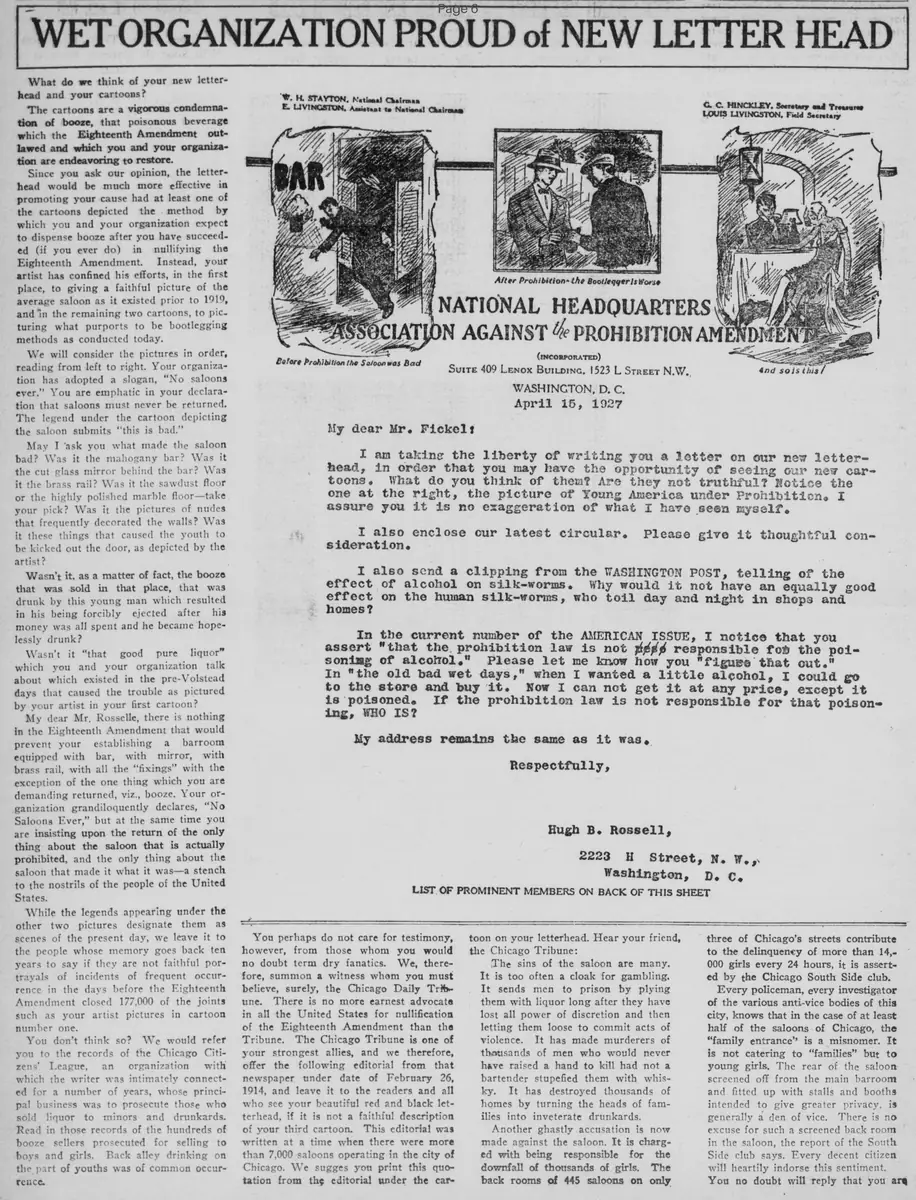
Since you ask our opinion, the letter-head would be much more effective in promoting your cause had at least one of the cartoons depicted the method by which you and your organization expect to dispense booze after you have succeeded (if you ever do) in nullifying the Eighteenth Amendment. Instead, your artist has confined his efforts, in the first place, to giving a faithful picture of the average saloon as it existed prior to 1919. and in the remaining two cartoons, to picturing what purports to be bootlegging methods as conducted today.
We will consider the pictures in order, reading from left to right. Your organization has adopted a slogan, "No saloons ever." You are emphatic in your declaration that saloons must never be returned. The legend under the cartoon depicting the saloon submits "this is bad."
May I ask you what made the saloon bad? Was it the mahogany bar? Was it the cut glass mirror behind the bar? Was it the brass rail? Was it the sawdust floor or the highly polished marble floor—take your pick? Was it the pictures of nudes that frequently decorated the walls? Was it these things that caused the youth to be kicked out the door, as depicted by the artist?
Wasn't it, as a matter of fact, the booze that was sold in that place, that was drunk by this young man which resulted in his being forcibly ejected after his money was all spent and he became hopelessly drunk?
Wasn't it "that good pure liquor" which you and your organization talk about which existed in the pre-Volstead days that caused the trouble as pictured by your artist in your first cartoon?
My dear Mr. Rosselle, there is nothing in the Eighteenth Amendment that would prevent your establishing a barroom equipped with bar, with mirror, with brass rail, with all the "fixings" with the exception of the one thing which you are demanding returned, viz., booze. Your organization grandiloquently declares. "No Saloons Ever." but at the same time you are insisting upon the return of the only thing about the saloon that is actually prohibited, and the only thing about the saloon that made it what it was-a stench to the nostrils of the people of the United States.
While the legends appearing under the other two pictures designate them as scenes of the present day, we leave it to the people whose memory goes back ten years to say if they are not faithful portrayals of incidents of frequent occurrence in the days before the Eighteenth Amendment closed 177,000 of the joints such as your artist pictures in cartoon number one.
You don't think so? We would refer you to the records of the Chicago Citizens' League, an organization with which the writer was intimately connected for a number of years. whose principal business was to prosecute those who sold liquor to minors and drunkards. Read in those records of the hundreds of booze sellers prosecuted for selling to boys and girls. Back alley drinking on the part of youths was of common occurrence.
WASHINGTON, D. C.
April 15, 1927
My dear Mr. Fickel:
I am taking the liberty of writing you a letter on our new letter-head, in order that you may have the opportunity of seeing our new cartoons.
What do you think of them? Are they not truthful? Notice the one at the right, the picture of Young America under Prohibition, I assure you it is no exaggeration of what I have seen myself.
I also enclose our latest circular. Please give it thoughtful consideration.
I also send a clipping from the Washington Post, telling of the effect of alcohol on silk-worms. Why would it not have an equally good effect on the human silk-worms, who toil day and night in shops and homes?
In the current number of the AMERICAN ISSUE, I notice that you assert "that the prohibition law is not being responsible for the poisoning of alcohol." Please let me know how you "figure that out."
In "the old bad wet days," when I wanted a little alcohol, I could go to the store and buy it. Now I can not get it at any price, except it is poisoned.
If the prohibition law is not responsible for that poisoning, WHO IS?
My address remains the same as it was.
Respectfully,
Hugh B. Rossell,
2223 H Street, N. W.,
Washington, D. C.
LIST OF PROMINENT MEMBERS ON BACK OF THIS SHEET
You perhaps do not care for testimony, however, from those whom you would no doubt term dry fanatics. We, therefore, summon a witness whom you must believe, surely, the Chicago Daily Tribune.
There is no more earnest advocate in all the United States for nullification of the Eighteenth Amendment than the Tribune. The Chicago Tribune is one of your strongest allies, and we therefore, offer the following editorial from that newspaper under date of February 26, 1914, and leave it to the readers and all who see your beautiful red and black letterhead, if it is not a faithful description of your third cartoon. This editorial was written at a time when there were more than 7,000 saloons operating in the city of Chicago. We suggest you print this quotation from the editorial under the cartoon on your letterhead. Hear your friend, the Chicago Tribune:
The sins of the saloon are many. It is too often a cloak for gambling. It sends men to prison by plying them with liquor long after they have lost all power of discretion and then letting them loose to commit acts of violence. It has made murderers of thousands of men who would never have raised a hand to kill had not a bartender stupefied them with whiskey. It has destroyed thousands of homes by turning the heads of families into inveterate drunkards.
Another ghastly accusation is now made against the saloon. It is charged with being responsible for the downfall of thousands of girls. The back rooms of 445 saloons on only three of Chicago's streets contribute to the delinquency of more than 14,000 girls every 24 hours, it is asserted by the Chicago South Side club.
Every policeman, every investigator of the various anti-vice bodies of this city, knows that in the case of at least half of the saloons of Chicago, the "family entrance' is a misnomer. It is not catering to "families" but to young girls. The rear of the saloon screened off from the main barroom and fitted up with stalls and booths intended to give greater privacy, is generally a den of vice. There is no excuse for such a screened back room in the saloon. the report of the South Side club says. Every decent citizen will heartily indorse this sentiment.
You no doubt will reply that you ar
opposed to the saloon. We also assume that you are opposed to illicit liquor sales resulting in scenes such as depicted by your artist in cartoons two and three. Can you point to any group of night clubs, cabarets or blind pigs with a record like that? Do you believe the Chicago Tribune editorial is overdrawn? If not, do you think that liquor today is claiming as many youthful drinkers as it did in those days described by the Chicago Tribune? But bear in mind that it was booze in both those days and these days-booze, the thing that you are asking be returned-that claimed these youthful victims. And have you or your organization ever exerted an ounce of influence to send these sellers of illicit liquor to the penitentiary where they belong? Your letterhead proves two things, that booze is bad when illegally sold, and that it is just as bad when legally sold; but it utterly fails to prove or even suggest how it can be made respectable and harmless when sold under whatever scheme you fellows have, (and which you have thus far refused to reveal to the public,) of selling it when the Eighteenth Amendment is nullified. We have taken the liberty of printing your letter in full because we wish to let the friends of prohibition read your testimony that prohibition prohibits. I refer to the paragraph where you state that in these days the only liquor you can get is poisonous stuff, unfit to drink, and therefore an illicit beverage. Wouldn't it be the part of patriotism and good sense to let the poisonous stuff alone? The bootlegger would soon go out of business if he had no patrons. We read with a great deal of interest the editorial on the silk worm's jag. Does your organization contemplate putting on a national campaign for the return of booze on the ground that an alcoholic diet makes silkworms more industrious? You suggest that if alcohol is good for silkworms, why isn't it good for the toilers who work in our mills? We wish to remind you, sir, that there are thousands of women in this country today who, in the old saloon days never coveted silk garments, but only decent clothing, and could not have it because the wages of the household were spent over the bar, but who, today, are properly clothed and fed and participating in this universal prosperity which is distinguishing America above all nations of the world.
What do we think of your new letter-head and your cartoons?
The cartoons are a vigorous condemnation of booze, that poisonous beverage which the Eighteenth Amendment outlawed and which you and your organization are endeavoring to restore.
Since you ask our opinion, the letter-head would be much more effective in promoting your cause had at least one of the cartoons depicted the method by which you and your organization expect to dispense booze after you have succeeded (if you ever do) in nullifying the Eighteenth Amendment. Instead, your artist has confined his efforts, in the first place, to giving a faithful picture of the average saloon as it existed prior to 1919. and in the remaining two cartoons, to picturing what purports to be bootlegging methods as conducted today.
We will consider the pictures in order, reading from left to right. Your organization has adopted a slogan, "No saloons ever." You are emphatic in your declaration that saloons must never be returned. The legend under the cartoon depicting the saloon submits "this is bad."
May I ask you what made the saloon bad? Was it the mahogany bar? Was it the cut glass mirror behind the bar? Was it the brass rail? Was it the sawdust floor or the highly polished marble floor—take your pick? Was it the pictures of nudes that frequently decorated the walls? Was it these things that caused the youth to be kicked out the door, as depicted by the artist?
Wasn't it, as a matter of fact, the booze that was sold in that place, that was drunk by this young man which resulted in his being forcibly ejected after his money was all spent and he became hopelessly drunk?
Wasn't it "that good pure liquor" which you and your organization talk about which existed in the pre-Volstead days that caused the trouble as pictured by your artist in your first cartoon?
My dear Mr. Rosselle, there is nothing in the Eighteenth Amendment that would prevent your establishing a barroom equipped with bar, with mirror, with brass rail, with all the "fixings" with the exception of the one thing which you are demanding returned, viz., booze. Your organization grandiloquently declares. "No Saloons Ever." but at the same time you are insisting upon the return of the only thing about the saloon that is actually prohibited, and the only thing about the saloon that made it what it was-a stench to the nostrils of the people of the United States.
While the legends appearing under the other two pictures designate them as scenes of the present day, we leave it to the people whose memory goes back ten years to say if they are not faithful portrayals of incidents of frequent occurrence in the days before the Eighteenth Amendment closed 177,000 of the joints such as your artist pictures in cartoon number one.
You don't think so? We would refer you to the records of the Chicago Citizens' League, an organization with which the writer was intimately connected for a number of years. whose principal business was to prosecute those who sold liquor to minors and drunkards. Read in those records of the hundreds of booze sellers prosecuted for selling to boys and girls. Back alley drinking on the part of youths was of common occurrence.
WASHINGTON, D. C.
April 15, 1927
My dear Mr. Fickel:
I am taking the liberty of writing you a letter on our new letter-head, in order that you may have the opportunity of seeing our new cartoons.
What do you think of them? Are they not truthful? Notice the one at the right, the picture of Young America under Prohibition, I assure you it is no exaggeration of what I have seen myself.
I also enclose our latest circular. Please give it thoughtful consideration.
I also send a clipping from the Washington Post, telling of the effect of alcohol on silk-worms. Why would it not have an equally good effect on the human silk-worms, who toil day and night in shops and homes?
In the current number of the AMERICAN ISSUE, I notice that you assert "that the prohibition law is not being responsible for the poisoning of alcohol." Please let me know how you "figure that out."
In "the old bad wet days," when I wanted a little alcohol, I could go to the store and buy it. Now I can not get it at any price, except it is poisoned.
If the prohibition law is not responsible for that poisoning, WHO IS?
My address remains the same as it was.
Respectfully,
Hugh B. Rossell,
2223 H Street, N. W.,
Washington, D. C.
LIST OF PROMINENT MEMBERS ON BACK OF THIS SHEET
You perhaps do not care for testimony, however, from those whom you would no doubt term dry fanatics. We, therefore, summon a witness whom you must believe, surely, the Chicago Daily Tribune.
There is no more earnest advocate in all the United States for nullification of the Eighteenth Amendment than the Tribune. The Chicago Tribune is one of your strongest allies, and we therefore, offer the following editorial from that newspaper under date of February 26, 1914, and leave it to the readers and all who see your beautiful red and black letterhead, if it is not a faithful description of your third cartoon. This editorial was written at a time when there were more than 7,000 saloons operating in the city of Chicago. We suggest you print this quotation from the editorial under the cartoon on your letterhead. Hear your friend, the Chicago Tribune:
The sins of the saloon are many. It is too often a cloak for gambling. It sends men to prison by plying them with liquor long after they have lost all power of discretion and then letting them loose to commit acts of violence. It has made murderers of thousands of men who would never have raised a hand to kill had not a bartender stupefied them with whiskey. It has destroyed thousands of homes by turning the heads of families into inveterate drunkards.
Another ghastly accusation is now made against the saloon. It is charged with being responsible for the downfall of thousands of girls. The back rooms of 445 saloons on only three of Chicago's streets contribute to the delinquency of more than 14,000 girls every 24 hours, it is asserted by the Chicago South Side club.
Every policeman, every investigator of the various anti-vice bodies of this city, knows that in the case of at least half of the saloons of Chicago, the "family entrance' is a misnomer. It is not catering to "families" but to young girls. The rear of the saloon screened off from the main barroom and fitted up with stalls and booths intended to give greater privacy, is generally a den of vice. There is no excuse for such a screened back room in the saloon. the report of the South Side club says. Every decent citizen will heartily indorse this sentiment.
You no doubt will reply that you ar
opposed to the saloon. We also assume that you are opposed to illicit liquor sales resulting in scenes such as depicted by your artist in cartoons two and three. Can you point to any group of night clubs, cabarets or blind pigs with a record like that? Do you believe the Chicago Tribune editorial is overdrawn? If not, do you think that liquor today is claiming as many youthful drinkers as it did in those days described by the Chicago Tribune? But bear in mind that it was booze in both those days and these days-booze, the thing that you are asking be returned-that claimed these youthful victims. And have you or your organization ever exerted an ounce of influence to send these sellers of illicit liquor to the penitentiary where they belong? Your letterhead proves two things, that booze is bad when illegally sold, and that it is just as bad when legally sold; but it utterly fails to prove or even suggest how it can be made respectable and harmless when sold under whatever scheme you fellows have, (and which you have thus far refused to reveal to the public,) of selling it when the Eighteenth Amendment is nullified. We have taken the liberty of printing your letter in full because we wish to let the friends of prohibition read your testimony that prohibition prohibits. I refer to the paragraph where you state that in these days the only liquor you can get is poisonous stuff, unfit to drink, and therefore an illicit beverage. Wouldn't it be the part of patriotism and good sense to let the poisonous stuff alone? The bootlegger would soon go out of business if he had no patrons. We read with a great deal of interest the editorial on the silk worm's jag. Does your organization contemplate putting on a national campaign for the return of booze on the ground that an alcoholic diet makes silkworms more industrious? You suggest that if alcohol is good for silkworms, why isn't it good for the toilers who work in our mills? We wish to remind you, sir, that there are thousands of women in this country today who, in the old saloon days never coveted silk garments, but only decent clothing, and could not have it because the wages of the household were spent over the bar, but who, today, are properly clothed and fed and participating in this universal prosperity which is distinguishing America above all nations of the world.
What sub-type of article is it?
Temperance
Moral Or Religious
Social Reform
What keywords are associated?
Prohibition
Eighteenth Amendment
Saloons
Booze
Cartoons
Bootlegging
Youth Drunkenness
Temperance
Wet Organization
Silk Worms
What entities or persons were involved?
Hugh B. Rossell
Wet Organization
Eighteenth Amendment
Chicago Tribune
Chicago Citizens' League
Chicago South Side Club
Editorial Details
Primary Topic
Defense Of Prohibition Against Anti Repeal Cartoons
Stance / Tone
Strongly Pro Prohibition, Critical Of Wet Organization
Key Figures
Hugh B. Rossell
Wet Organization
Eighteenth Amendment
Chicago Tribune
Chicago Citizens' League
Chicago South Side Club
Key Arguments
The Harm Of Saloons Stemmed From Booze, Not Their Furnishings
Pre Prohibition Saloons Led To Youth Drunkenness And Ejection
Eighteenth Amendment Bans Only Alcohol, Allowing Non Alcoholic Barrooms
Bootlegging Scenes In Cartoons Resemble Pre Prohibition Vices
Chicago Records Show Frequent Sales To Minors Before Prohibition
Saloons Contributed To Gambling, Violence, Murder, And Female Delinquency
Anti Prohibition Group Fails To Propose Safe Alcohol Distribution Method
Prohibition Has Improved Family Prosperity And Reduced Alcohol Access
Poisonous Illicit Liquor Proves Prohibition's Effectiveness