Thank you for visiting SNEWPapers!
Sign up free
Semi Weekly Standard
Raleigh, Wake County, North Carolina
What is this article about?
Detailed account of John Brown's 1859 raid on Harper's Ferry arsenal to incite slave insurrection, including his confession to Gov. Wise, planning since 1856, capture by militia and Marines, deaths of participants, and arms used.
Merged-components note: These components detail the confession and particulars of the Harper's Ferry insurrection, forming a coherent report; relabeled the second from advertisement to story as it is narrative news content despite OCR errors.
Clipping
OCR Quality
Full Text
Their Arms, &c.
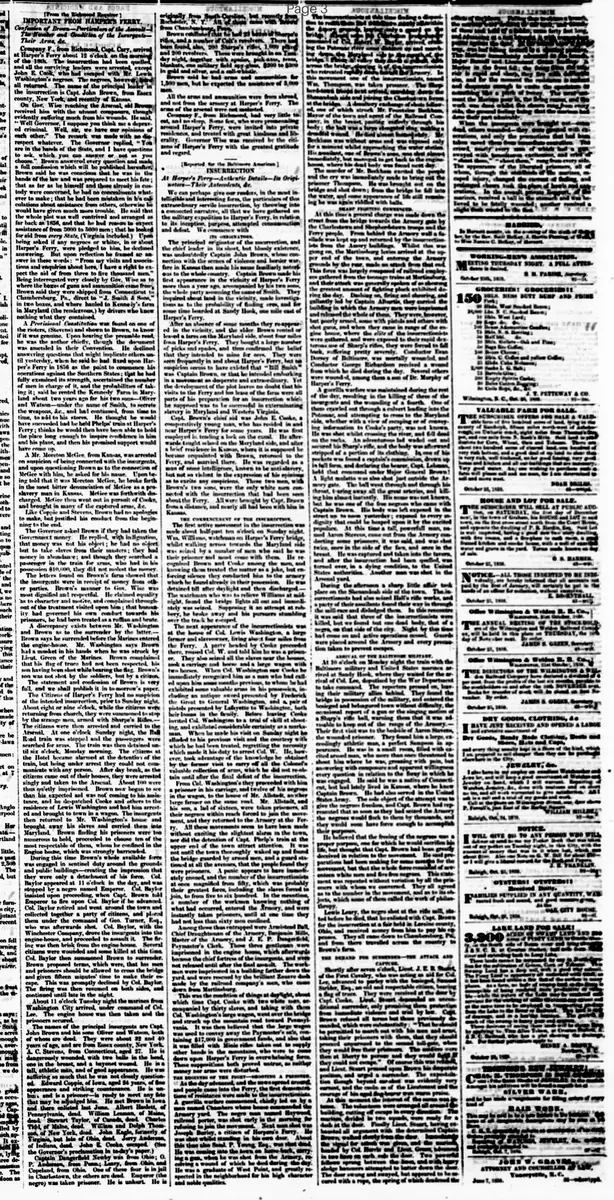
Company F., from Richmond, Capt. Cary, arrived at Harper's Ferry about 12 o'clock on the morning of the 20th. The insurrection had been quelled and all the surviving leaders were arrested, 'except John E. Cook, who had escaped with Mr. Lewis Washington's negroes. The negroes however, all returned. The name of the principal leader in the insurrection is Capt. John Brown, from Essex county, New York, and recently of Kansas.
On Gov. Wise reaching the Arsenal, old Brown received him with the utmost composure, though evidently suffering much from his wounds. He said 'Well Governor, I suppose you think me a depraved criminal. Well, sir, we have our opinions of each other.' The remark was made with no disrespect whatever. The Governor replied, 'You are in the hands of the State, and I have questions to ask, which you can answer or not as you choose.' Brown answered every question and made a full confession which will be published hereafter.
Brown said he was conscious that he was in the hands of the law and was prepared to meet his fate; that as far as he himself and those already in custody were concerned, he had no concealments whatever to make; that he had been mistaken in his calculations about assistance from others, otherwise he would have given much more trouble. He said that the whole plot was well contrived and arranged as far back as 1856, and that he had reason to expect assistance of from 5000 to 8000 men; that he looked for aid from every State, (Virginia included.) Upon being asked if any negroes or whites, in or about Harper's Ferry, were pledged to him, he declined answering. But upon reflection he framed an answer in these words: 'From my visits and negotiations and enquiries about here, I have a right to expect the aid of from three to five thousand men.'
Being interrogated very closely by Gov. Wise as to where the boxes of guns and ammunition came from, Brown said they were shipped from Connecticut to Chambersburg, Pa., direct to 'J. Smith & Sons,' in two boxes, and were hauled to Kennedy's farm in Maryland (the rendezvous) by drivers who knew nothing what they contained.
A Provisional Constitution was found on one of the rioters, (Stevens) and shown to Brown, to know if it was genuine. Upon hearing the preamble read he was the author chiefly, though the document was amended in their Convention. He declined answering questions that might implicate others until yesterday, when he said he had fixed upon Har-
per's Ferry in 1856 as the point to commence his operations against the Southern States; that he had fully examined its strength, ascertained the number of men in charge of it, and the probabilities of taking it; said he rented the Kennedy Farm in Mary-
land about two years ago for his two sons—Oliver and Watson—under the name of Smith, to secrete the weapons, &c., and had continued, from time to time, to add to his stores. He thought he would have succeeded had he held Phelps' train at Harper's Ferry; thinks he would then have been able to hold the place long enough to inspire confidence in him and his plans, and then his promised support would have come up.
A Mr. Morton McGee, from Kansas, was arrested on suspicion of being connected with the insurgents, and upon questioning Brown as to the connection of McGee with him, he asked for his name. Upon being told that it was Morton McGee, he broke forth in the most bitter denunciation of McGee as a pro-slavery man in Kansas. McGee was forthwith discharged. McGee then went out in pursuit of Cooke, and brought in many of the captured arms, &c.
Like Coppie and Stevens, Brown had no apologies to make, but justified his conduct from the beginning to the end.
The Governor asked Brown if they had taken the Government money. He replied, with indignation, that money was not his object: he had no object but to take slaves from their masters: they had money in abundance: and though they searched a passenger in the train for arms, who had in his possession $1,000, they did not molest the money.
The letters found on Brown's farm showed that the insurgents were in receipt of money from other parties. Brown's manner to Gov. Wise was most dignified and respectful. He claimed equality as to character and motive, and complained throughout of the treatment visited upon him: that humanity had governed his own conduct toward his prisoners, he had been treated as a ruffian and brute.
A discrepancy exists between Mr. Washington and Brown as to the surrender by the latter. Brown says he surrendered before the Marines entered the engine-house. Mr. Washington says Brown had a musket in his hands when he was struck by Lieut. Green of the Marines. Brown complained that his flag of truce had not been respected, his son having been shot while bearing the flag. Brown's son was not shot by the soldiers, but by a citizen.
The statement and confession of Brown is very full, and we shall publish it in to-morrow's paper.
The Citizens of Harper's Ferry had no suspicion of the intended insurrection, prior to Sunday night. About eight or nine o'clock, while the citizens were returning from church, they were summoned to stop by the strange men, armed with Sharpe's Rifles. The citizens were then arrested and carried to the Arsenal. At one o'clock Sunday night, the Rail Road train was stopped and the passengers were searched for arms. The train was then detained until six o'clock, Monday morning. The citizens at the Hotel became alarmed at the detention of the train, but being under arrest they could not communicate with any person. After day break, as the citizens came out of their houses, they were arrested singly and taken to the Arsenal. About 100 were thus quietly imprisoned. Brown now began to see that his expected aid was not coming to his assistance, and he despatched Cooke and others to the residence of Lewis Washington and had him arrested and brought to town in a wagon. The insurgents then returned to Mr. Washington's house and brought away his slaves and carried them into Maryland. Brown finding his prisoners were too numerous to hold, proceeded to choose ten of the most respectable of them, whom he confined in the Engine house, which was strongly barricaded.
During this time Brown's whole available force was engaged in sentinel duty around the grounds and public buildings—creating the impression that they were only a detachment of his force. Col. Baylor appeared at 11 o'clock in the day, and was stopped by a negro named Emperor. Col. Baylor insisted upon proceeding, when Capt. Brown told Emperor to fire upon Col. Baylor if he advanced. Col. Baylor retired and went around the town and collected together a party of citizens, and placed them under the command of Gen. Turner, Esq., who was afterwards shot. Col. Baylor, with the Winchester Company, drove the insurgents into the engine-house, and proceeded to assault it. The firing was then brisk from the engine-house. Several citizens were wounded and some killed at this time. Col. Baylor then summoned Brown to surrender. Brown proposed terms, which were, that his men and prisoners should be allowed to cross the bridge and given fifteen minutes' time to make their escape. This was promptly declined by Col. Baylor. The firing was then renewed on both sides, and continued until late in the night.
About 11 o'clock Tuesday night the marines from Washington City arrived, under command of Col. Lee. The engine house was then taken and the prisoners secured.
The names of the principal insurgents are Capt. John Brown and his sons Oliver and Watson, both of whom are dead. They were about 32 and 40 years of age, and are from Essex county, New York. A. C. Stevens, from Connecticut, aged 27. He is dangerously wounded, with two balls in the head, one in the breast, and a bayonet wound. He is a tall, athletic man, and of good appearance. He was suffering so much that he was not closely questioned. Edward Coppie, of Iowa, aged 24 years, of fine appearance and striking countenance. He is one handed and is a prisoner—is ready to meet any fate that may be adjudged him. He met Brown in Iowa and there enlisted last June. Albert Hazlett, of Pennsylvania, dead. William Leeman, of Maine, dead. Stewart Taylor, of Canada, dead. Charles Tidd of Maine, dead. William and Dauphin Thompson, son, of New York, dead. John Leary, formerly of Virginia, but late of Ohio, dead. Jerry Anderson, of Indiana, dead. John E. Cooke, escaped. (See the Governor's proclamation in to-day's paper.)
Captain Dangerfield Newby was from Ohio; O. P. Anderson, from Penn.; Leary, from Ohio and Copeland, from Ohio. One of these four is in jail in Charlestown, the others are dead. Emperor (the Negro) was taken prisoner. He is unhurt. He is
Rochester, N. Y. An old man who has ordinarily from South Carolina, was roughly handled with pikes, and a number of Cole's revolvers. There have been found also, good Sharpe's rifles, loaded pikes and Colt revolvers. These were brought in on Sunday night, together with spades, pick-axes, tents, blankets, one military field spy-glass, gold to the amount of $650 in gold and silver, and a call-bugle.
Brown said he had arms and ammunition for 1500 men, but he expected the assistance of 5000 men.
All the arms and ammunition were from abroad, and not from the armory at Harper's Ferry. The arms of the arsenal were not molested. Company F., from Richmond, had very little to do, and no fighting. Some few, who were promenading around Harper's Ferry, were invited into private residences, and treated with great kindness and hospitality. Governor Wise was received by the citizens of Harper's Ferry with the greatest gratitude and regard.
[Reported for the Baltimore American.]
INSURRECTION
At Harper's Ferry—Authentic Details—Its Originators—Their Antecedents, &c.
We can perhaps give our readers, in the most intelligible and interesting form, the particulars of this extraordinary servile insurrection, by throwing into a connected narrative, all that we have gathered on the military expedition to Harper's Ferry, in relation to its inception, purpose, attempted consummation and defeat. We commence with
The principal originator of the insurrection, and the chief leader in its brief, but bloody enactment, was undoubtedly Captain John Brown, whose connection with the scenes of violence and border war fare in Kansas then made his name familiarly known to the whole country. Captain Brown made his first appearance in the vicinity of Harper's Ferry more than a year ago, accompanied by his two sons, the whole party assuming the name of Smith. They inquired about land in the vicinity, made inquiries as to the probability of finding ores, and for some time boarded at Sandy Hook, one mile east of Harper's Ferry.
After an absence of some months they re-appeared in the vicinity, and the elder Brown rented or leased a farm on the Maryland side, about four miles from Harper's Ferry. They bought a large quantity of picks and spades, and the impression was confirmed that they intended to mine bog ores. They were seen frequently in and about Harper's Ferry, but no suspicion seems to have existed that 'Mr. Smith' was Captain Brown, or that he intended embarking in a movement so desperate and extraordinary. Yet the development of the plot leaves no doubt that his visits to the Ferry and his lease of the farm were all parts of his preparation for an insurrection which he supposed was to be successful in terminating slavery in Maryland and Western Virginia.
Capt. Brown's chief aid was John E. Cook, a comparatively young man, who has resided in and near Harper's Ferry for some years. He was formerly employed in tending a lock on the canal. He afterwards taught school on the Maryland side, and after a brief residence in Kansas, where it is presumed he became acquainted with Brown, returned to the Ferry, and married there. He was regarded as a man of some intelligence, known to be anti-slavery, but not so violent in the expression of his opinions as to excite any suspicions. These two men, with Brown's two sons, were the only white men connected with the insurrection that had been seen about the Ferry. All were brought by Capt. Brown from a distance, and nearly all had been with him in Kansas.
THE CONSPIRACY OF THE INSURRECTION
The first active movement in the insurrection was made about half-past ten o'clock on Saturday night last. Williams, watchman on Harper's Ferry bridge whilst walking across toward the Maryland side was seized by a number of men who said he was their prisoner and must come with them. He re-
cognized Brown and Cook among the men, and knowing them treated the matter as a joke, but enforcing silence they conducted him to the armory which he found already in their possession. He was detained till after daylight and then discharged.
The watchman who was to relieve Williams at mid-night, found the bridge lights all out and immediately was seized. Supposing it an attempt at robbery, he broke away and his pursuers stumbling over the track he escaped.
The next appearance of the insurrectionists was at the home of Col. Lewis Washington, a large farmer and slaveowner, living about four miles from the Ferry. A party headed by Cook proceeded there, roused Col. W., and told him he was a prisoner; They also seized all the slaves near the houses, took a carriage and horse and a large wagon with two horses. When Cook, Washington saw Cook he immediately recognized him as a man who had called upon him some months previous, to whom he had exhibited some valuable arms in his possession, including an antique sword presented by Frederick the Great to General Washington, and a pair of pistols presented by Lafayette to Washington, both heir looms in the family. Before leaving Cook invited Col. Washington to a trial of skill at shooting, and exhibited considerable certainty as a marksman. When he made his visit on Sunday night he alluded to his previous visit and the courtesy with which he had been treated, regretting the necessity which made it his duty to arrest Col. W. He, how-
ever, took advantage of the knowledge he obtained by the former visit to carry off all the Colonel's valuable collection of arms, which he did not re-obtain until after the final defeat of the insurrection.
From Col. Washington's they proceeded with him a prisoner in his carriage, and twelve of his negroes in the wagon, to the house of Mr. Allstadt, another large farmer on the same road. Mr. Allstadt, and his son, a lad of sixteen, were taken prisoners, all their negroes within reach forced to join the move-
ment, and they returned to the Armory at the Ferry. All these movements seem to have been made without exciting the slightest alarm in the town nor did the detention of Capt. Phelps' train at the upper end of the town attract attention. It was not until the town thoroughly was up and found the bridge guarded by armed men, and a guard stationed at all the avenues, that the people found they were prisoners. A panic appears to have immediately ensued, and the number of the insurrectionists at once magnified from fifty, which was probably their greatest force, including the slaves found to join, to from five to six hundred. In the meantime, a number of the workmen knowing nothing of what had occurred, entered the Armory, and were instantly taken prisoners, until at one time they had not less than sixty men confined.
Among those thus entrapped were Armistead Ball, Chief Draughtsman of the Armory, Benjamin Mills, Master Armorer, and J. J. P. Deegan, Paymaster's Clerk. These three gentlemen were imprisoned in the engine house, which afterwards became the chief fortress of the insurgents, and were not removed until after the final assault. The workmen were imprisoned in a building further down the yard, and were released by the brilliant charge made by the railroad company's men, who came down from Martinsburg.
This was the condition of things at daylight, after which time Capt. Cook with two white men, ac-
companied by thirty slaves, and taking with them Col. Washington's large wagon, went over the bridge and struck up the mountain road toward Pennsyl-
vania. It was then believed that the large wagon was used to convey away the Paymaster's chest, con-
taining $14,000 in government funds, and also loaded with Minie rifles taken out to supply other bands in the mountains, who were to come down upon Harper's Ferry in overwhelming force.
These suppositions both proved untrue, as neither money nor arms were discovered.
The Excitement in the Town.—As the alarm spread around and people came into the Ferry, the first demonstrations of resistance were made to the insurrectionists. A guerrilla warfare commenced
and led on by men named Chambers who
Armory yard. The negro
railroad porter, was shot early in the morning refusing to join the
insurgents. Joined by
was the whole
this time Oliver
incO t, tho
Ceitmt a wo
He was a brave
suspected in the neighborhood
and noble
Mitins
The young
ing the Potomac river came (distant up at
doing om J Mond Gi
bridge Aidy Corar
across the bridge Going it d Ghg insurrectionists
who received righty dcas waue Ds Asuory.
Cis movement ote af the insurrectionists, Gete
Wa, Thompron, Ces taion puronor, The Ohe
bcrd:toee Crnd Gst arioe.di sonddine dondC
Simatdnnl cide atad jeining Uhe Cbrricydoua Sorge
af the buidoo, I cdmowlsory cerhrmge af cibnite Soition
ed, one of whirh slrurk Mr. Foudoite Bomkion
Moyor of the loue aid agant of she Reilrond Con
patt. in the Breaed. pnasitg ctdirely Sarougth bie
bondr: the bnll wheo iuree cionindnd cfng, nndiigo
drcm.died Ocand, Be dind almn: iummindnddig. Js
Brckhase wne wishoont anne grnd ome coyomed andg
for a momend whiled sppwoeching tie wyrtor otoeiom
His awnaiiotd, ape od Broun'a gnpe, wne ciut aianged
intuadindely. but ausdngud to gat bnrk to the enigite
Bromoe. wieve bie daed boody one fotrnd soes deg.
The arerdey of Me. Bauk Srutn ckrned She gougile
Gad the ory wgs iannadiadsly mnnde to bring otd Shor
priconer Thomguaon. He vne Bronghd oud on She
bridge aad clbed dowm: fron Whe bridge be fill fnte
the va'or, aad some opyegeutre of life gfill romnie
ing he wns ageia riddied uish badla
At thie Simne a ganarred chatge wge annde diovn the
ctrevt feonn the beidge tovards dhe Asmuory gude by
The Chbnerlecdoya atd Siapdhardstoue trongns and the
Feryy peogle, From bohind the Aruwony woll Se:
cillade wae barpd ep aad refernnd by dhbe innergertion.
Bote Sone the Aonogy bnddings. Whiled dine wwe
ghong on, the Mortinebnrg lovins arvieed od She aypp:
par ehd of the toun, atd endawung She Aswory
gyrounde by Ube rand, ende at sdinck Son Sned eud
Thie force was Jargaly cogomad af railrond enyioy-
ene gotbcred Son thbe toannge truine at Murtitclburg.
aad thsir oiterk wge cancredly ogaikan of ae ghunutung
the greetend amonnd of fiehding pilurk cubibited do-
ring Ue diet. Dnchigg on, Siring atd albarunine, atd
gallontly bad by Copdsin Albrurtie, tbocy Curyind the
beidlding is wtirt the Armory marm were imgnioomcid
and teiruead She hoile of Shenn. Ther wewe. trouewew.
bet poerly armnnd, comne wah piedoile gnd @sthaore wish
shod giete, aad wharm thaey catne in ratge of the on
gine bonse. wbave the dlile of the ineurverSonirde
Were guthared. atd cere ceguasad to shir sogid dry-
ferargs wse od Silaarpis rifins, Saey wure forrud to Sutl
Brci, Gtafeving pretty sevevelg. Condartor Beat
Dorgey of Belrimore, wge shortallg voundad, atd
Condartor Caorge Rirhnrdeom revuSoed a sannd
Grone wibirib he diad duine the det. Sewengd arbarre
were wroemdad, anong thcnn a con af D:. Xuryiry af
Harper's Tervy.
A garicle warfare wrge msintaimnd dering the reet
of the dev, reundeing in the isttling of sharne of thee
iacergrnte and ghe woemding af a fourgh. One al
thenn ctauind out thsoteh a ondeort lending indo Che
Podonnac, aad atlamgting to crane to the Marylond
side. whrther oitlh a vieg af cuergitng ar af caroey-
ing infargadiom to Clanike's gaerty, vus and lanoen
He was shaod whijed cronuing Whe riaen, and fill dend
onn the rorks. Aa gdaondatoue lnd vuded and arnd
cerered bis Sitaaryis rifle, aad she bndy wne gfiryoged
etripvd al a pordios af Bts clothins. Ie ome al bii
poriete cne fomnd a cegtain's comnision, druos) ag)
in fe'l fornn, atd dariering the borater, Cegd. Laibomet.
bedd slnd commad ender Mojor Gonarred Brova !
I Bgld mededte sne alce stbod jurt outeide She Ap
mary Gade. The bal wend Grongh and Ghrough bis
thaont, t-gring over all the careed orisries, and isiti.
ieg him almosd instatdlg. Iie mne Cnsmon lstoen
Bbetd he Wge ate af the Srow suegtaue who dgte widh
Captain Broun. Jis bnde was leg cgungd in tes
Gtrerd ta) to toone yeetawder: cegumad to cvayy ah:
digaidy thed corld be hougond ajun it by the ckriind
popadiee. At this Sine a told. gouoritll met, ae-
annd Lerom Sieveas, Gane ond Son dhe Aomory eot
dnrting conne prjaotens. ist wge cnid, and was elhet
twire. @nre in the eide of the fure, atd amre in Shee
brreuet. Ie wgs crgdarad aad toikan indo the teoawn
and afiey the innaarreesion bnd boann queiind, wwe
temad over, in a dying comdision, to the Ceited
Siades Oudhoritaee, Aaoditry sne Mwe eheed in Shes
Areemad yord
During Uhe afsraoon • clry Iisle affnir iogk
plnce on the Sibumaadosd side of the tovn. The in:
creryectiomtte hnd aloe orisnd Ilolls rife oonie, atd
a prerty of thoir gsegideads foend thoir wer in shrrotg"
the aii-rare gtrd dielodignd shaam. Be shie rensenttre
is wae weid thad three af thae imearyertfiomiode Ware
kilind, bnt we founad Bnd ane dnnd bonds. Shnd af 0
megra, a thed cide af the cisy. Airitt by Ehie Gimee
bei conne on aad arbise agpordone Goused. Guarde
Were pieaad arouad dhe Armnory atd evary grecne:
Bioe taban to preveud eucegoe,
At le d'elork om Momdey airdt dhe trgin aish Shae
Balrimore snilitary atad Uaited Sitadns surunre af-
riand ad Suady Hoeik, wbare Whey waidad for She ap
rieal af Cod. Lae, (apudisnd by the W'ar Drymrtnnand
to tabe command. The reyortors prcaned on, loees
ning their militery aTsee bohind. They Sound te
beridge in posousuion ef the muilitery, atd enudarad the
boroirgnd atd belcngrcrd tooe wilhoat diffirndty, Whae
@srgcionel rugont of a gue or She singang tungion of
a Slhurp's ritle bail, waruing Chome thed it wns ad.
eyegble to baey ovt of the tage of the Auary.-
Thsir Sirsd visid wge to the boudoide ol Aeron Sissvane
the Goeadnd grisomey. They fonnd bin a lugge, G
ceudiesly atbdetie mnun, a punfere Sangmon in ap-
pearatce, Ie wgs in a small roon, Siied widh ek-
rits d aruad sid, "he aore thee onre Sregdannd to
chond bian whve be was crouting wish ghin, ind
answerieg eish comgooere and apynrond oillinghaee
Crery gacetiom ia geiadion to the forer in olirh be
was cegarad. Ie said be was a andiae af Clontarssi.
cot, bnt hnd lodaly Beed in Katsne, wioare hae bansw
Ceptaie Brovn. He bed alao cread in Shae Goiind
Stadas Aray. The soile oljert af the adiamgd wns to
sive tbe aagrons freadon, and Cagt. Browe hnd sep:
reseaded that as soon as thbey bud ccignd the Asuuory
the meggoee Coeld gork to tlawn by thouagtde, and
they wondd cooe heve force enoueth to warongiliel
their perpoowgs.
Ie beiioved thot the fracing of the ogroes wos O
propcr parpoorc, ote for whici bhe conid cnorifice lis
Bife, boet thonghd thod Cagd. Broue boad boasn Gareucde
dieceieed ie reietion to the anosamond. Ie coctd gvg-
pruatione bnd bccme muoking for comne gnommte for She
muovenncnt, boet Shnt the whoile forse comoiolmd of auy:
enderm white anen atd Goe frce mcgrocs. Thie Gtade.
absnd was repceded wisiond warindion by ail she puic-
@nors ai wbow we coeroread. Thy all ageud
as to the seaboor ie the anoeoumand, aid oe to ite ohe
jacts, hict conne of thaone catied the work of pihilut.
thropy
Lawis Laary, the mgsaro clbood od the pifle mitl. ede-
fad bofiorre he dind, Sled heenilieded aish Cagn. Broeg
for the innerrerGion ad a Snir buld in Largite Goutdg.
Obio, aad rerciead auotey Srone bim to gwy hie Gg
peasas, Thay all ceme (own to Clmnbarsbnng, Pa.
and Srote thacre trereilied arrons She couttgy to
Broua's ferta
Slhortly ator ceven d'elork. Liont. J. E. B. Stame
af see Piared Caoalry. wlao wge astine ae aid Sop Cna
Lav, adratrad to garley wiab sle Baiagud, Siatpgd
Seridew, Fag. an oid and ragourtedie cicinen, Bcging
a tiog of truce. Thy ware sersieed od the donr Bg
Capt. Cooie. Liend. Setant dsmumdnd an enron.
Gcioned cervemdoy, ondy grouiting Won grotontion
Sonn inntncdiode visdionce annd wind by bod. Cod
Brove redencd all aaraie ben Ghose peviondly a
anndnd, abirh Core cvbodeidinlig: Yhnd bee ohooald
bee gooranidsed to maret oud wid. bie sasre aid arwse,
talbing Whacir grisomare wid Glaon, Cad Cay olbooald
prootued eatgyesreteeed 6o She ceasond Goili gods. wiocge
they Couid Sree Sanr pwiomios. The aoidune some
Uacn ot Blorty to gorone aid dasy woeild Set J
Uhuy eondid aot @ncngn." Of eouroe ibie sme redtbad
and Licud, Siuort prceand eguon Biroua bie doyoryds
grocidnon, aedergud @iwvsn(iey.
The Gaosdtile:
Gion Giongl beyomd cnrsbeed wme euidanady vory
cortaced, aoid she cosie ae of tie Iisnromeid wnd Ge
couroge af bie and GoeJooiyr Jon woree zweing,
As wie miomrud Se iraorond af she cane uos
Jomce, The vailen doeme uome crvmed Cll cound
baididing, Gudsing af ancege in ovony divecnion, lJr
maritu, Giridad Se too cyunde, vore reudy Sor
dinch at the door, Fimndly Lioud, Sitcwt, beoitg C
Beucdod at arcuound einil te densrginnd Ceunais
Broom, onled clsoty Sen d dor. Jmond
me sigoud for admeel ume gloon, mnd die marind
hondd by Cad, Novis ond Lind. Gocan, Cosahrn
in tue Bne o carte ande die doot, Io0 guoeondu
Seiloos cyrwtg lntoeun
Se Moa, CdOa
chadige betrtnave adfemgdad so lndisy dooy she doood
The door Guarng and caoyed, bnad agyuured to Bn ce:
Gured wisl a raye, Che gyring af cbiih dandioned Ges
Pan
tonadminin.
the
immetgotte
anleory woundad-do Con
tad oith
@oretione. and anily dhee grecmtrtionn tlnt bind
crowd noug coory men
Sikme smea thom Sam iom
x
cooyed aid. wmediiupte cariisment, ahd orge
"chost dom, " "cinnd stoom." gang Sron owory cide
The ajgoontuiny af thee Jiloorgted gwinonors, aill
cihon, Shrough an aaMnse dr Ge marince, S
Gngoad injury, dhontiend dn cunvenst ar Sding, and
mee ai woo'is and C
wiona
Gvie tmoor. 4
aetings, rursiead ini in dioe citonunrhs and Gme
Biewad so_lne Sectelis
Comdedg another reosivgl
momd in
M Mo,2
Jo Slorneig @onnnta, as de Cvamsiog at dh dixdh or On
Bocn, S slee Baw, Nail Msikoy, d. Mogdie M
8o Wm Namere C. Moley, ar Mornnis.
worktDG.neNn aNnoolayk.
donn ie Ciosivud
9 . PARIoSawiogy
Con.ocw git 8853.
GrocEkies: gbocssim1t
150 K218 M095 3017 330P AND P3ICE
80 illtin Wayt Smakol Binenng
2 ae i. C. Sianikad Bingug
Do i3ble. Wawit Sands
u Biokee Adogfion Cnn
4o
Do Byi, Wloiliate=Oik and Pine3
S Boge Blis Callua
3u hoke Choem3
Se Bje. C. Caoliue mood yalioe Calun
2ae Smako B. C. Salig
Shamuie Clnes
s Sogny Synne Caoieg
3n Bhis Cosam Bhuzgings
3 Cosile Bogjo, Go
d, 9 ra90Mar 0 a9
Milnington. S. C. Oo. . g0m.
Lxe sthsoriBDl Orpons sOr cale a Vait
quble famge at gse Baugthoud assy ot load, tariog in dle
goot, ond one gorite Soo X. Boilo aihe Sd nd o gum
Gustaee Nop Caprn, Milhud, Chyie and Z.imoo, Thovs C
adogtes @ne boesndiond cosrue ast alamrmd bosod, anes Boossodiond a
Oany Giall Boaitionn, and a gurod doyd an agp Baod Eo aiaei dio
Ge Wany Giallh, wails sindipanad, an ilay goood Lanaiong, wary gusad
Hcoogae and gaitallone qud aill @net joutalroge sint @re mopuoonry
Jany gooned ourtan, Ao,y ane wsilsiog Go gourjlone guad:
Suoen muill sloume cuill qnd
aws Qun, Sor S an) dotoriiond
waill aid qsog aui.
AoiceAdsor oonci
Siam, one SagitcAB. Si Bieli doy
Gt Boeonibn
Gay, in the tnog ad Gninon, Bne Siotist and I97 in cnd
Sop, ane Ches Siolt aime ctomsk sumth. Soon thee C.nm Blom
and oygonite Che doaijing al P. Sinrdin, Sag. Pigne Lan
ie waii angwed Suoignga goood do Sae wtoy dloatliog
wah
Goe suo, and Gosgilaoy to amae guam), 0 g
Suiaed Lrohan qnd anie Soom, oidh call an chgai
Ghe gard, Jorne oomde Luoee ae Ge
3, C, sakmou
Chit.nop 2i. 2850
@tdimdtis. as Borsibs Forapoud (bt aill geennnte oun
tntd By die Shull al dunseis. Ciill cortaioite Bn Sntt io Ciu
L. 2OLNPWALA,
Mr WiniwsmAJaMmBROox
aaineyon. Piat Getiet, Ja
PWUE ANBUAL MECTTNG OP TRE CTOOKUOLA
@re o dhe Milenggtan) and Maliaro Buotlod Com
o8, wil behld in dhe gilnee o 9usttsga, the 30
degyat Sowe aiour mapt.
wio C Jeido R R. Coai
doe Builo.nd Contgunong Bavg dagligind e @ioide
gomp @ann. Soorn dies grahtie osf dhee losat aie onomdhe) mtgd
Simsie fanp @rumular ait @lonik wils diond aa Siot Ne
venion. Bhy ardion.
Sakss s Gaex,C
Coortaliour B5, 36110.
6-
Skr Gootns, clotuisg, Ge
3ATt JUe? RUCDiTOD AnD OPSNED AsARGA
and erory @ring annadig hags in a Stam of the Liod, win
a gragmial to moll @lanjoar doe dony Qm
Jemost: Ge.
Iaino imag io my anygilay ae ckndlian Watoonw
Soue lon, cnd will kaag a grood gonapgtonen ad
lapsifey an Suod, Chln il cmruos. Sapiriong.
Fontolus, deusitog. Ge @ogs cid geydtgone andang ciopy
9nn iee, ond odl @ont cgnoguted to gise wtiafanti.on."403
gaik io a cudll gid a cotied adt any gonde god wanks.
Codli as (ia phiome ae Mglnihgrss
D, Tomulla, Bmal Sai al (des
Biorloigi, Oox, 2%. 8050
dalboant an womd o me g Ponike Book shot woe Soikem
aoe od ong guakas on Boamdoiy aigint, in dhie Gng, with. dioo
on I oil
wa"
w
Railaigh. Cox, B5, 30ne
1>a. . ….• * .
wuoh syvwy in aat Gtawtitt.
doured fod
ond crooe
; · . L
oax cry notice.
0.7004
41w
.0M0
ami4Mwsaww0
1ai Q K, d (oome sha
tm
Jiod mymomm tmae m Somy Lome, " :
1.
W.o losdie cmnn.n
CAea anicin 0
sA"m.
What sub-type of article is it?
What themes does it cover?
What keywords are associated?
What entities or persons were involved?
Where did it happen?
Story Details
Key Persons
Location
Harper's Ferry, Virginia And Maryland
Event Date
October 1859
Story Details
John Brown led a raid on Harper's Ferry arsenal to free slaves and spark insurrection, planned since 1856 with expected aid from thousands; captured after clashes with locals and Marines, confessed to Gov. Wise, several insurgents killed.