Thank you for visiting SNEWPapers!
Sign up free
Litchfield Enquirer
Litchfield, Litchfield County, Connecticut
What is this article about?
Satirical New York Express article mocks repeated failed attempts to destroy the Bank of the United States in the 1830s, portraying Nicholas Biddle as an immortal 'monster' surviving political attacks by Jackson, Benton, and New York financiers, despite vetoes, deposit removals, and proofs of its unsoundness.
Clipping
OCR Quality
Full Text
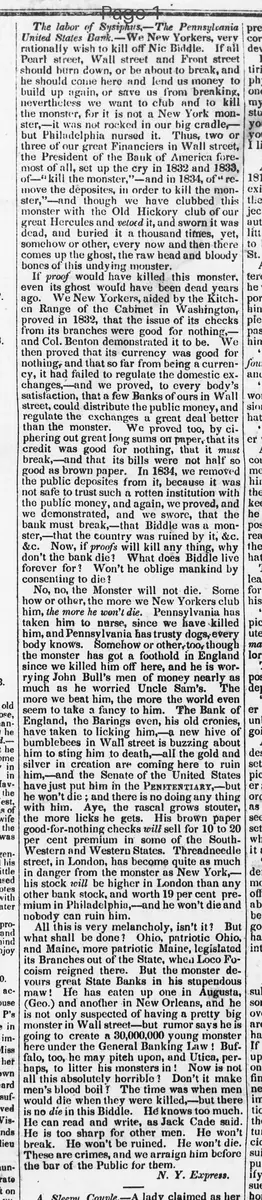
If proof would have killed this monster, even its ghost would have been dead years ago. We New Yorkers, aided by the Kitchen Range of the Cabinet in Washington, proved in 1832, that the issue of its checks from its branches were good for nothing,— and Col. Benton demonstrated it to be. We then proved that its currency was good for nothing, and that so far from being a currency, it had failed to regulate the domestic exchanges,—and we proved, to every body's satisfaction, that a few Banks of ours in Wall street, could distribute the public money, and regulate the exchanges a great deal better than the monster.
We proved too, by ciphering out great long sums on paper, that its credit was good for nothing, that it must break,—and that its bills were not half so good as brown paper. In 1834, we removed the public deposites from it, because it was not safe to trust such a rotten institution with the public money, and again, we proved, and we demonstrated, and we swore, that the bank must break,—that Biddle was a monster,—that the country was ruined by it, &c. &c. Now, if proofs will kill any thing, why don't the bank die? What does Biddle live forever for? Won't he oblige mankind by consenting to die?
No. no. the Monster will not die. Somehow or other, the more we New Yorkers club him, the more he won't die. Pennsylvania has taken him to nurse. since we have killed him, and Pennsylvania has trusty dogs, every body knows. Somehow or other, too, though the monster has got a foothold in England since we killed him off here. and he is worrying John Bull's men of money nearly as much as he worried Uncle Sam's. The more we beat him, the more the world even seem to take a fancy to him. The Bank of England, the Barings even, his old cronies, have taken to licking him,—a new hive of bumblebees in Wall street is buzzing about him to sting him to death. all the gold and silver in creation are coming here to ruin him.—and the Senate of the United States have just put him in the Penitentiary,—but he won't die ; and there is no doing any thing with him. Aye. the rascal grows stouter, the more licks he gets. His brown paper good-for-nothing checks will sell for 10 to 20 per cent premium in some of the Southern and Western States. Threadneedle street. in London. has become quite as much in danger from the monster as New York,— his stock will be higher in London than any other bank stock, and worth 19 per cent premium in Philadelphia,—and he won't die and nobody can ruin him
All this is very melancholy. isn't it? But what shall be done? Ohio, patriotic Ohio, and Maine, more patriotic Maine. legislated its Branches out of the State, when Loco Focoism reigned there. But the monster devours great State Banks in his stupendous maw! He has eaten up one in Augusta, (Geo.) and another in New Orleans, and he is not only suspected of having a pretty big monster in Wall street—but rumor says he is going to create a 30,000,000 young monster here under the General Banking Law ! Buffalo, too, he may pitch upon, and Utica, perhaps, to litter his monsters in! Now is not all' this absolutely horrible? Don't it make men's blood boil? The time was when men would die when they were killed.—but there is no die in this Biddle. He knows too much. He can read and write, as Jack Cade said. He is too sharp for other men. He won't break. He won't be ruined. He won't die. These are crimes, and we arraign him before the bar of the Public for them.
N. Y. Express.
What sub-type of article is it?
What themes does it cover?
What keywords are associated?
What entities or persons were involved?
Where did it happen?
Story Details
Key Persons
Location
New York, Philadelphia, Pennsylvania, Washington, England
Event Date
1832 1834
Story Details
Satirical narrative of New Yorkers' and politicians' repeated failed attempts to destroy the Bank of the United States and Nicholas Biddle, depicted as an undying monster that thrives despite vetoes, deposit removals, and proofs of insolvency, now supported in Pennsylvania and England.