Thank you for visiting SNEWPapers!
Sign up free
The Spirit Of Democracy
Woodsfield, Monroe County, Ohio
What is this article about?
Large Union demonstration in Nashville on Nov. 23, attended by citizens from both parties, featuring speeches by Hon. Andrew Ewing and Major A. J. Donnelson, and resolutions supporting the Union, opposing secession, criticizing Northern abolitionism, and endorsing the congressional compromise on slavery issues.
Clipping
OCR Quality
Full Text
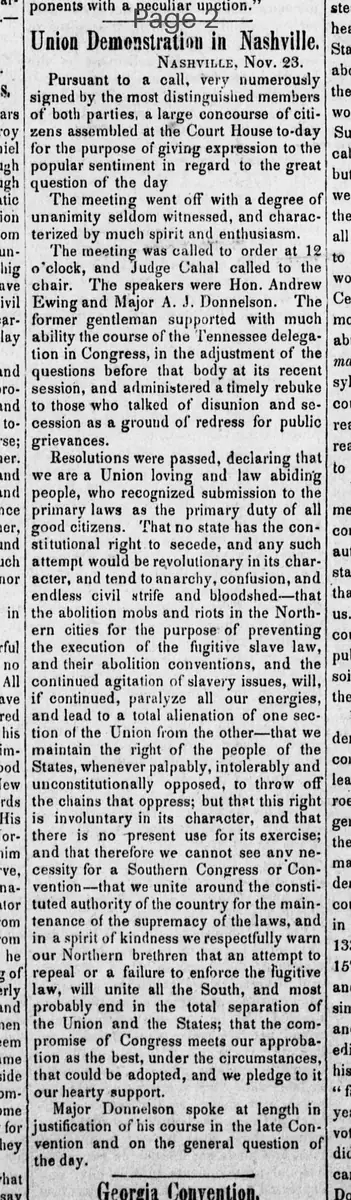
Nashville, Nov. 23.
Pursuant to a call, very numerously signed by the most distinguished members of both parties, a large concourse of citizens assembled at the Court House to-day for the purpose of giving expression to the popular sentiment in regard to the great question of the day.
The meeting went off with a degree of unanimity seldom witnessed, and characterized by much spirit and enthusiasm.
The meeting was called to order at 12 o'clock, and Judge Cahal called to the chair. The speakers were Hon. Andrew Ewing and Major A. J. Donnelson. The former gentleman supported with much ability the course of the Tennessee delegation in Congress, in the adjustment of the questions before that body at its recent session, and administered a timely rebuke to those who talked of disunion and secession as a ground of redress for public grievances.
Resolutions were passed, declaring that we are a Union loving and law abiding people, who recognized submission to the primary laws as the primary duty of all good citizens. That no state has the constitutional right to secede, and any such attempt would be revolutionary in its character, and tend to anarchy, confusion, and endless civil strife and bloodshed--that the abolition mobs and riots in the Northern cities for the purpose of preventing the execution of the fugitive slave law, and their abolition conventions, and the continued agitation of slavery issues, will if continued, paralyze all our energies, and lead to a total alienation of one section of the Union from the other--that we maintain the right of the people of the States, whenever palpably, intolerably and unconstitutionally opposed, to throw off the chains that oppress; but that this right is revolutionary in its character, and that there is no present use for its exercise; and that therefore we cannot see any necessity for a Southern Congress or Convention--that we unite around the constituted authority of the country for the maintenance of the supremacy of the laws, and in a spirit of kindness we respectfully warn our Northern brethren that an attempt to repeal or a failure to enforce the fugitive law, will unite all the South. and most probably end in the total separation of the Union and the States; that the compromise of Congress meets our approbation as the best, under the circumstances, that could be adopted, and we pledge to it our hearty support.
Major Donnelson spoke at length in justification of his course in the late Convention and on the general question of the day.
What sub-type of article is it?
What keywords are associated?
What entities or persons were involved?
Where did it happen?
Domestic News Details
Primary Location
Nashville
Event Date
Nov. 23
Key Persons
Outcome
resolutions passed declaring support for union, opposition to secession, criticism of northern abolitionism, endorsement of congressional compromise, and warning against failure to enforce fugitive slave law.
Event Details
Pursuant to a call signed by distinguished members of both parties, a large concourse of citizens assembled at the Court House. The meeting was called to order at 12 o'clock by Judge Cahal. Speakers Hon. Andrew Ewing and Major A. J. Donnelson addressed the crowd, supporting the Tennessee delegation's course in Congress and rebuking disunion talk. Resolutions affirmed Union loyalty, rejected secession as revolutionary, criticized Northern abolition mobs and agitation, maintained revolutionary rights but saw no current need, opposed a Southern Congress, pledged support to constituted authority, warned Northern brethren on fugitive slave law enforcement, and approved the congressional compromise.