Thank you for visiting SNEWPapers!
Sign up free
Richmond Enquirer
Richmond, Richmond County, Virginia
What is this article about?
Report of U.S. House debates on the Georgia-Creek Indian land controversy, featuring speeches by Webster and Forsyth on treaty validity and committee referral. Votes favor select committee. Other House business includes militia claims, tactics bill, Jefferson lottery, and woollen duty passage. Senate confirms Poinsett nomination despite opposition.
Merged-components note: These components constitute a single extended report on the U.S. Congress debate concerning the Georgia and Creek Indians land claims, spanning pages 2 and 3 with sequential reading orders and clear textual continuity across sessions and speakers.
Clippings
1 of 2
OCR Quality
Full Text
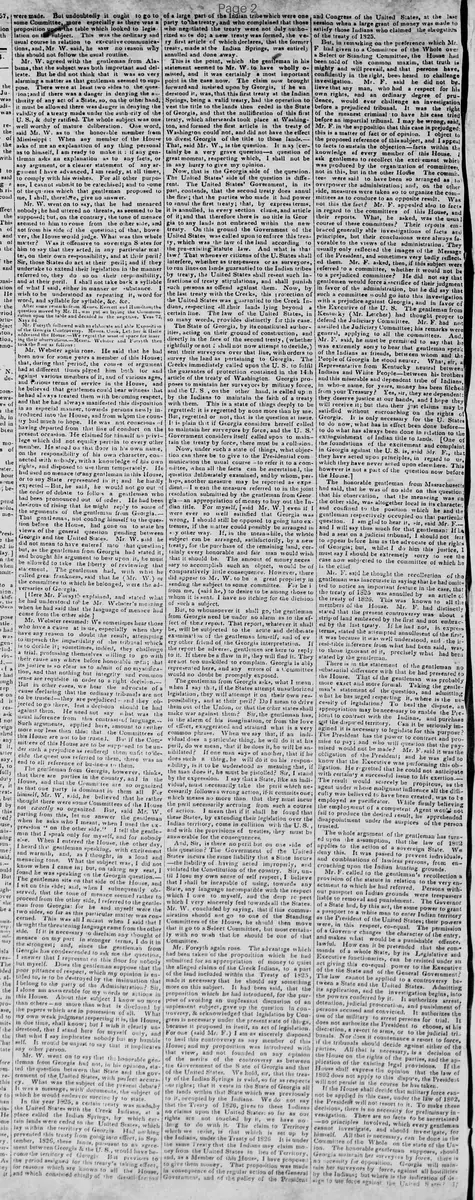
Mr. Webster again rose. He said that he had been now for some years a member of this House; that, during that period, the course of argument had at different times placed him both for and against various members of it, and of various ages, and various terms of service in the House, and he believed that gentlemen could bear witness that he had always treated them with becoming respect, and that he had always manifested this disposition in an especial manner, towards persons newly introduced into the House, and from whom the country had much to hope. He was not conscious of having departed from that line of conduct on the present occasion. He claimed for himself no privilege which did not equally pertain to every other member. He stood on that floor in his own name, on the responsibility of his own character, connected with nobody, with a knowledge of his own rights, and disposed to use them temperately. He had used no menace to any gentleman in this House, or to any State represented in it; and he hardly expected—But, he said, he would not go out of the order of debate to follow a gentleman who had been pronounced out of order. He had been desirous of rising that he might reply to some of the arguments of the gentleman from Georgia.—That gentleman, not confining himself to the question before the House, had gone on to state his views of the general question pending between Georgia and the United States. Mr. W. said he did not mean to have entered into that question; but, as the gentleman from Georgia had stated it, and brought his argument to bear upon it, he must be allowed to take the liberty of reviewing that statement. The gentleman had, with what he called great frankness, said that he (Mr. W.) or the committee to which he belonged, were the adversaries of Georgia.
[Here Mr. Forsyth explained, and stated what he had understood to be Mr. Webster's meaning when he had said that the language of menace had come from the other side.]
Mr. Webster resumed: We sometimes hear those who have a cause at issue, especially when they have any reason to doubt the result, attempting to impeach the impartiality of the tribunal which is to decide it; sometimes, indeed, they challenge a trial, professing themselves willing to go with their cause any where before honorable men; that its justice is so clear as to admit of no mystification, and that nothing but integrity and common sense are requisite in order to a right decision.—But in other cases, we hear the advocate of a cause declaring that the ordinary tribunals are not to be trusted—they are prejudiced—and they object to go there, lest a decision should be had against them. He need not say what was the usual inference from this contrast of language.—Such arguments, applied here, amount to neither more nor less than this: that the Committees of this House are not to be trusted. But if the Committees of this House are to be supposed to be under such a prejudice as rendered them unfit to decide the questions referred to them, there was an end to all reference of business to them.
The gentleman from Georgia, however, thinks, that there are parties in the country, and in the House, and that the Committee are so organized as that one party is dominant in them all For himself, Mr. W. said, he believed that he rather thought there were some Committees of the House not exactly so organized. But, said Mr. W. parting from this, let me answer the gentleman when he asks who I meant, when I used the expression "on the other side." I tell the gentleman that I speak only for myself, and for nobody else. When I entered the House, the other day, I heard that gentleman speaking, with excitement and warmth, and, as I thought, in a loud and menacing tone. What the subject was, I did not know when I came in; but, on taking my seat, I found he was speaking on the Georgia question.—The gentleman sits on that side of the House, and I sit on this side; and, when I subsequently observed, that the tone of menace seemed rather to proceed from the other side, I referred to the gentleman from Georgia: for he and myself were the two sides, so far as this particular matter was concerned. This was all I meant when I said that I thought the threatening language came from the other side. If it is necessary to disclaim any thought of menace on my part in stronger terms, I do it in the strongest; and, since the gentleman from Georgia has condescended to ask me the question, I answer that I represent on this floor for nobody but myself. Does the gentleman suppose that the poor pittance of respect, which my opinion is entitled to, is to be destroyed by the insinuation that I belong to the party of the Administration? Sir, I alone am answerable for my words or actions in this House. About this subject I know no more than others—no more than what is disclosed by the papers which are in possession of all. What my own weak judgment respecting it is, the House, in due time, shall know; but I wish it clearly understood, that I stand here for myself only, and that what I say implicates nobody but my humble self. It would be unjust to say that it implicates any other person.
Mr. W. went on to say that the honorable gentleman from Georgia had not, in his opinion, stated the question between that State and the government of the United States, with perfect accuracy.
What was the subject of the present debate? It was a message, with documents, the subject of which he would endeavor succinctly to state.
In the year 1825, a certain treaty was made, by the United States with the Creek Indians, at a place called the Indian Springs, by which certain lands were ceded to the United States, which lay within the territory of Georgia Had nothing prevented this treaty from going into effect, in September, 1826, these lands, pursuant to an agreement between Georgia & the U. S., would have become the territory of Georgia But previous to the period assigned for this treaty's taking effect, for reasons which are known to all the House, and which consisted chiefly of the dissatisfaction of a large part of the Indian tribe which were one party to the treaty, and who complained that those who negotiated the treaty were not duly authorized so to do; a new treaty was formed. the very first article of which declares, that the former treaty, made at the Indian Springs, was entirely annulled and done away.
This is the point, which the gentleman in his statement seemed to Mr. W. to have wholly omitted, and it was certainly a most important point in the case now. The claim now brought forward and insisted upon by Georgia, if he understood it. was, that this first treaty at the Indian Springs. being a valid treaty, had the operation to vest the title to the lands then ceded in the State of Georgia, and that the nullification of this first treaty, which afterwards took place at Washington, and formed the first article in the treaty of Washington could not, and did not have the effect to divest Georgia of the title to those lands.—That, said Mr. W., is the question. It may certainly be a very grave question—a question of great moment, respecting which, I shall not be in any hurry to give my opinion.
Now, that is the Georgia side of the question.
The United States' side of the question is different. The United States' Government, in its part, contends, that the second treaty does annul the first; that the parties who made it had power to annul the first treaty; that, by express terms, it is annulled, in every section clause, and article of it; and that therefore there is no title in Georgia to any lands not embraced within the new treaty. On this ground the Government of the United States was called upon to enforce this treaty, which was the law of the land according to the pre-existing statute law. And what is that law? That whenever citizens of the U. States shall interfere, whether as trespassers or as surveyors, to run lines on lands guaranteed to the Indian tribes by treaty, the United States shall resent such infractions of treaty stipulations, and shall punish such persons as offend against them. Now, by the last treaty with the Creeks, this protection of the United States was guaranteed to the Creek Indians, respecting all their lands lying beyond a certain line. The Law of the United States, in so many words, provides distinctly for this case.
The State of Georgia, by its constituted authorities, acting on their ground of construction, and directly in the face of the second treaty, (whether rightfully or not : shall not now attempt to decide,) sent their surveyors over that line, with orders to survey the land as pertaining to Georgia. The Creeks immediately called upon the U. S. to fulfil the guarantees of protection contained in the 14th article of the treaty of Washington. Georgia proposes to maintain her surveyors by military force, and the U. S., on the other hand, is called upon by the Indians to maintain the faith of a treaty with them. This is a state of things deeply to be regretted: it is regretted by none more than by me. But, regretted or not, that is the question at issue.
It is plain that if Georgia considers herself called to maintain her surveyors by force, and the U. S.' Government considers itself called upon to maintain the treaty by force, there must be a collision.
Now, under such a state of things, what objection can there be to give to the Presidential communication the usual course—to refer it to a committee, when all the facts can be ascertained, the question deliberately examined, and by whom, perhaps, another measure may be reported as expedient— I mean the measure referred to in the joint resolution submitted by the gentleman from Georgia—an appropriation of money to buy out the Indian title. For myself, [said Mr. W.] even if I were ever so well satisfied that Georgia was wrong, I should still be opposed to going into extremes, if the matter could possibly be arranged in any other way. If, in the meanwhile, the whole subject can be arranged, satisfactorily, by a new treaty, for the purchase of the remaining land, certainly every honorable and fair man would wish that it should be. The amount of money necessary to accomplish such an object, would be of comparatively little consequence. However, there did appear to Mr. W. to be a great propriety in sending the subject to some committee. Far be it from me, (said he,) to desire to be among those to whom it is sent. I have no itching for the decision of such a subject.
But, to whomsoever it shall go, the gentleman from Georgia need be under no alarm as to the effect of their report. That report, whatever it shall be, will be subjected to the acute and deliberate examination of the gentleman himself, and of every other friend of the Georgia interpretation. If the report be adverse. gentlemen are here to reply to it. If there be a flaw in it, they will find it. They are not too unskilled to complain. Georgia is ably represented here, and any errors of a Committee would no doubt be promptly exposed.
The gentleman from Georgia asks, what I mean when I say that, if the States attempt unauthorized legislation, they will attempt it on their own responsibility, and at their peril? Do I mean to drive them out of the Union, or that the other states shall make war against them? Sir, the gentleman has, in the alarm of his imagination, or from the love of effect, exaggerated and strained what is a very common phrase. When we say that, if an individual does a particular thing, he will do it at his peril, do we mean, that if he does it, he will be annihilated? If one man says of another, that if he does such a thing, he will do it on his responsibility, is it to be understood as meaning that, if the man does it, he must be pistoled? Sir, I stand by the expression. I say that a State, like an individual, must necessarily take the peril which necessarily follows a wrong action, if it commits one; which means no more than that they must incur the peril necessarily accruing from such a course of action. I mean that if it shall be found that these States, by extending their legislation over the Indian territory, come in collision with the U. S., and with the provisions of treaties, they must be answerable for the consequences.
And, Sir, is there no peril but on one side of this question? The Government of the United States incurs the same liability that a State incurs—the liability of having acted improperly, and violated the Constitution of the country. Sir, until I lose my own sense of self respect, I believe that I shall be incapable of using, towards any State, any language incompatible with the respect which I owe to myself, and the deep respect which I very sincerely feel towards all the States.
Mr. W. concluded by saying, that if this communication should not go to one of the Standing Committees of the House, he should then move that it go to a Select Committee, but most certainly with no wish that he should be one of that Committee.
Mr. Forsyth again rose. The advantage which had been taken of the proposition which he had submitted for an appropriation of money to quiet the alleged claims of the Creek Indians, to a part of the land included within the Treaty of 1825, made it necessary that he should say something more on this subject. It had been said, that the proposition which he had introduced, for the purpose of avoiding an unpleasant discussion of an unpleasant subject, gave up the question in controversy, & acknowledged that legislation by Congress is necessary under the present state of things, because it proposed in itself, an act of legislation. For one (said Mr. F.) I am as sincerely disposed to heal this controversy as any member of this House; and my proposition was introduced with that view, and not founded on any opinion of the merits of the controversy as between the Government of the State of Georgia and that of the United States. We hold, sir, that the treaty of the Indian Springs is valid, so far as respects our rights; that it vests in the State of Georgia all the lands within that State which was previously to it, occupied by the Indians. We do not say that the Treaty of 1826, gives to these Indians no claims upon the United States: so far as our rights are not touched by it, we have no thing to do with it. The claim to Territory which we resist, is that which is set up by the Indians, under the Treaty of 1826 It is under the same Treaty that the Indians may claim money from the United States in lieu of Territory, and, as a Member of this House, I have proposed to give them money, That proposition was made In consequence of the regular action of the General Government, and of the policy of the President and Congress of the United States, at the last session when a large grant of money was made to satisfy those Indians who claimed the abrogation of the treaty of 1825.
But, in remarking on the preference which Mr. F had given to a Committee of the Whole over Select or Standing Committee, the House had been told of the common maxim, that truth is mighty and will prevail, and that persons have, confidently in the right, been heard to challenge investigation.
Mr. F. said he did not believe that any man, who had a respect for his own rights, and an ordinary degree of prudence, would ever challenge an investigation before a prejudiced tribunal. It was the right of the meanest criminal to have his case tried before an impartial tribunal. I may be wrong, said, Mr. F. in the supposition that this case is prejudged: this is a matter of fact or of opinion. I object to the proposed reference of this subject, and I appeal to facts to sustain the objection—facts within the knowledge of every member of this House. I ask gentlemen to recollect the excitement which was produced by the organization of committees, not in this, but in the other House The committees were said to have been so arranged as to overpower the administration; and, on the other side, measures were taken so to organize the committees as to conduce to an opposite result. Was not this the fact? Mr. F. appealed also to facts in regard to the committees of this House. and their reports. What, he asked, was the usual course of these committees? Their reports embraced generally able investigations of facts and principles, but their conclusions were always favorable to the views of the administration. They usually only reflected the images of the Message of the President, and sometimes very badly reflected them. Mr. F. asked, then, if this subject were referred to a committee, whether it would not be to a prejudiced committee? He did not say that gentlemen would force a sacrifice of their judgment in favor of the administration, but he did say that such a committee would go into this investigation with a prejudice against Georgia, and in favor of the Executive of the U. S. The gentleman from Kentucky (Mr. Letcher) had thought proper to defend the Judiciary Committee. Mr. F. had not assailed the Judiciary Committee; his remarks were general, applying to all the committees. And, Mr. F. said, he must be permitted to say that he was extremely sorry to hear that gentleman speak of the Indians as friends, between whom and the People of Georgia he stood neuter. What, sir, a Representative from Kentucky neutral between Indians and White People—between his brothers and this miserable and dependent tribe of Indians in whose name, for years, money has been filched from your Treasury? Yes, sir, they are dependent: they deserve justice at our hands, and I hope they will receive it; but then their just claims may be satisfied without encroaching on the rights of Georgia. It is only necessary for the U. States to do now, what has in effect been done before—to do what has always been done in relation to the extinguishment of Indian title to lands. [One of the foundations of the excitement and complaint in Georgia against the U. S. is, said Mr. F., that they have acted upon principles, in regard to us, which they have never acted upon elsewhere. This however is not a part of the question now before the House.]
The honorable gentleman from Massachusetts had said, that he was of no side on this question; that his observation, that the menacing was on the other side, was altogether local in its character, and confined to the position which he and the gentleman respectively occupied—on that particular question. I am glad to hear it, sir, said Mr. F.—and I will say thus much for that gentleman: If he had a seat on a judicial tribunal, I should not fear to appear before him as the advocate of the rights of Georgia; but, whilst I do him this justice, I must say I should be extremely sorry to see the case now subjected to the committee of which he is the chief
Mr. F. said he thought the recollection of the gentleman was inaccurate in saying that he had omitted to notice an important feature in the case, that the treaty of 1825 was annulled by an article of the treaty of 1826. This was known to all the members of the House. Mr. F. had distinctly stated that the present controversy was about a strip of land embraced by the first and not embraced by the last treaty. If he had not, in express terms, stated the attempted annullment of the first, it was because it was well understood, and the irresistible inference from what had been said, was, to those ignorant of it, precisely what had been stated by the gentleman.
There is in the statement of the gentleman no substantial difference with that he had presented to the House. That of the gentleman was probably more exact and more formal. Taking the gentleman's statement of the question, and admitting what he has urged respecting it, where is the necessity of legislation? To heal the dispute, an appropriation may be necessary to enable the President to contract with the Indians, and purchase out the disputed territory. Can it be seriously imagined it is necessary to legislate for this purpose? The President has the power to contract and promise to pay; and who will question that the promised would not be made? Mr. F. said it was the obligation of the President; and he was glad to know that the Executive was performing this obligation. He regretted that he could not anticipate with certainty a successful issue to his exertion.—The result would scarcely be propitious, as the agent under whose malignant influence all the difficulty was believed to have been created, was to be employed as pacificator. While firmly believing the employment of a competent Agent would not fail to produce the desired result, he apprehended disappointment under the auspices of the person trusted.
The whole argument of the gentleman has turned upon the assumption, that the law of 1802 applies to the action of a sovereign State. We deny this. It was passed to prevent individuals, and combinations of lawless persons, from encroaching upon the Indian hunting grounds.
Mr. F. called to the gentleman's recollection a provision of the statute in relation to the very enactment to which he had referred. Persons without passport on Indian grounds were trespassers liable to removal and punishment. The Governor of a State had, by this act, the same power to grant a passport to a white man to enter Indian territory as the President of the United States; their powers were, in this respect, co-equal. The permission of a Governor changes the character of the entry, and makes what would be a punishable offence, lawful. How can it be pretended that the commands of a whole State, by its Legislative and Executive functionaries, can be resisted under an act giving this co-equal power to the Executive of the the State and of the General Government?
The law cannot be applied to a controversy between a State and the United States. Admitting its application, and the investigation begins, into the powers conferred by it. It authorizes arrest, detention, judicial prosecution, and punishment of persons accused and convicted. It authorizes the use of the military to arrest persons for trial. It does not authorize the President to choose, at his discretion, a resort to arms, or to the judicial tribunals. Nor does it countenance a resort to force, if the tribunals should decide against either of the parties. All that is necessary, is a decision of the House on the rights of the parties, and the application of the existing legal provisions. If the House shall express the opinion that the law of 1802 does not apply to this dispute, the President will not persist in the course he has taken.
If the House shall decide that military force cannot be applied in this case, under the law of 1802, the President will not resort to it. To make these decisions, there is no necessity for preliminary investigation. There are no facts to be ascertained—no principles involved, which every gentleman cannot investigate, and should investigate, for himself. All that is necessary, can be done in the Committee of the Whole on the state of the Union. The honorable gentleman supposes, should Georgia maintain her surveyors by force, there is no necessity for opposition. Georgia will maintain her surveyors by force, against all hostilities by the Indians; but where is the indication of design to use force against the United States? If the Indians remain tranquil, as they will do, if not excited by insidious intermeddling, there is no danger of bloodshed; unless, indeed, pending judicial inquiry, military force should be used, not to arrest accused persons for trial, but to settle the controversy.
The gentleman has asked, how a love of effect could produce such an exaggeration of the ordinary expressions used by him, relating to the peril of a State, if it attempted to extend its laws over Indian territory. Of the first part of this remark, Mr. F. had only to say, that it had induced him to notice the second part. The expression used by the gentleman was not an ordinary expression, nor had it been used in an ordinary manner. He has now given the House, after repeating it, and declaring his determination to stand by it, an explanation; and to what does it amount? 'The determination of a State is made at its peril, means under its responsibility—the peril of doing wrong. And what peril is this but the ordinary peril of every State and every individual, in every act and every determination? It could scarcely have been supposed the gentleman meant no more, when he called upon the gentleman from Mississippi to convey it to his State as a salutary lesson. Mr. F. rejoiced that no more was intended, and that an explanation had been given, although not a satisfactory one.
Mr. F. said, he would conclude his remarks by recalling to the House the fact he had stated in his previous address to it, that all the documents connected with the messages of the President, and the whole subject to which the messages related, were already before the Committee of the Whole House on the state of the Union. If that reference was correct, the messages ought to be also referred to that Committee.
Mr. Ingersoll also addressed the House.
The question was then taken upon the motion of Mr. Forsyth, to refer the President's communication, with the accompanying documents to a Committee of the Whole on the state of the Union, and negatived—ayes 81, noes 92.
The question was then taken on the motion of Mr. Cook, to refer it to the Committee of the Judiciary and negatived—ayes 81, noes 95.
Mr. Webster now moved that it be referred to a Select Committee. This motion prevailed without a division, and the committee was ordered to consist of seven members.
Mr. Thompson of Georgia, then said, that it was with the most perfect deference to the Chair, that he should make the motion he was about to submit. The question to be reported on was one of great importance, not only to the State from which he came, but to the U.S., and he was persuaded that the Speaker himself must be sensible, that the motion proceeded from no want of respect for him, since its effect would be to relieve him from a very unpleasant responsibility. He then moved that the Select Committee be appointed by ballot.
Mr. Vance of Ohio opposed this motion as tending to unnecessary delay, and he demanded the yeas and nays, on the motion of Mr. Thompson, Yeas 90, Nays 104.
So the House refused to order the committee to be appointed by ballot.
Mr. Saunders rose to ask for information in regard to the proceedings which had just taken place. A motion was made to refer the subject to a Committee of the Whole House on the State of the Union, which was negatived. A gentleman from Virginia then moved its reference to a Select Committee. The Chair decided the motion could not be sustained, pending the motion to refer to a Standing Committee. The House refused the reference of the subject to a Standing Committee, of which the gentleman from Massachusetts was Chairman. The gentleman from Massachusetts then renewed the motion to refer the motion to a Select Committee. My inquiry of the Chair is, on whose motion the Speaker understands the reference to be made, that of the gentleman from Virginia, or that of the gentleman from Massachusetts?
The Speaker replied, the gentleman from N. Carolina had the same means of knowing as the Chair, and was as competent as himself to decide the question.
SATURDAY, FEB. 10.
HOUSE OF REPRESENTATIVES.
The following gentlemen compose the committee appointed yesterday on The President's Messages in relation to the conflicting claims of the State of Georgia and the Creek Indians, to certain lands within the limits of this State: Messrs. Everett, Powell, Cooke, Drayton, Whittlesey, Lawrence and Buckner.
GEORGIA MILITIA CLAIMS.
Mr. Vance, from the Committee on Military Affairs, to which was referred the memorial of the Legislature of the State of Georgia, relative to the claims of citizens of that State for Military services rendered in the years 1792, 3 and 4, made a favorable report thereon; which was read and committed to a Committee of the Whole House on the State of the Union.
MILITIA TACTICS.
Mr. Vance, from the Committee on Military Affairs, reported a bill to provide systems of Cavalry, Artillery, and Infantry exercise, for the use of the Militia of the U. States: Which was twice read and ordered to be engrossed for a third reading on Thursday next.
JEFFERSON LOTTERY BILL.
Mr. Alexander of Va. from the Committee for the District of Columbia, to which had been referred the bill from the Senate, to authorize the Corporation of the City of Washington to introduce into the Lotteries—they are authorized to establish certain land prizes (being the lands of the late President Jefferson,) reported the same without amendment.
On reporting this bill, Mr. Alexander observed, that the Legislature of Virginia had passed an act for the benefit of the family of Mr. Jefferson, granting a lottery for the disposal of his real estate. An Agent in Washington had been employed to prepare a scheme for the Lottery thus granted, but owing to the small number of the prizes, this scheme was found impracticable. Application was made to Congress to fulfil the wishes of the Legislature of Virginia, by connecting the Jefferson Lottery with some scheme which had for its object the benefit of the City of Washington, and the present bill was intended to effect that object. What Mr. Jefferson might have thought or done in relation to such a proposal, had he lived, it was not for him to say; but, in making this application, the executor of that illustrious man had done no more than was his duty, under the will. He had acted under the influence of feeling and of duty, and the application was recommended by every principle of filial gratitude, and by all those sentiments of the human heart, which, if he would, he could not change.
The question was then taken, and the bill was ordered to a third reading on Monday—Ayes 104, Noes 26.
On motion of Mr. Forsyth, the Committee of the Whole House on the State of the Union was discharged from the consideration of certain resolutions of the Legislature of Georgia, in relation to lands claimed by the State and by the Creek Indians, and the resolutions were referred to the Select Committee appointed yesterday on that subject.
WOOLLEN DUTY BILL
The bill for the protection of the woollen manufactures was read a third time, and the question being on the passage of the bill,
Mr. Cambreleng delivered his sentiments in opposition to the bill, in a speech of more than an hour. He concluded by moving its third reading on the 4th day of March next; he withdrew his motion, however, at the request of
Mr. Buchanan, who moved that the bill be recommitted to the Committee on Manufactures, with instruction so to amend the same as to make the duties on the importation of Foreign Woollen Goods, and Foreign Wool, commence at the same time, and to make the duties the same on Foreign Wool, whether imported upon the skin or not; also to increase the duty on the importation of Foreign Spirits not less than ten cents per gallon; and also to increase the duty on the importation of Foreign Hemp not less than five dollars per ton.
On this question, Mr. B. demanded the yeas and nays, and they were ordered by the House.
Mr. Lawrence warmly opposed the recommittal which he considered as going to defeat the bill.
Mr. Buchanan having replied and vindicated his conduct in moving to recommittal at so late a period of the discussion—
Mr. Wurts delivered his views in opposition to the provisions of the bill, at the same time professing his sentiments in favor of the protection of domestic industry; and his willingness to go as far as to enforce the collection of the duties under the tariff of 1824.
Mr. Lawrence now spoke to the merits of the bill, and insisted that it was in accordance with the uniform policy of Pennsylvania.
Mr. Stevenson of Pennsylvania, replied to Mr. Lawrence and defended himself from the charge of opposing the policy of his State.
Mr. Stewart spoke in reply to Mr. Stevenson and noticed the remarks of Mr. Cambreleng, and those made on Thursday by Mr. McDuffie.
Mr. Cook opposed the recommittal. The House had already manifested its sentiments, as to a tax on foreign whiskey, by refusing, a day or two since, both the propositions of the gentleman from Kentucky. (Mr. Wickliffe,) and of another gentleman from the same State, (Mr. Moore.) After some remarks on the course which the debate had taken, he moved to lay the bill on the table, giving notice, that should that motion fail, he would then call the previous question. On his present motion, he demanded the yeas and nays, and they were taken accordingly—Yeas 84, Nays 109.
So the House refused to lay the bill on the table.
Mr. Ingham now rose, and expressed his sentiments in opposition to the bill, in a speech of two hours. Mr. I. having taken his seat—
Mr. Hamilton and Mr. Bartlett rose, and both claimed the floor.
The Chair decided that Mr. Bartlett was entitled to it. From this decision Mr. Hamilton appealed. The House sustained the decision—ayes 106, noes 57.
The number of ayes having been announced, Mr. McDuffie demanded the appointment of Tellers. But the noes having been announced, he withdrew the demand.
Mr. Mitchell, of Tenn., now moved to adjourn. The Chair decided that this motion could not now be received. inasmuch, as Mr. Bartlett already had the floor.
Mr. Bartlett, after briefly adverting to the late period of the session. the mass of unfinished business before the House, and to the protracted debate which had already taken place on this bill, demanded the previous question.
The question being put, the House sustained the demand—ayes 97, noes 85.
Mr. Mitchell, of Tenn., again moved to adjourn.
On this question Mr. Hamilton demanded the yeas and nays—Yeas 90, Nays 109.
So the House refused to adjourn.
The Speaker then put the question,
"Shall the main question now be put?"
On this question, Mr. Edwards, of N. Carolina, demanded the yeas and nays. —Yeas 102, Nays 98.
Mr. Cambreleng now moved to adjourn, and called for the yeas and nays on his motion; but the House refused to order them.
The question then being put on adjournment, it was negative—ayes 81, noes 105.
The question now at length recurred—" Shall this bill pass?" and was decided by yeas and nays, yeas 103, nays 95.
So the Bill was Passed, and sent to the Senate for concurrence: and then
The House adjourned [at six o'clock.]
MONDAY, FEBRUARY 12.
IN SENATE
Executive Proceedings.
The Senate resumed the consideration of the nomination of Joel R. Poinsett, as Envoy Extraordinary and Minister Plenipotentiary of the United States to the Assembly of American Ministers, transferred from Panama to Tacubaya in Mexico, in the place Richard C. Anderson, deceased.
Mr. Benton offered the following resolution:
Resolved, That it is inexpedient for the United States to send any Minister in the place of R.C. Anderson, deceased, to the Congress of American Nations at Tacubaya.
The question being taken on this resolution, it was negatived by the following vote:
YEAS—Messrs. Benton, Berrien, Branch, Chandler, Cobb, Dickerson, Eaton, Findlay, Hayne, Kane, King, McKinley, Macon, Randolph, Ridgely, Rowan, Smith of S. Carolina, Tazewell, Van Buren, White, Williams, and Woodbury—22.
NAYS—Messrs. Barton, Bateman, Bell, Bouligny, Chambers, Clayton, Edwards, Harrison, Hendricks, Holmes, Johnson of Kentucky, Johnson of Louisiana, Knight, Marks, Mills, Noble, Reed, Robbins, Ruggles, Sanford, Seymour, Silsbee, Smith of Md., Thomas, and Willey—25.
Mr. Benton submitted the following resolution:
It appearing to the Senate, from the documents communicated by the President in the Treaty of Union, League and Perpetual Confederation, concluded by the assembly of American Nations at Panama, on the 15th of July, 1826, it is stipulated that the Governments there represented, would renew their invitations to the neutral and friendly Powers to send Plenipotentiaries to Tacubaya; and it further appearing that no such invitations have yet been given to our Government:
Therefore, resolved, That, without now expressing its opinion as to the expediency of the United States being represented at the Congress of Tacubaya, the Senate are of opinion that no further steps ought to be taken in that Mission, nor any further expense incurred.
The question being taken on this resolution, it was decided in the negative as follows:
YEAS—Messrs. Benton, Berrien, Branch, Chandler, Cobb, Dickerson, Eaton, Findlay, Hayne, Kane, King, McKinley, Macon, Randolph, Ridgely, Rowan, Smith of South Carolina, Tazewell, Van Buren, White, Williams and Woodbury—22
NAYS—Messrs. Barton, Bateman, Bell, Bouligny, Chambers, Chase, Clayton, Edwards, Harrison, Hendricks, Holmes, Johnson of Kentucky, Johnson of Louisiana, Knight, Marks, Mills, Noble, Reed, Robbins, Ruggles, Sanford, Seymour, Silsbee, Smith of Maryland, Thomas, and Willey—26
The question being put, "Will the Senate advise and consent to the appointment of Joel R. Poinsett as Minister Plenipotentiary, &c. it was decided in the affirmative, as follows:
YEAS—Messrs. Barton, Bateman, Bell, Benton, Bouligny, Chambers, Chase, Clayton, Eaton, Edwards, Harrison, Hendricks, Holmes, Johnson of Kentucky, Johnson of Louisiana, Kane, Knight, McKinley, Marks, Mills, Noble, Reed, Robbins, Ruggles, Sanford, Seymour, Silsbee, Smith of Maryland, Thomas, Willey.—30.
NAYS—Messrs. Berrien, Branch, Chandler, Cobb, Dickerson, Findlay, King, Macon, Randolph, Ridgely, Rowan, Smith of South Carolina, Tazewell, Van Buren, White, Williams, Woodbury.—17.
The Senate then proceeded to the nomination of John Boyle, of Kentucky, to the office of Judge of the United States for the District of Kentucky, and on the question of advising and consenting to that nomination, it was decided in the affirmative, as follows:
YEAS—Messrs. Barton, Bateman, Bell, Benton, Berrien, Bouligny, Chambers, Chase, Clayton, Eaton, Edwards, Harrison, Hayne, Hendricks, Holmes, Johnson of Kentucky, Johnson of Louisiana, Kane, King, Knight, McKinley, Marks, Noble, Reed, Ridgely, Robbins, Ruggles, Sanford, Silsbee, Smith of Maryland, Tazewell, Thomas, Van Buren, White, Willey, Williams, Woodbury.—37.
NAYS—Messrs. Branch, Chandler, Findlay, Macon, Randolph, Rowan, Smith of South Carolina.—7.
On motion, the injunction of secrecy was then removed from the above proceedings, and
The Senate Adjourned.
What sub-type of article is it?
What themes does it cover?
What keywords are associated?
What entities or persons were involved?
Where did it happen?
Story Details
Key Persons
Location
House Of Representatives
Event Date
February 10; February 12
Story Details
Debate in the House on the Georgia Controversy over Creek Indian lands from 1825 and 1826 treaties, with speeches by Webster defending committee impartiality and explaining treaty annulment, and Forsyth arguing against prejudiced committees and for Georgia's rights; motion to refer to select committee passes; other bills advanced including woollen duties; Senate confirms Poinsett as minister and Boyle as judge.