Thank you for visiting SNEWPapers!
Sign up free
Daily National Intelligencer
Washington, District Of Columbia
What is this article about?
An elderly Virginia-born sailor, now living under the Blue Ridge, advocates for building a battery on the Horse Shoe in Chesapeake Bay to secure inward navigation to Norfolk and Hampton Roads, citing low costs, natural geography, and lessons from the Revolution and War of 1812. He references Commodore Decatur's views and warns of the strategic importance of defending against enemy footholds.
Clipping
OCR Quality
Full Text
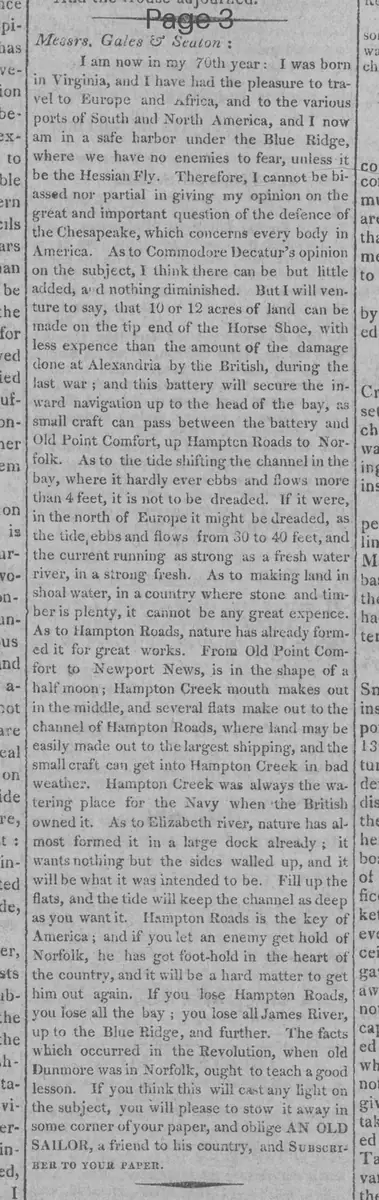
I am now in my 70th year: I was born in Virginia, and I have had the pleasure to travel to Europe and Africa, and to the various ports of South and North America, and I now am in a safe harbor under the Blue Ridge. where we have no enemies to fear, unless it be the Hessian Fly. Therefore, I cannot be biassed nor partial in giving my opinion on the great and important question of the defence of the Chesapeake, which concerns every body in America. As to Commodore Decatur's opinion on the subject, I think there can be but little added, and nothing diminished. But I will venture to say, that 10 or 12 acres of land can be made on the tip end of the Horse Shoe, with less expence than the amount of the damage done at Alexandria by the British, during the last war ; and this battery will secure the inward navigation up to the head of the bay, as small craft can pass between the battery and Old Point Comfort, up Hampton Roads to Norfolk. As to the tide shifting the channel in the bay, where it hardly ever ebbs and flows more than 4 feet, it is not to be dreaded. If it were, in the north of Europe it might be dreaded, as the tide, ebbs and flows from 30 to 40 feet, and the current running as strong as a fresh water river, in a strong fresh. As to making land in shoal water, in a country where stone and timber is plenty, it cannot be any great expence. As to Hampton Roads, nature has already formed it for great works. From Old Point Comfort to Newport News, is in the shape of a half moon; Hampton Creek mouth makes out in the middle, and several flats make out to the channel of Hampton Roads, where land may be easily made out to the largest shipping, and the small craft can get into Hampton Creek in bad weather. Hampton Creek was always the watering place for the Navy when the British owned it. As to Elizabeth river, nature has almost formed it in a large dock already; it wants nothing but the sides walled up, and it will be what it was intended to be. Fill up the flats, and the tide will keep the channel as deep as you want it. Hampton Roads is the key of America; and if you let an enemy get hold of Norfolk, he has got foot-hold in the heart of the country, and it will be a hard matter to get him out again. If you lose Hampton Roads. you lose all the bay ; you lose all James River. up to the Blue Ridge, and further. The facts which occurred in the Revolution, when old Dunmore was in Norfolk, ought to teach a good lesson. If you think this will cast any light on the subject, you will please to stow it away in some corner of your paper, and oblige AN OLD SAILOR, a friend to his country, and SUBSCRIBER TO YOUR PAPER.
What sub-type of article is it?
What themes does it cover?
What keywords are associated?
What entities or persons were involved?
Letter to Editor Details
Author
An Old Sailor
Recipient
Messrs. Gales & Seaton
Main Argument
construct a battery on the tip of the horse shoe in chesapeake bay using 10-12 acres of made land to secure navigation to norfolk via hampton roads, at low cost compared to war damages, leveraging natural geography and avoiding enemy footholds as in the revolution.
Notable Details