Thank you for visiting SNEWPapers!
Sign up free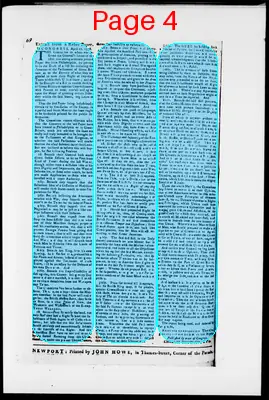
Story
May 14, 1778
The Newport Gazette
Newport, Newport County, Rhode Island
What is this article about?
Continental Congress committee report on April 22, 1778, analyzing British bills proposing tax rights and commissioners for peace talks. Deems them weak, insincere attempts to divide Americans, urges unity, troop readiness, and no negotiations without independence acknowledgment.
Clipping
OCR Quality
92%
Excellent
Full Text
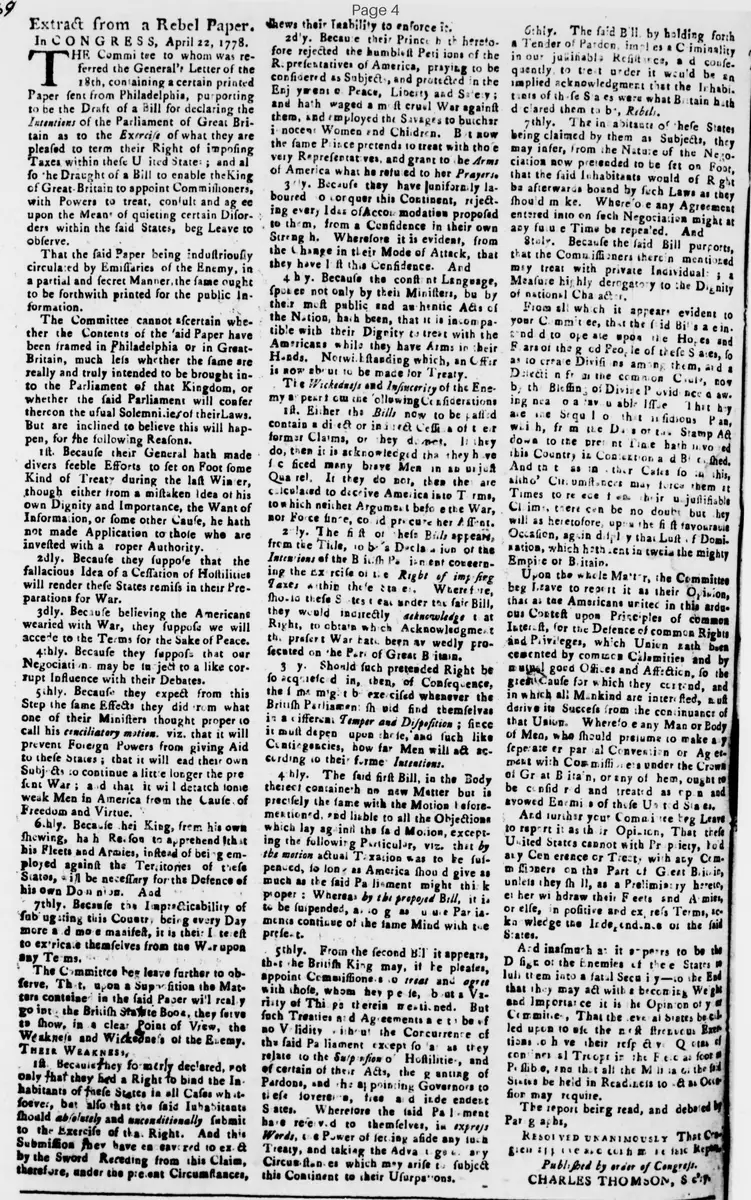
Extract from a Rebel Paper.
In CONGRESS, April 22, 1778.
The Committee to whom was referred the General's Letter of the 18th, containing a certain printed Paper sent from Philadelphia, purporting to be the Draft of a Bill for declaring the Intentions of the Parliament of Great Britain as to the Exercise of what they are pleased to term their Right of imposing Taxes within these United States; and also the Draught of a Bill to enable the King of Great-Britain to appoint Commissioners, with Powers to treat, consult and agree upon the Means of quieting certain Disorders within the said States, beg Leave to observe.
That the said Paper being industriously circulated by Emissaries of the Enemy, in a partial and secret Manner, the same ought to be forthwith printed for the public Information.
The Committee cannot ascertain whether the Contents of the said Paper have been framed in Philadelphia or in Great-Britain, much less whether the same are really and truly intended to be brought into the Parliament of that Kingdom, or whether the said Parliament will confer thereon the usual Solemnities of their Laws.
But are inclined to believe this will happen, for the following Reasons.
1st. Because their General hath made divers feeble Efforts to set on Foot some Kind of Treaty during the last Winter, though either from a mistaken Idea of his own Dignity and Importance, the Want of Information, or some other Cause, he hath not made Application to those who are invested with a proper Authority.
2dly. Because they suppose that the fallacious Idea of a Cessation of Hostilities will render these States remiss in their Preparations for War.
3dly. Because believing the Americans wearied with War, they suppose we will accede to the Terms for the Sake of Peace.
4thly. Because they suppose that our Negotiation may be subject to a like corrupt Influence with their Debates.
5thly. Because they expect from this Step the same Effects they did from what one of their Ministers thought proper to call his conciliatory motion. viz. that it will prevent Foreign Powers from giving Aid to these States: that it will cause their own Subjects to continue a little longer the present War: and that it will detach some weak Men in America from the Cause of Freedom and Virtue.
6thly. Because their King, from his own Shewing, hath Reason to apprehend that his Fleets and Armies, instead of being employed against the Territories of these States, will be necessary for the Defence of his own Dominions. And
7thly. Because the Impracticability of Subjugating this Country, being every Day more and more manifest, it is their last Effort to extricate themselves from the War upon any Terms.
The Committee beg leave further to observe, That, upon a Supposition the Matters contained in the said Paper will really go into the British Statute Book, they serve to shew, in a clear Point of View, the Weakness and Wickedness of the Enemy.
Their Weakness,
1st. Because they formerly declared, not only that they had a Right to bind the Inhabitants of these States in all Cases whatsoever, but also that the said Inhabitants should absolutely and unconditionally submit to the Exercise of that Right. And this Submission they have endeavoured to exact by the Sword. Receding from this Claim, therefore, under the present Circumstances, shews their Inability to enforce it.
2dly. Because their Prince hath heretofore rejected the humblest Petitions of the Representatives of America, praying to be considered as Subjects, and protected in the Enjoyment of Peace, Liberty and Safety; and hath waged a most cruel War against them, and employed the Savages to butcher innocent Women and Children. But now the same Prince pretends to treat with those very Representatives, and grant to the Arms of America what he refused to her Prayers.
3dly. Because they have uniformly laboured to conquer this Continent, rejecting every Idea of Accommodation proposed to them, from a Confidence in their own Strength. Wherefore it is evident, from the Change in their Mode of Attack, that they have lost that Confidence. And
4thly. Because the constant Language, spoken not only by their Ministers, but by their most public and authentic Acts of the Nation, hath been, that it is incompatible with their Dignity to treat with the Americans while they have Arms in their Hands. Notwithstanding which, an Offer is now about to be made for Treaty.
The Wickedness and Insincerity of the Enemy appears on the following Considerations.
1st. Either the Bills now to be passed contain a direct or implicit Cessation of their former Claims, or they do not. If they do, then it is acknowledged that they have sacrificed many brave Men in an unjust Quarrel. If they do not, then they are calculated to deceive America into Terms, to which neither Argument before the War, nor Force since, could procure her Assent.
2dly. The first of these Bills appears, from the Title, to be a Declaration of the Intentions of the British Parliament concerning the Exercise of the Right of imposing Taxes within these States. Wherefore, should these States treat under said Bill, they would indirectly acknowledge that Right, to obtain which Acknowledgment the present War hath been lavishly prosecuted on the Part of Great Britain.
3dly. Should such pretended Right be so acquiesced in, then, of Consequence, the same might be exercised whenever the British Parliament should find themselves in a different Temper and Disposition; since it must depend upon these, and such like Contingencies, how far Men will act according to their former Intentions.
4thly. The said first Bill, in the Body thereof contains no new Matter but is precisely the same with the Motion beforementioned, and liable to all the Objections which lay against the said Motion, excepting the following Particular, viz. that by the motion actual Taxation was to be suspended, so long as America should give as much as the said Parliament might think proper: Whereas by the proposed Bill, it is to be suspended, as long as our Parliament continues of the same Mind with the present.
5thly. From the second Bill it appears, that the British King may, if he pleases, appoint Commissioners to treat and agree with those, whom they please, but a Variety of Things therein mentioned. But such Treaties and Agreements can be of no Validity without the Concurrence of the said Parliament except so far as they relate to the Suspension of Hostilities, and of certain of their Acts, the granting of Pardons, and the appointing Governors to these sovereign, free and independent States. Wherefore the said Parliament have reserved to themselves, in express Words, the Power of setting aside any such Treaty, and taking the Advantage of any Circumstances which may arise to subject this Continent to their Usurpations.
6thly. The said Bill, by holding forth a Tender of Pardon, implies a Criminality in our justifiable Resistance, and consequently, to treat under it would be an implied Acknowledgment that the Inhabitants of the States were what Britain hath declared them to be, Rebels.
7thly. The Inhabitants of these States being claimed by them as Subjects, they may infer, from the Nature of the Negociation now pretended to be set on Foot, that the said Inhabitants would of Right be afterwards bound by such Laws as they should make. Wherefore any Agreement entered into on such Negociation might at any future Time be repealed. And
8thly. Because the said Bill purports, that the Commissioners therein mentioned may treat with private Individuals; a Measure highly derogatory to the Dignity of national Character.
From all which it appears evident to your Committee, that the said Bills are calculated to operate upon the Hopes and Fears of the good People of these States, So as to create Divisions among them, and a Defection from the common Cause, nor by the Blessing of Divine Providence awarding near to a happy Issue this by acting Sequel to that insidious Plan, which from the Day of the Stamp Act down to the present Time hath involved this Country in Contention and Bloodshed, And that as in other Cases of this, altho' Circumstances may force them at Times to recede from their unjustifiable Claim, there can be no doubt but they will as heretofore, upon the first favourable Occasion, again directly their Lust of Domination, which hath twice rent in twain the mighty Empire of Britain.
Upon the whole Matter, the Committee beg leave to report it as their Opinion, that as the Americans united in this arduous Contest upon Principles of common Interest, for the Defence of common Rights and Privileges, which Union hath been cemented by common Calamities and by mutual good Offices and Affection, so the great Cause for which they contend, and in which all Mankind are interested, must derive its Success from the Continuance of that Union. Wherefore any Man or Body of Men, who should presume to make any separate or partial Convention or Agreement with Commissioners under the Crown of Great Britain, or any of them, ought to be considered and treated as open and avowed Enemies of these United States.
And further your Committee beg Leave to report it as their Opinion, That these United States cannot with Propriety, and any Conference or Treaty, with any Commissioners on the Part of Great Britain, unless they shall, as a Preliminary thereto, either withdraw their Fleets and Armies, or else, in positive and express Terms, acknowledge the Independence of the said States.
And inasmuch as it appears to be the Design of the Enemies of these States to lull them into a fatal Security, to the End that they may act with less Becoming Weight and Importance it is the Opinion of your Committee, That the several States be called upon to use the most strenuous Exertions to have their respective Quotas of the continental Troops in the Field as soon as possible, and that all the Militia of the said States be held in Readiness to act as Occasion may require.
The report being read, and debated by Paragraphs,
Resolved Unanimously That the said Paper be immediately Published by order of Congress.
CHARLES THOMSON. Secry
In CONGRESS, April 22, 1778.
The Committee to whom was referred the General's Letter of the 18th, containing a certain printed Paper sent from Philadelphia, purporting to be the Draft of a Bill for declaring the Intentions of the Parliament of Great Britain as to the Exercise of what they are pleased to term their Right of imposing Taxes within these United States; and also the Draught of a Bill to enable the King of Great-Britain to appoint Commissioners, with Powers to treat, consult and agree upon the Means of quieting certain Disorders within the said States, beg Leave to observe.
That the said Paper being industriously circulated by Emissaries of the Enemy, in a partial and secret Manner, the same ought to be forthwith printed for the public Information.
The Committee cannot ascertain whether the Contents of the said Paper have been framed in Philadelphia or in Great-Britain, much less whether the same are really and truly intended to be brought into the Parliament of that Kingdom, or whether the said Parliament will confer thereon the usual Solemnities of their Laws.
But are inclined to believe this will happen, for the following Reasons.
1st. Because their General hath made divers feeble Efforts to set on Foot some Kind of Treaty during the last Winter, though either from a mistaken Idea of his own Dignity and Importance, the Want of Information, or some other Cause, he hath not made Application to those who are invested with a proper Authority.
2dly. Because they suppose that the fallacious Idea of a Cessation of Hostilities will render these States remiss in their Preparations for War.
3dly. Because believing the Americans wearied with War, they suppose we will accede to the Terms for the Sake of Peace.
4thly. Because they suppose that our Negotiation may be subject to a like corrupt Influence with their Debates.
5thly. Because they expect from this Step the same Effects they did from what one of their Ministers thought proper to call his conciliatory motion. viz. that it will prevent Foreign Powers from giving Aid to these States: that it will cause their own Subjects to continue a little longer the present War: and that it will detach some weak Men in America from the Cause of Freedom and Virtue.
6thly. Because their King, from his own Shewing, hath Reason to apprehend that his Fleets and Armies, instead of being employed against the Territories of these States, will be necessary for the Defence of his own Dominions. And
7thly. Because the Impracticability of Subjugating this Country, being every Day more and more manifest, it is their last Effort to extricate themselves from the War upon any Terms.
The Committee beg leave further to observe, That, upon a Supposition the Matters contained in the said Paper will really go into the British Statute Book, they serve to shew, in a clear Point of View, the Weakness and Wickedness of the Enemy.
Their Weakness,
1st. Because they formerly declared, not only that they had a Right to bind the Inhabitants of these States in all Cases whatsoever, but also that the said Inhabitants should absolutely and unconditionally submit to the Exercise of that Right. And this Submission they have endeavoured to exact by the Sword. Receding from this Claim, therefore, under the present Circumstances, shews their Inability to enforce it.
2dly. Because their Prince hath heretofore rejected the humblest Petitions of the Representatives of America, praying to be considered as Subjects, and protected in the Enjoyment of Peace, Liberty and Safety; and hath waged a most cruel War against them, and employed the Savages to butcher innocent Women and Children. But now the same Prince pretends to treat with those very Representatives, and grant to the Arms of America what he refused to her Prayers.
3dly. Because they have uniformly laboured to conquer this Continent, rejecting every Idea of Accommodation proposed to them, from a Confidence in their own Strength. Wherefore it is evident, from the Change in their Mode of Attack, that they have lost that Confidence. And
4thly. Because the constant Language, spoken not only by their Ministers, but by their most public and authentic Acts of the Nation, hath been, that it is incompatible with their Dignity to treat with the Americans while they have Arms in their Hands. Notwithstanding which, an Offer is now about to be made for Treaty.
The Wickedness and Insincerity of the Enemy appears on the following Considerations.
1st. Either the Bills now to be passed contain a direct or implicit Cessation of their former Claims, or they do not. If they do, then it is acknowledged that they have sacrificed many brave Men in an unjust Quarrel. If they do not, then they are calculated to deceive America into Terms, to which neither Argument before the War, nor Force since, could procure her Assent.
2dly. The first of these Bills appears, from the Title, to be a Declaration of the Intentions of the British Parliament concerning the Exercise of the Right of imposing Taxes within these States. Wherefore, should these States treat under said Bill, they would indirectly acknowledge that Right, to obtain which Acknowledgment the present War hath been lavishly prosecuted on the Part of Great Britain.
3dly. Should such pretended Right be so acquiesced in, then, of Consequence, the same might be exercised whenever the British Parliament should find themselves in a different Temper and Disposition; since it must depend upon these, and such like Contingencies, how far Men will act according to their former Intentions.
4thly. The said first Bill, in the Body thereof contains no new Matter but is precisely the same with the Motion beforementioned, and liable to all the Objections which lay against the said Motion, excepting the following Particular, viz. that by the motion actual Taxation was to be suspended, so long as America should give as much as the said Parliament might think proper: Whereas by the proposed Bill, it is to be suspended, as long as our Parliament continues of the same Mind with the present.
5thly. From the second Bill it appears, that the British King may, if he pleases, appoint Commissioners to treat and agree with those, whom they please, but a Variety of Things therein mentioned. But such Treaties and Agreements can be of no Validity without the Concurrence of the said Parliament except so far as they relate to the Suspension of Hostilities, and of certain of their Acts, the granting of Pardons, and the appointing Governors to these sovereign, free and independent States. Wherefore the said Parliament have reserved to themselves, in express Words, the Power of setting aside any such Treaty, and taking the Advantage of any Circumstances which may arise to subject this Continent to their Usurpations.
6thly. The said Bill, by holding forth a Tender of Pardon, implies a Criminality in our justifiable Resistance, and consequently, to treat under it would be an implied Acknowledgment that the Inhabitants of the States were what Britain hath declared them to be, Rebels.
7thly. The Inhabitants of these States being claimed by them as Subjects, they may infer, from the Nature of the Negociation now pretended to be set on Foot, that the said Inhabitants would of Right be afterwards bound by such Laws as they should make. Wherefore any Agreement entered into on such Negociation might at any future Time be repealed. And
8thly. Because the said Bill purports, that the Commissioners therein mentioned may treat with private Individuals; a Measure highly derogatory to the Dignity of national Character.
From all which it appears evident to your Committee, that the said Bills are calculated to operate upon the Hopes and Fears of the good People of these States, So as to create Divisions among them, and a Defection from the common Cause, nor by the Blessing of Divine Providence awarding near to a happy Issue this by acting Sequel to that insidious Plan, which from the Day of the Stamp Act down to the present Time hath involved this Country in Contention and Bloodshed, And that as in other Cases of this, altho' Circumstances may force them at Times to recede from their unjustifiable Claim, there can be no doubt but they will as heretofore, upon the first favourable Occasion, again directly their Lust of Domination, which hath twice rent in twain the mighty Empire of Britain.
Upon the whole Matter, the Committee beg leave to report it as their Opinion, that as the Americans united in this arduous Contest upon Principles of common Interest, for the Defence of common Rights and Privileges, which Union hath been cemented by common Calamities and by mutual good Offices and Affection, so the great Cause for which they contend, and in which all Mankind are interested, must derive its Success from the Continuance of that Union. Wherefore any Man or Body of Men, who should presume to make any separate or partial Convention or Agreement with Commissioners under the Crown of Great Britain, or any of them, ought to be considered and treated as open and avowed Enemies of these United States.
And further your Committee beg Leave to report it as their Opinion, That these United States cannot with Propriety, and any Conference or Treaty, with any Commissioners on the Part of Great Britain, unless they shall, as a Preliminary thereto, either withdraw their Fleets and Armies, or else, in positive and express Terms, acknowledge the Independence of the said States.
And inasmuch as it appears to be the Design of the Enemies of these States to lull them into a fatal Security, to the End that they may act with less Becoming Weight and Importance it is the Opinion of your Committee, That the several States be called upon to use the most strenuous Exertions to have their respective Quotas of the continental Troops in the Field as soon as possible, and that all the Militia of the said States be held in Readiness to act as Occasion may require.
The report being read, and debated by Paragraphs,
Resolved Unanimously That the said Paper be immediately Published by order of Congress.
CHARLES THOMSON. Secry
What sub-type of article is it?
Historical Event
What themes does it cover?
Deception
Justice
Moral Virtue
What keywords are associated?
Continental Congress
British Bills
American Revolution
Deception
Independence
Taxation Rights
Peace Commissioners
What entities or persons were involved?
Charles Thomson
Where did it happen?
United States
Story Details
Key Persons
Charles Thomson
Location
United States
Event Date
April 22, 1778
Story Details
Committee analyzes British draft bills on taxation and commissioners as weak and insincere ploys to divide Americans, urges publication, union, military readiness, and no talks without independence recognition.