Thank you for visiting SNEWPapers!
Sign up free
Letter to Editor
August 23, 1825
The New Hampshire Gazette
Portsmouth, Rockingham County, New Hampshire
What is this article about?
This philosophical letter condemns anonymous writers of malicious personal attacks as cowardly and dishonorable, arguing that such secrecy reveals a lack of moral courage and invites inevitable exposure and public shame, while honorable actions are performed openly.
Clipping
OCR Quality
98%
Excellent
Full Text
COMMUNICATED.
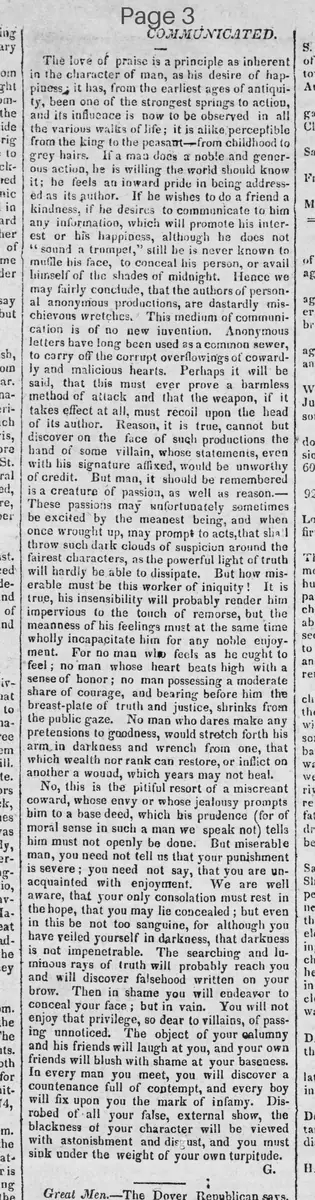
The love of praise is a principle as inherent in the character of man, as his desire of happiness; it has, from the earliest ages of antiquity, been one of the strongest springs to action, and its influence is now to be observed in all the various walks of life; it is alike perceptible from the king to the peasant--from childhood to grey hairs. If a man does a noble and generous action, he is willing the world should know it: he feels an inward pride in being addressed as its author. If he wishes to do a friend a kindness, if he desires to communicate to him any information, which will promote his interest or his happiness, although he does not "sound a trumpet," still he is never known to muffle his face, to conceal his person, or avail himself of the shades of midnight. Hence we may fairly conclude, that the authors of personal anonymous productions, are dastardly mischievous wretches. This medium of communication is of no new invention. Anonymous letters have long been used as a common sewer, to carry off the corrupt overflowings of cowardly and malicious hearts. Perhaps it will be said, that this must ever prove a harmless method of attack and that the weapon, if it takes effect at all, must recoil upon the head of its author. Reason, it is true, cannot but discover on the face of such productions the hand of some villain, whose statements, even with his signature affixed, would be unworthy of credit. But man, it should be remembered is a creature of passion, as well as reason. These passions may unfortunately sometimes be excited by the meanest being, and when once wrought up, may prompt to acts, that shall throw such dark clouds of suspicion around the fairest characters, as the powerful light of truth will hardly be able to dissipate. But how miserable must be this worker of iniquity! It is true, his insensibility will probably render him impervious to the touch of remorse, but the meanness of his feelings must at the same time wholly incapacitate him for any noble enjoyment. For no man who feels as he ought to feel; no man whose heart beats high with a sense of honor; no man possessing a moderate share of courage, and bearing before him the breast-plate of truth and justice, shrinks from the public gaze. No man who dares make any pretensions to goodness, would stretch forth his arm in darkness and wrench from one, that which wealth nor rank can restore, or inflict on another a wound, which years may not heal. No, this is the pitiful resort of a miscreant coward, whose envy or whose jealousy prompts him to a base deed, which his prudence (for of moral sense in such a man we speak not) tells him must not openly be done. But miserable man, you need not tell us that your punishment is severe; you need not say, that you are unacquainted with enjoyment. We are well aware, that your only consolation must rest in the hope, that you may lie concealed; but even in this be not too sanguine, for although you have veiled yourself in darkness, that darkness is not impenetrable. The searching and luminous rays of truth will probably reach you and will discover falsehood written on your brow. Then in shame you will endeavor to conceal your face; but in vain. You will not enjoy that privilege, so dear to villains, of passing unnoticed. The object of your calumny and his friends will laugh at you, and your own friends will blush with shame at your baseness. In every man you meet, you will discover a countenance full of contempt, and every boy will fix upon you the mark of infamy. Disrobed of all your false, external show, the blackness of your character will be viewed with astonishment and disgust, and you must sink under the weight of your own turpitude.
G.
The love of praise is a principle as inherent in the character of man, as his desire of happiness; it has, from the earliest ages of antiquity, been one of the strongest springs to action, and its influence is now to be observed in all the various walks of life; it is alike perceptible from the king to the peasant--from childhood to grey hairs. If a man does a noble and generous action, he is willing the world should know it: he feels an inward pride in being addressed as its author. If he wishes to do a friend a kindness, if he desires to communicate to him any information, which will promote his interest or his happiness, although he does not "sound a trumpet," still he is never known to muffle his face, to conceal his person, or avail himself of the shades of midnight. Hence we may fairly conclude, that the authors of personal anonymous productions, are dastardly mischievous wretches. This medium of communication is of no new invention. Anonymous letters have long been used as a common sewer, to carry off the corrupt overflowings of cowardly and malicious hearts. Perhaps it will be said, that this must ever prove a harmless method of attack and that the weapon, if it takes effect at all, must recoil upon the head of its author. Reason, it is true, cannot but discover on the face of such productions the hand of some villain, whose statements, even with his signature affixed, would be unworthy of credit. But man, it should be remembered is a creature of passion, as well as reason. These passions may unfortunately sometimes be excited by the meanest being, and when once wrought up, may prompt to acts, that shall throw such dark clouds of suspicion around the fairest characters, as the powerful light of truth will hardly be able to dissipate. But how miserable must be this worker of iniquity! It is true, his insensibility will probably render him impervious to the touch of remorse, but the meanness of his feelings must at the same time wholly incapacitate him for any noble enjoyment. For no man who feels as he ought to feel; no man whose heart beats high with a sense of honor; no man possessing a moderate share of courage, and bearing before him the breast-plate of truth and justice, shrinks from the public gaze. No man who dares make any pretensions to goodness, would stretch forth his arm in darkness and wrench from one, that which wealth nor rank can restore, or inflict on another a wound, which years may not heal. No, this is the pitiful resort of a miscreant coward, whose envy or whose jealousy prompts him to a base deed, which his prudence (for of moral sense in such a man we speak not) tells him must not openly be done. But miserable man, you need not tell us that your punishment is severe; you need not say, that you are unacquainted with enjoyment. We are well aware, that your only consolation must rest in the hope, that you may lie concealed; but even in this be not too sanguine, for although you have veiled yourself in darkness, that darkness is not impenetrable. The searching and luminous rays of truth will probably reach you and will discover falsehood written on your brow. Then in shame you will endeavor to conceal your face; but in vain. You will not enjoy that privilege, so dear to villains, of passing unnoticed. The object of your calumny and his friends will laugh at you, and your own friends will blush with shame at your baseness. In every man you meet, you will discover a countenance full of contempt, and every boy will fix upon you the mark of infamy. Disrobed of all your false, external show, the blackness of your character will be viewed with astonishment and disgust, and you must sink under the weight of your own turpitude.
G.
What sub-type of article is it?
Philosophical
Ethical Moral
Reflective
What themes does it cover?
Morality
What keywords are associated?
Anonymous Letters
Cowardice
Morality
Honor
Calumny
Truth Exposure
Public Shame
What entities or persons were involved?
G.
Letter to Editor Details
Author
G.
Main Argument
authors of anonymous personal attacks are cowardly, malicious individuals who hide due to lack of honor, and truth will expose them to public shame and contempt.
Notable Details
Love Of Praise Inherent In Human Nature
Anonymous Letters As 'Common Sewer' For Malice
Man As Creature Of Passion And Reason
Breast Plate Of Truth And Justice