Thank you for visiting SNEWPapers!
Sign up free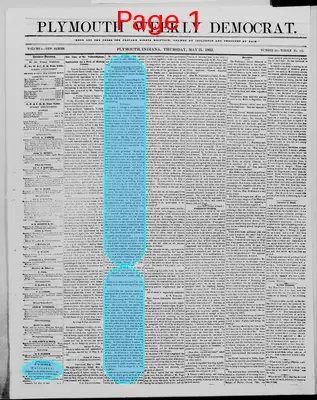
The Plymouth Weekly Democrat
Plymouth, Marshall County, Indiana
What is this article about?
During the Civil War, General A. E. Burnside submits a statement to the U.S. Circuit Court in Cincinnati justifying the arrest of Clement L. Vallandigham for violating General Order No. 38 by criticizing the government. Counsel argue over a habeas corpus writ, debating military authority and civil liberties.
Merged-components note: These three components form a single continuous article on the Vallandigham case court proceedings.
Clipping
OCR Quality
Full Text
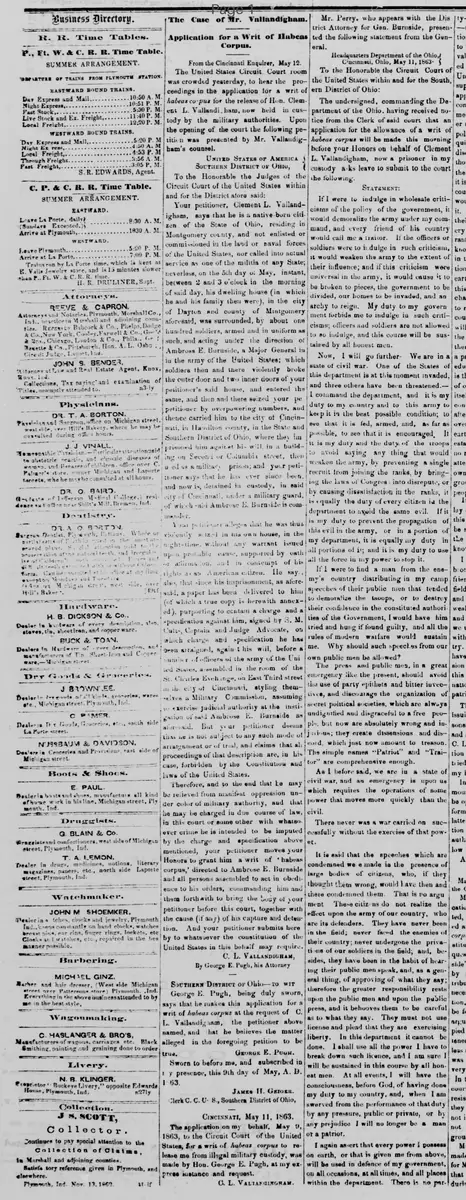
J. S. SCOTT
Collector
Continues to pay special attention to the Collection of Claims in Marshall and adjoining counties. Satisfactory reference given in Plymouth, and...
Mr. Perry, who appears with the District Attorney for Gen. Burnside, presented the following statement from the General.
Headquarters Department of the Ohio,
Cincinnati, Ohio, May 11, 1863.
To the Honorable the Circuit Court of the United States within and for the Southern District of Ohio:
The undersigned, commanding the Department of the Ohio, having received notice from the Clerk of said court that an application for the allowance of a writ of habeas corpus will be made this morning before your Honors on behalf of Clement L. Vallandigham, now a prisoner in my custody asks leave to submit to the court the following.
STATEMENT:
If I were to indulge in wholesale criticisms of the policy of the government, it would demoralize the army under my command, and every friend of his country would call me a traitor. If the officers or soldiers were to indulge in such criticism, it would weaken the army to the extent of their influence: and if this criticism were universal in the army, it would cause it to be broken to pieces, the government to be divided, our homes to be invaded, and anarchy to reign. My duty to my government forbids me to indulge in such criticisms; officers and soldiers are not allowed to so indulge, and this course will be sustained by all honest men.
Now, I will go further- We are in a state of civil war. One of the States of this department is at this moment invaded, and three others have been threatened. I command the department, and it is my duty to my country and to this army to keep it in the best possible condition; to see that it is fed, armed, and, as far as possible, to see that it is encouraged. It is my duty and the duty of the troops to avoid saying anything that would weaken the army, by preventing a single recruit from joining the ranks, by bringing the laws of Congress into disrepute, or by causing dissatisfaction in the ranks. It is equally the duty of every citizen in the department to avoid the same evil. If it is my duty to prevent the propagation of this evil in the army, or in a portion of my department, it is equally my duty in all portions of it; and it is my duty to use all the force in my power to stop it.
If I were to find a man from the enemy's country distributing in my camp speeches of their public men that tended to demoralize the troops, or to destroy their confidence in the constituted authorities of the Government, I would have him tried and hung if found guilty, and all the rules of modern warfare would sustain me. Why should such speeches from our own public men be allowed?
The press and public men, in a great emergency like the present, should avoid the use of party epithets and bitter invectives, and discourage the organization of secret political societies, which are always undignified and disgraceful to a free people, but now are absolutely wrong and injurious; they create dissensions and discord, which just now amount to treason. The simple names 'Patriot' and 'Traitor' are comprehensive enough.
As I before said, we are in a state of civil war, and an emergency is upon us which requires the operations of some power that moves more quickly than the civil.
There never was a war carried on successfully without the exercise of that power.
It is said that the speeches which are condemned were made in the presence of large bodies of citizens, who, if they thought them wrong, would have then and there condemned them. That is no argument. These citizens do not realize the effect upon the army of our country, who are its defenders. They have never been in the field; never faced the enemies of their country; never undergone the privations of our soldiers in the field; and, besides, they have been in the habit of hearing their public men speak, and, as a general thing, of approving of what they say; therefore the greater responsibility rests upon the public men and upon the public press, and it behooves them to be careful as to what they say. They must not use license and plead that they are exercising liberty. In this department it cannot be done. I shall use all the power I have to break down such license, and I am sure I will be sustained in this course by all honest men. At all events, I will have the consciousness, before God, of having done my duty to my country, and, when I am swerved from the performance of that duty by any pressure, public or private, or by any prejudice I will no longer be a man or a patriot.
I again assert that every power I possess on earth, or that is given me from above, will be used in defence of my government, on all occasions, at all times, and all places within the department. There is no party--no community--no State government--no State legislative body--no corporation or body of men, that have the power to inaugurate a war policy that has the validity of law and power but the constituted authorities of the government of the United States; and I am determined to support their policy. If the people do not approve that policy, they can change the constitutional authorities of that government, at the proper time and by the proper method. Let them freely discuss the policy in a proper tone; but my duty requires me to stop license and intemperate discussion, which tend to weaken the authority of the government and army; while the latter is in the presence of the enemy it is cowardly so to weaken it. This license could not be used to our camps; the man would be torn to pieces who would attempt it. There is no fear of the people losing their liberties; we all know that to be the cry of demagogues, and none but the ignorant will listen to it. All intelligent men know that our people are too far advanced in the scale of religion, civilization, education, and freedom, to allow any power on earth to interfere with their liberties; but this same advancement in these great characteristics of our people teaches them to make all necessary sacrifice for their country, when emergency requires. They will support the constituted authorities of the government, whether they agree with them or not. Indeed, the army itself is a part of the people, and is so thoroughly educated in the love of civil liberty, which is the best guarantee for the permanence of our republican institutions, that it would itself be the first to oppose any attempt to continue the exercise of military authority after the establishment of peace by the overthrow of the rebellion. No man on earth can lead our citizen soldiery to the establishment of a military despotism, and no man living would have the folly to attempt it. To do so would be to seal his own doom. On this point there can be no ground for apprehension on the part of the people.
It is said that we can have peace if we lay down our arms. All sensible men know this to be untrue. Were it so, ought we to be so cowardly as to lay them down until the authority of the government is acknowledged?
I beg to call upon the father, mother, brothers, sisters, sons, daughters, relatives, friends and neighbors of the soldiers in the field, to aid me in stopping this license and intemperate discouraging our armies, weakening the hands of the government, and thereby strengthening the enemy. If we use our honest efforts, God will bless us with a glorious peace and a united country. Men of every shade of opinion have the same vital interest in the suppression of the rebellion; for, should we fail in this task the dread horrors and distracted nation will fall alike on all, whether patriots or traitors.
These are, substantially, my reasons for issuing 'General Order No. 38:' my reasons for the determination to enforce it; and also my reasons for the arrest of Hon. C. L. Vallandigham, for a supposed violation of that order, for which he has been tried. The result of that trial is now in my hands.
In enforcing this order, I can be unanimously sustained by the people, and I can be opposed by factious, bad men. In the former event, quietness will prevail; in the latter event, the responsibility and retribution will attach to the men who resist the authority and the neighborhood that allow it.
All of which is respectfully submitted.
A. E. BURNSIDE,
Major General, Commanding Department of the Ohio.
Mr. Pugh then moved that the application for a writ of habeas corpus be granted, and proceeded in a lengthy and learned argument to discuss the writ of habeas corpus, indemnity act, articles of war, constitutional provisions touching on the question of personal liberty, Gen. Burnside's answers, which he took up paragraph by paragraph, and closed by an eloquent tribute to the Federal compact, and the necessity for its perpetuity and preservation, that its laws and constitution shall be faithfully and jealously observed. The argument of the distinguished jurist occupied three hours in delivery, and was listened to with profound interest and breathless attention. The citation of authorities was immense, and the deductions made very searching and elaborate.
In the course of Mr. Pugh's argument, the court interposed and asked counsel who resisted the application to state what points they proposed raising why the writ should not issue--the statement of Gen. Burnside not stating clearly and distinctly the grounds of objection.
Mr. Perry replied that the objections made were, that the affidavit of Mr. Pugh for Mr. Vallandigham was insufficient, and that the arrest was made by the military during the existence of actual war, and though I am as if the army were in the field.
Intimations being made by Mr. Perry that the General was acting under martial law, the court inquired for proof that this district was under martial law, to which Mr. Perry answered: 'General historical knowledge.'
After Mr. Pugh had concluded, Mr. Perry stated that he was called by General Burnside to assist the District Attorney, without any instructions as to what course to pursue. He then proceeded to review the form of the proceedings. Counsel for Mr. Vallandigham had intimated that the question now before this court would be taken up to the Supreme Court on a writ of error. In the discussion of the main question, Mr. Perry claimed that the arrest was legal, and, as the issuing of the writ would be nugatory in its operations, it should not be issued by the court. The affidavit does not deny that the prisoner is guilty of the charges preferred by Gen. Burnside. If such speeches are permitted to be delivered and distributed throughout the army in the field, and the freedom of the mails in their transportation tolerated, then the entire effect in demoralization will be produced. The learned gentleman then reviewed the commencement of the rebellion, and how the civil powers were compelled to throw themselves upon the military arm of the government for protection. Civil remedy was no remedy. Now, this discussion is going on within a garrison and protected by fortifications mounted with cannon. This court owes its existence to the military power. It was necessary for the morale of the army that public appeals against the government and continued crusades against the war should stop. It was the merest farce to put a military commander here that could not suppress such a thing, and to make an army efficient it is necessary to protect armies against all such disorganizing influences. He believed that martial law ipso facto existed, and under that existence Gen. Burnside derived his authority to act. Mr. Perry cited numerous decisions and authorities in support of his argument. The court adjourned until this morning at 9:30, when the argument will be resumed by Mr. Perry, and closed by Messrs. Bell and Pugh.
What sub-type of article is it?
What themes does it cover?
What keywords are associated?
What entities or persons were involved?
Where did it happen?
Story Details
Key Persons
Location
Cincinnati, Ohio; Southern District Of Ohio
Event Date
May 11, 1863
Story Details
General Burnside defends the arrest of Vallandigham for anti-war speeches violating Order No. 38, arguing military necessity during civil war. Counsel debate habeas corpus application, with Pugh advocating for civil liberties and Perry supporting military authority under martial law.