Thank you for visiting SNEWPapers!
Sign up free
Daily National Intelligencer
Washington, District Of Columbia
What is this article about?
Proceedings of the U.S. Senate and House on December 6: new members join, committees appointed, petitions presented, President's Message referred to select committees on various topics including foreign affairs, military, navy, currency, roads, militia organization, and war-related burdens; debates on compensating state-called militia from the late war.
Merged-components note: These two components continue the same story on congressional proceedings in sequential reading order.
Clipping
OCR Quality
Full Text
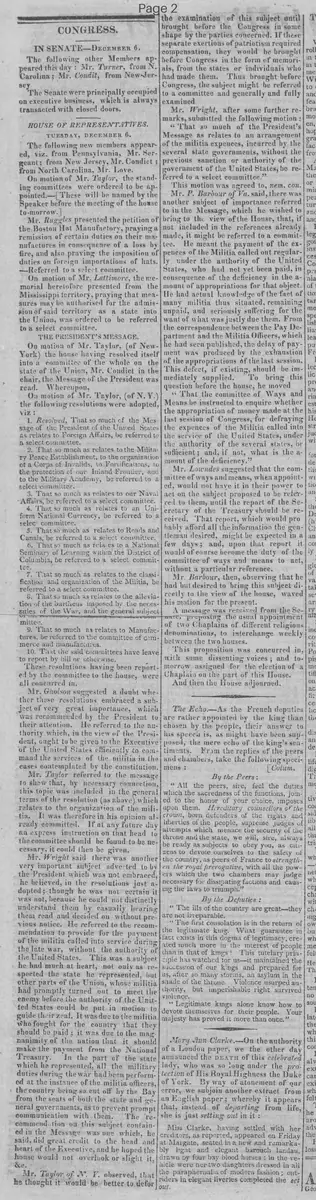
SENATE--December 6.
The following other Members appeared this day: Mr. Turner, from N. Carolina; Mr. Condit, from New-Jersey.
The Senate were principally occupied on executive business, which is always transacted with closed doors.
HOUSE OF REPRESENTATIVES
TUESDAY, DECEMBER 6.
The following new members appeared, viz. from Pennsylvania, Mr. Sergeant; from New Jersey, Mr. Condict: from North Carolina, Mr. Love.
On motion of Mr. Taylor, the standing committees were ordered to be appointed. These will be named by the Speaker before the meeting of the house to-morrow.
Mr. Ruggles presented the petition of the Boston Hat Manufactory, praying a remission of certain duties on their manufactures in consequence of a loss by fire, and also praying the imposition of duties on foreign importations of hats.
Referred to a select committee.
On motion of Mr. Lattimore, the memorial heretofore presented from the Mississippi territory, praying that measures may be authorised for the admission of said territory as a state into the Union, was ordered to be referred to a select committee.
THE PRESIDENT'S MESSAGE,
On motion of Mr. Taylor, (of New-York) the house having resolved itself into a committee of the whole on the state of the Union, Mr. Condict in the chair, the Message of the President was read. Whereupon,
On motion of Mr. Taylor, (of N. Y.) the following resolutions were adopted, viz:
1. Resolved, That so much of the Message of the President of the United States as relates to Foreign Affairs, be referred to a select committee.
2. That so much as relates to the Military Peace Establishment, to the organization of a Corps of Invalids, to Fortifications, to the protection of our Inland Frontier, and to the Military Academy, be referred to a select committee.
3. That so much as relates to our Naval Affairs, be referred to a select committee.
4. That so much as relates to an Uniform National Currency, be referred to a select committee.
5. That so much as relates to Roads and Canals, be referred to a select committee.
6. That so much as relates to a National Seminary of Learning within the District of Columbia, be referred to a select committee.
7. That so much as relates to the classification and organization of the Militia, be referred to a select committee.
8. That so much as relates to the alleviation of the burthens imposed by the necessities of the War, and the general subject, be referred to a select committee.
9. That so much as relates to Manufactures, be referred to the committee of commerce and manufactures.
10. That the said committees have leave to report by bill or otherwise.
These resolutions having been reported by the committee to the house, were all concurred in.
Mr. Gholson suggested a doubt whether these resolutions embraced a subject of very great importance, which was recommended by the President to their attention. He referred to the authority which, in the view of the President, ought to be given to the Executive of the United States efficiently to command the services of the militia in the cases contemplated by the constitution.
Mr. Taylor referred to the message to shew that, by necessary connection, this topic was included in the general terms of the resolution (as above) which relates to the organization of the militia. It was therefore in his opinion already committed. If at any future day an express instruction on that head to the committee should be found to be necessary, it could then be given.
Mr. Wright said there was another very important subject adverted to by the President which was not embraced, he believed, in the resolutions just adopted;—though he was not certain it was not, because he could not distinctly understand them by casually hearing them read and decided on without previous notice. He referred to the recommendation to provide for the payment of the militia called into service during the late war, without the authority of the United States. This was a subject he had much at heart, not only as respected the state he represented, but other parts of the Union, whose militia had promptly turned out to meet the enemy before the authority of the United States could be put in motion to guide their zeal. It was due to the militia who fought for the country that they should be paid; it was due to the magnanimity of the nation that it should make the payment from the National Treasury. In the part of the state which he represented, all the military duties during the war had been performed at the instance of the militia officers, the country being so cut off by the Bay from the seats of both the state and general governments, as to prevent prompt communication with them. The recommendation on this subject contained in the Message was one which, he said, did great credit to the head and heart of the Executive, and he hoped the house would not overlook or slight it, &c.
Mr. Taylor of N. Y. observed, that he thought it would be better to defer
the examination of this subject until brought before the Congress in some shape by the parties concerned. If these separate exertions of patriotism required compensation, they would be brought before Congress in the form of memorials, from the states or individuals who had made them. Thus brought before Congress, the subject might be referred to a committee and generally and fully examined.
Mr. Wright, after some further remarks, submitted the following motion:
"That so much of the President's Message as relates to an arrangement of the militia expences, incurred by the several state governments, without the previous sanction or authority of the government of the United States, be referred to a select committee."
This motion was agreed to. nem. con.
Mr. P. A. Barbour of Va. said, there was another subject of importance referred to in the Message, which he wished to bring to the view of the House, that, if not included in the references already made, it might be referred to a committee. He meant the payment of the expences of the Militia called out regularly under the authority of the United States, who had not yet been paid, in consequence of the deficiency in the amount of appropriations for that object. He had actual knowledge of the fact of many militia thus situated, remaining unpaid, and seriously suffering for the want of what was justly due them. From the correspondence between the Pay Department and the Militia Officers, which he had seen published, the delay of payment was produced by the exhaustion of the appropriations of the last session. This defect, if existing, should be immediately supplied. To bring this question before the house, he moved
"That the committee of Ways and Means be instructed to enquire whether the appropriation of money made at the last session of Congress, for defraying the expences of the Militia called into the service of the United States, under the authority of the several states, be sufficient: and, if not, what is the amount of the deficiency."
Mr. Lowndes suggested that the committee of ways and means, when appointed, would not have it in their power to act on the subject proposed to be referred to them, until the report of the Secretary of the Treasury should be received. That report, which would probably afford all the information the gentleman desired, might be expected in a few days; and, upon that report it would of course become the duty of the committee of ways and means to act, without a particular reference.
Mr. Barbour, then, observing that he had but desired to bring this subject directly to the view of the house, waved his motion for the present.
A message was received from the Senate, proposing the usual appointment of two Chaplains of different religious denominations, to interchange weekly between the two houses.
This proposition was concurred in, with some dissenting voices; and to-morrow assigned for the election of a Chaplain on the part of this House.
And then the House adjourned.
What sub-type of article is it?
What themes does it cover?
What keywords are associated?
What entities or persons were involved?
Where did it happen?
Story Details
Key Persons
Location
United States Congress
Event Date
December 6
Story Details
Report of Senate and House of Representatives proceedings on December 6, including new members' appearances, appointment of standing committees, petitions on hat manufactory duties and Mississippi territory statehood, referral of President's Message sections to select committees on foreign affairs, military, naval, currency, roads, seminary, militia, war burdens, and manufactures; discussions on militia command authority, payments for unsanctioned and authorized service during the late war, with motions to refer and inquire into deficiencies.