Thank you for visiting SNEWPapers!
Sign up free
Gazette Of The United States
New York, New York County, New York
What is this article about?
A letter defends the U.S. government against accusations of an aristocratic cabal suppressing public knowledge of religion and government. It cites President Washington's speeches promoting science, literature, and post-office improvements for information dissemination, and Vice-President Adams' advocacy for public education to prevent ignorance.
Clipping
OCR Quality
Full Text
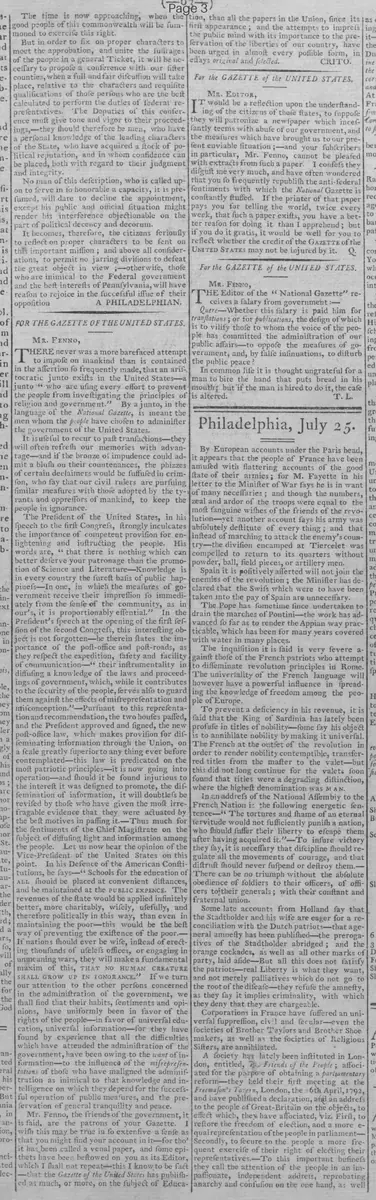
MR. FENNO,
There never was a more barefaced attempt to impose on mankind than is contained in the assertion so frequently made, that an aristocratic junto exists in the United States—a junto "who are using every effort to prevent the people from investigating the principles of religion and government." By a junto, in the language of the National Gazette, is meant the men whom the people have chosen to administer the government of the United States.
It is useful to recur to past transactions—they will often refresh our memories with advantage—and if the bronze of impudence could admit a blush on their countenances, the phizzes of certain declaimers would be suffused in crimson, who say that our civil rulers are pursuing similar measures with those adopted by the tyrants and oppressors of mankind, to keep the people in ignorance.
The President of the United States, in his speech to the first Congress, strongly inculcates the importance of competent provision for enlightening and instructing the people. His words are, "that there is nothing which can better deserve your patronage than the promotion of Science and Literature—Knowledge is in every country the surest basis of public happiness—In one, in which the measures of government receive their impression so immediately from the sense of the community, as in ours, it is proportionably essential." In the President's speech at the opening of the first session of the second Congress, this interesting object is not forgotten—he therein states the importance of the post-office and post-roads, as they respect the expedition, safety and facility of communication—“their instrumentality in diffusing a knowledge of the laws and proceedings of government, which, while it contributes to the security of the people, serves also to guard them against the effects of misrepresentation and misconception.”—Pursuant to this representation and recommendation, the two houses passed, and the President approved and signed, the new post-office law, which makes provision for disseminating information through the Union, on a scale greatly superior to any thing ever before contemplated—this law is predicated on the most patriotic principles—it is now going into operation—and should it be found injurious to the interest it was designed to promote, the dissemination of information, it will doubtless be revised by those who have given the most irrefragable evidence that they were actuated by the best motives in passing it.—Thus much for the sentiments of the Chief Magistrate on the subject of diffusing light and information among the people. Let us now hear the opinion of the Vice-President of the United States on this point. In his Defence of the American Constitutions, he says—“Schools for the education of ALL should be placed at convenient distances, and be maintained at the PUBLIC ExpENCE. The revenues of the state would be applied infinitely better, more charitably, wisely, usefully, and therefore politically in this way, than even in maintaining the poor—this would be the best way of preventing the existence of the poor.—If nations should ever be wise, instead of erecting thousands of useless offices, or engaging in unmeaning wars, they will make a fundamental maxim of this, THAT NO HUMAN CREATURE SHALL GROW UP IN IGNORANCE." If we turn our attention to the other persons concerned in the administration of the government, we shall find that their habits, sentiments and opinions, have uniformly been in favor of the rights of the people—in favor of universal education, universal information—for they have found by experience that all the difficulties which have attended the administration of the government, have been owing to the want of information—to the influence of the misrepresentations of those who have maligned the administration as inimical to that knowledge and intelligence on which they depend for the successful operation of public measures, and the preservation of general tranquility and peace.
Mr. Fenno, the friends of the government, it is said, are the patrons of your Gazette. I wish this may be true in so extensive a sense as that you might find your account in it—for tho' it has been called a venal paper, and some epithets have been bestowed on you as its Editor, which I shall not repeat—this I know to be fact—that the Gazette of the United States has published as much, or more, on the subject of Education, than all the papers in the Union, since its first appearance; and the attempts to impress the public mind with its importance to the preservation of the liberties of our country, have been urged in almost every possible form, in essays original and selected.
CRITO.
What sub-type of article is it?
What themes does it cover?
What keywords are associated?
What entities or persons were involved?
Letter to Editor Details
Author
Crito.
Recipient
Mr. Fenno,
Main Argument
the u.s. administration is not an aristocratic junto suppressing public knowledge; instead, leaders like washington and adams actively promote education, information dissemination via post-office laws, and universal schooling to enlighten the people and counter misrepresentations.
Notable Details