Thank you for visiting SNEWPapers!
Sign up free
The Enquirer
Richmond, Henrico County, Virginia
What is this article about?
Reports from various U.S. ports detail the arrival of combined French and Spanish fleets at Martinique in mid-May, consisting of 16-22 ships of the line, frigates, and 8,000-15,000 troops under Admirals Villeneuve and Gravina, and General Lauriston. The fleets are preparing for potential attacks on British West India colonies like Jamaica, amid concerns over economic impacts on British commerce. Economic analysis highlights the West Indies' vital role in British imports, valued at one-third of total maritime commerce in 1801.
Clipping
OCR Quality
Full Text
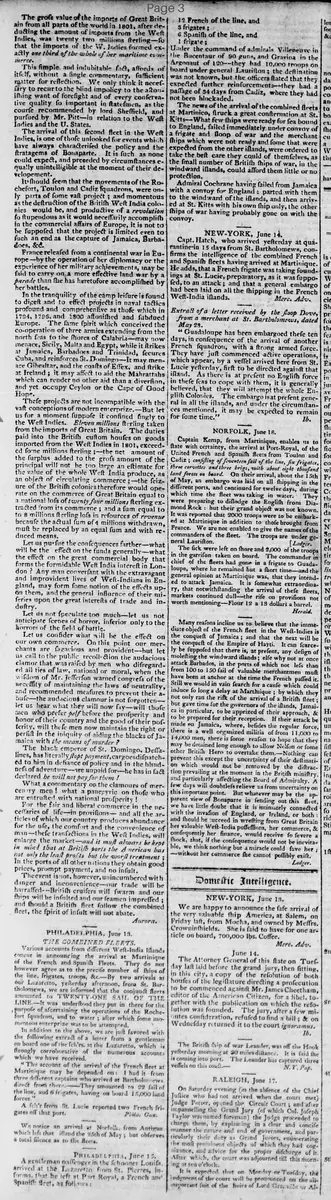
This important and indubitable fact, affords of itself, without a single commentary, sufficient matter for reflection. We only think it necessary to recur to the blind impolicy, the astonishing want of foresight and of every conservative quality so important in statesmen, as the course recommended by Lord Sheffield, and pursued by Mr. Pitt—in relation to the West Indies and the U. States.
The arrival of this second fleet in the West Indies, is one of those unlooked for events which have always characterized the policy and the stratagems of Bonaparte. It is such as none could expect, and preceded by circumstances equally unintelligible at the moment of their development.
It should seem that the movements of the Rochefort, Toulon and Cadiz squadrons, were only parts of some vast project; and momentous as the destruction of the British West India colonies would be, and productive of a revolution so stupendous as it would necessarily accomplish in the commercial affairs of Europe, it is not to be supposed that the project is limited even to such an end as the capture of Jamaica, Barbadoes, &c.
France released from a continental war in Europe—by the operation of her diplomacy or the experience of her military achievements, may be said to carry on a more effective land war by a parade than she has heretofore accomplished by her battles.
In the tranquility of the camp leisure is found to digest and to effect projects in naval tactics profound and comprehensive as those which in 1794, 1795, and 1800 astonished and subdued Europe. The same spirit which conceived the co-operation of three armies extending from the north seas to the shores of Calabria—may now menace, Sicily, Malta and Egypt, while it strikes at Jamaica, Barbadoes and Trinidad, secures Cuba, and reinforces St. Domingo—It may menace Gibraltar, and the coasts of Essex, and strike at Ireland; it may affect to aid the Mahrattas which can render no other aid than a diversion, and yet occupy Ceylon or the Cape of Good Hope.
These projects are not incompatible with the vast conceptions of modern enterprize.—But let us for a moment suppose it confined singly to the West Indies. Eleven millions sterling taken from the imports of Great Britain. The duties paid into the British custom houses on goods imported from the West Indies in 1801, exceeded some millions sterling—the net amount of the surplus added to the gross amount of the principal will not be too large an estimate for the value of the whole West India produce, as an object of circulating commerce—the seizure of the British colonies therefore would operate on the commerce of Great Britain equal to a national loss of twenty four millions sterling extracted from its commerce; and a sum equal to 8 millions sterling loss in resources of revenue because the actual sum of 4 millions withdrawn, must be replaced by an equal sum and with reduced means.
Let us pursue the consequences farther—what will be the effect on the funds generally—what the effect on the great commercial body that forms the formidable West India interest in London? Any man conversant with the extravagant and improvident lives of West-Indians in England, may form some notion of the effects upon them, and the general influence of their miseries upon the great interests of trade and industry.
Let us not speculate too much—let us not anticipate scenes of horror, inferior only to the horrors of the field of battle.
Let us consider what will be the effect on our own commerce. On this point our merchants are sagacious and provident—but let us call to the public recollection the audacious clamor that was raised by men who disregarded all ties of law, national or moral, when the wisdom of Mr. Jefferson warned congress of the necessity of maintaining the laws of neutrality, and recommended measures to prevent their abuse—the audacious clamour is not forgotten—let us hear what they will now say—will those men who prefer pelf before the prosperity and honor of their country and the good of their posterity, will these men now maintain the right or persist in the iniquity of aiding the blacks of Jamaica with the means of murder?
The black emperor of St. Domingo. Dessalines, has literally stopped payment, cargoes dispatched to him in defiance of policy and in the blindness of adventure—are unpaid for—he has in fact declared he will not pay for them!
What a commentary on the clamours of mercenery men! what a panegyric on those who are entrusted with national prosperity!
For the fair and liberal commerce in the necessaries of life—in provisions—and all the articles of which our country produces abundance for the use, the comfort and the convenience of man—these transactions in the West Indies, will enlarge the market—and it must always be kept in mind that at British ports the American has not only the least profits but the worst treatment; In the ports of all other nations they obtain good prices, prompt payment, and no insult.
The event is not, however, unincumbered with danger and inconvenience—our trade will be harassed—British cruisers will warn and our ships will be insulted and our seamen impressed; and should a British fleet follow the combined fleet, the spirit of insult will not abate.
Aurora.
PHILADELPHIA, June 13.
THE COMBINED FLEETS.
Various accounts from different West-India Islands concur in announcing the arrival at Martinique of the French and Spanish Fleets. They do not however agree as to the precise number of ships of the line, frigates, troops, &c. By two arrivals at our Lazaretto, yesterday afternoon, from St. Bartholomew's, we are informed that the conjunct fleets amounted to TWENTY-ONE SAIL OF THE LINE.—It was understood they put in there for the purpose of ascertaining the operations of the Rochefort squadron, and to water; after which some momentous enterprize was to be attempted.
In addition to the above, we are just favored with the following extract of a letter from a gentleman on board one of the schrs. at the Lazaretto, which is strongly corroborative of the numerous accounts which we have received.
"The account of the arrival of the French fleet at Martinique may be depended on: I had it from three different captains who arrived at Bartholomew's direct from there.—They amounted to 22 sail of the line, and 6 frigates, having on board 15,000 land forces"
A Sch'r from St. Lucie reported two French frigates off that port.
Phila. Gaz.
We notice an arrival at Norfolk, from Antigua which left that island the 25th of May; but observes a total silence as to the fleets.
PHILADELPHIA, June 15.
A gentleman passenger in the schooner Louisa, arrived at the Lazaretto from St. Pierres, informs, that he left at Port Royal, a French and Spanish Fleet, as follows:
16 French of the line, and 6 frigates;
6 Spanish of the line, and 1 frigate:
Under the command of admirals Villeneuve in the Bucentaur of 90 guns, and Gravina in the Argonaut of 120—they had 10,000 troops on board under general Lauriston; the destination was not known, but the officers stated that they expected further reinforcements—they had a passage of 34 days from Cadiz, where they had not been blockaded.
The news of the arrival of the combined fleets at Martinico, struck a great consternation at St. Kitts—What few ships were ready for sea bound to England, sailed immediately under convoy of a frigate and sloop of war and the merchant ships which were not ready and some that were expected from the other islands, were ordered to take the best care they could of themselves, as the small number of British Ships of war, in the windward islands, could afford them little or no protection.
Admiral Cochrane having sailed from Jamaica with a convoy for England: parted with them to the windward of the islands, and then arrived at St. Kitts with his own ship only, the other ships of war having probably gone on with the convoy.
NEW-YORK, June 14.
Capt. Hatch, who arrived yesterday at quarantine in 15 days from St. Bartholomews, confirms the intelligence of the combined French and Spanish fleets having arrived at Martinique. He adds, that a French frigate was taking soundings at St. Lucie, preparatory, as it was supposed, to an attack; and that a general embargo had been laid on all the shipping in the French West-India islands.
Merc. Adv.
Extract of a letter received by the sloop Dove, from a merchant at St. Bartholemew's, dated May 28.
"Guadaloupe has been embargoed these ten days, in consequence of the arrival of another French squadron, with a strong armed force. They have just commenced active operations, which appear, by a vessel arrived here from St. Lucie yesterday, first to be directed against that island. As there is at present no English force in these seas to cope with them, it is generally believed, that they will attempt the whole English Colonies. The embargo is at present general in all the islands, and under the circumstances mentioned, it may be expected to remain for some time."
Ib.
NORFOLK, June 18.
Captain Kemp, from Martinique, enables us to state with certainty, the arrival at Port-Royal, of the United French and Spanish fleets from Toulon and Cadiz; consisting of seventeen sail of the line, six frigates, three corvettes and three brigs, with about eight thousand land forces on board. On their arrival, about the 15th of May, an embargo was laid on all shipping in the different ports, and continued for twelve days, during which time the fleet was taking in water. They were preparing to dislodge the English from Diamond Rock: but their grand object was not known. It was reported that 2000 troops were to be embarked at Martinique in addition to those brought from France. We are not enabled to give the names of the commanders of the fleet. The troops are under general Lauriton.
[Ledger.]
The sick were left on shore and 2,000 of the troops in the garrison taken on board. The commander in chief of the fleets had gone in a frigate to Guadaloupe, where he remained but a short time—and the general opinion at Martinique was, that they intended to attack Jamaica. It is somewhat extraordinary, that notwithstanding the arrival of these fleets markets continued dull—the rise on provisions not worth mentioning—Flour 12 a 13 dollars a barrel.
Herald.
Many reasons incline us to believe that the immediate object of the French fleet in the West-Indies is the conquest of Jamaica; and that the next will be the conquest of the Empire of Hayti. It can scarcely be supposed that there is, at present, any design of molesting the windward islands; else why not at once attack Barbados, in the ports of which not less than from 100 to 150 sail of valuable merchantmen must have been at anchor at the time the French passed it. Still we would in vain search for a cause which could induce so long a delay at Martinique; by which they not only ran the risk of the arrival of a British fleet; but gave time for the governors of the islands, Jamaica in particular, to be apprized of their approach, & to be prepared for their reception. If their attack be made on Jamaica, where, besides the regular force, there is a well organized militia of from 11,000 to 14,000 men, there is some reason to hope that they may be detained long enough to allow Nelson or some other British Hero to overtake them.—Nothing can prevent this except the uncertainty of their destination which would not be removed by the distraction prevailing at the moment in the British ministry. and particularly affecting the Board of Admiralty. A few days will doubtless relieve us from uncertainty on this important point. But whatever may be the apparent view of Bonaparte in sending out this fleet, we have little doubt that it is intimately connected with the invasion of England, or Ireland, or both: and should he succeed in wresting from Great Britain her valuable West-India possessions, her commerce, & consequently her finance, would receive so severe a shock, that, if the consequence would not be inevitable, we think nothing but a miracle could save her; —without her commerce she cannot possibly exist.
Ledger.
What sub-type of article is it?
What keywords are associated?
What entities or persons were involved?
Where did it happen?
Foreign News Details
Primary Location
Martinique, West Indies
Event Date
Arrival About The 15th Of May; Reports From June 13 18
Key Persons
Outcome
no battles reported; potential conquest of jamaica and other british colonies; economic loss to britain estimated at 24 millions sterling; embargoes on shipping; british convoys depart; markets remain dull
Event Details
Combined French and Spanish fleets from Toulon, Cadiz, and Rochefort arrive at Martinique with 16-22 ships of the line, 6-7 frigates, corvettes, brigs, and 8,000-15,000 troops. They water, embargo ports, prepare to dislodge English from Diamond Rock, and expect reinforcements. Suspected targets include Jamaica, Barbados, St. Kitts, St. Lucie, Guadaloupe, and broader threats to British commerce and colonies. British forces limited; Admiral Cochrane arrives alone at St. Kitts. Commentary on Napoleon's strategy and economic importance of West Indies to Britain, with U.S. trade implications and criticism of aiding Haitian revolutionaries.