Thank you for visiting SNEWPapers!
Sign up free
Story
November 4, 1849
The New York Herald
New York, New York County, New York
What is this article about?
In New York, black descendants of slaves hold a meeting at Putnam Hall, declare voting rights, endorse Whig candidates Seward for president and Douglas for vice president in 1852, likely tipping the upcoming election against Democrats with their 1000 votes.
Clipping
OCR Quality
95%
Excellent
Full Text
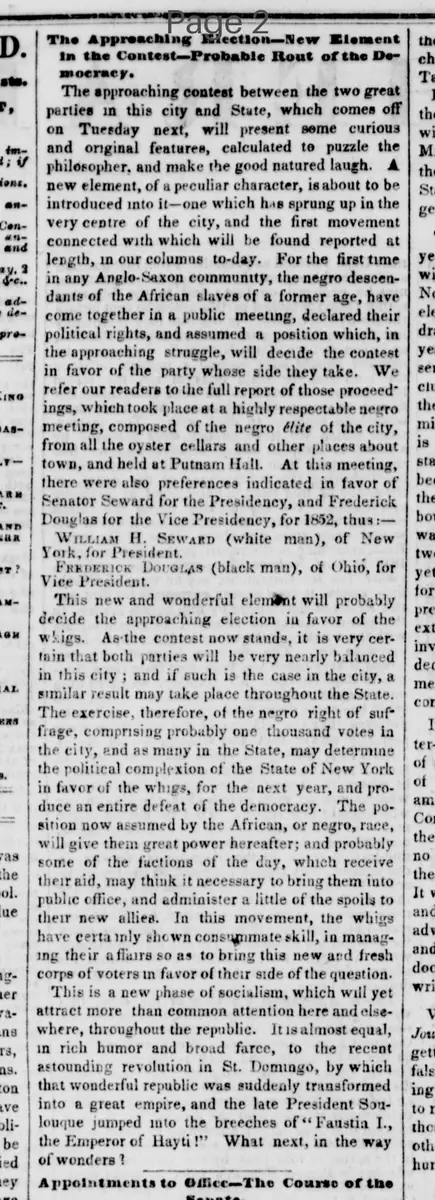
The Approaching Election—New Element in the Contest—Probable Rout of the Democracy.
The approaching contest between the two great parties in this city and State, which comes off on Tuesday next, will present some curious and original features, calculated to puzzle the philosopher, and make the good natured laugh.
A new element, of a peculiar character, is about to be introduced into it—one which has sprung up in the very centre of the city, and the first movement connected with which will be found reported at length, in our columns to-day. For the first time in any Anglo-Saxon community, the negro descendants of the African slaves of a former age, have come together in a public meeting, declared their political rights, and assumed a position which, in the approaching struggle, will decide the contest in favor of the party whose side they take. We refer our readers to the full report of those proceedings, which took place at a highly respectable negro meeting, composed of the negro élite of the city, from all the oyster cellars and other places about town, and held at Putnam Hall. At this meeting, there were also preferences indicated in favor of Senator Seward for the Presidency, and Frederick Douglas for the Vice Presidency, for 1852, thus:——
WILLIAM H. SEWARD (white man), of New York, for President.
FREDERICK DOUGLAS (black man), of Ohio, for Vice President.
This new and wonderful element will probably decide the approaching election in favor of the whigs. As the contest now stands, it is very certain that both parties will be very nearly balanced in this city; and if such is the case in the city, a similar result may take place throughout the State. The exercise, therefore, of the negro right of suffrage, comprising probably one thousand votes in the city, and as many in the State, may determine the political complexion of the State of New York in favor of the whigs, for the next year, and produce an entire defeat of the democracy. The position now assumed by the African, or negro, race, will give them great power hereafter; and probably some of the factions of the day, which receive their aid, may think it necessary to bring them into public office, and administer a little of the spoils to their new allies. In this movement, the whigs have certainly shown consummate skill, in managing their affairs so as to bring this new and fresh corps of voters in favor of their side of the question.
This is a new phase of socialism, which will yet attract more than common attention here and elsewhere, throughout the republic. It is almost equal, in rich humor and broad farce, to the recent astounding revolution in St. Domingo, by which that wonderful republic was suddenly transformed into a great empire, and the late President Soulouque jumped into the breeches of "Faustin I., the Emperor of Hayti!" What next, in the way of wonders?
The approaching contest between the two great parties in this city and State, which comes off on Tuesday next, will present some curious and original features, calculated to puzzle the philosopher, and make the good natured laugh.
A new element, of a peculiar character, is about to be introduced into it—one which has sprung up in the very centre of the city, and the first movement connected with which will be found reported at length, in our columns to-day. For the first time in any Anglo-Saxon community, the negro descendants of the African slaves of a former age, have come together in a public meeting, declared their political rights, and assumed a position which, in the approaching struggle, will decide the contest in favor of the party whose side they take. We refer our readers to the full report of those proceedings, which took place at a highly respectable negro meeting, composed of the negro élite of the city, from all the oyster cellars and other places about town, and held at Putnam Hall. At this meeting, there were also preferences indicated in favor of Senator Seward for the Presidency, and Frederick Douglas for the Vice Presidency, for 1852, thus:——
WILLIAM H. SEWARD (white man), of New York, for President.
FREDERICK DOUGLAS (black man), of Ohio, for Vice President.
This new and wonderful element will probably decide the approaching election in favor of the whigs. As the contest now stands, it is very certain that both parties will be very nearly balanced in this city; and if such is the case in the city, a similar result may take place throughout the State. The exercise, therefore, of the negro right of suffrage, comprising probably one thousand votes in the city, and as many in the State, may determine the political complexion of the State of New York in favor of the whigs, for the next year, and produce an entire defeat of the democracy. The position now assumed by the African, or negro, race, will give them great power hereafter; and probably some of the factions of the day, which receive their aid, may think it necessary to bring them into public office, and administer a little of the spoils to their new allies. In this movement, the whigs have certainly shown consummate skill, in managing their affairs so as to bring this new and fresh corps of voters in favor of their side of the question.
This is a new phase of socialism, which will yet attract more than common attention here and elsewhere, throughout the republic. It is almost equal, in rich humor and broad farce, to the recent astounding revolution in St. Domingo, by which that wonderful republic was suddenly transformed into a great empire, and the late President Soulouque jumped into the breeches of "Faustin I., the Emperor of Hayti!" What next, in the way of wonders?
What sub-type of article is it?
Historical Event
Curiosity
What themes does it cover?
Social Manners
Justice
What keywords are associated?
Election Contest
Negro Suffrage
Whig Victory
Political Rights
Seward Nomination
Douglas Vice President
What entities or persons were involved?
William H. Seward
Frederick Douglas
Where did it happen?
New York City And State, Putnam Hall
Story Details
Key Persons
William H. Seward
Frederick Douglas
Location
New York City And State, Putnam Hall
Event Date
Approaching Contest On Tuesday Next, For 1852
Story Details
Negro descendants hold public meeting at Putnam Hall, declare political rights, support Whigs, nominate Seward for President and Douglas for Vice President, potentially deciding election against Democracy.