Thank you for visiting SNEWPapers!
Sign up free
Editorial
August 10, 1814
The Enquirer
Richmond, Henrico County, Virginia
What is this article about?
Editorial criticizes British influence and corruption in America since 1797, highlighting hypocrisy of British adherents during the War of 1812, praising U.S. naval victories, and detailing incidents involving USS Essex and HMS Phoebe to expose British perfidy.
Clipping
OCR Quality
75%
Good
Full Text
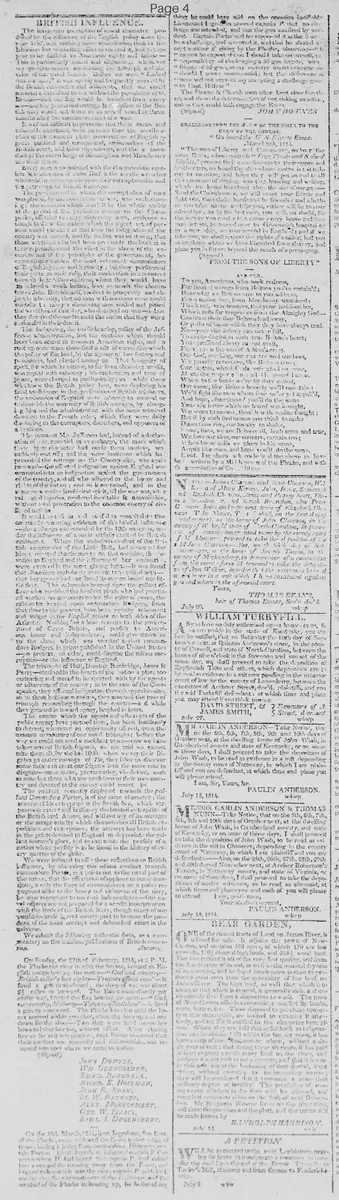
BRITISH INFLUENCE.
The inveterate corruption and character produced by the influence of the English policy since the year 1797, is in nothing more conspicuous, than in the laborious but ineffectual attempts to conceal it, and yet appear to be faithful to American rights and honor. It is particularly taken notice of and disgusting. Whenever any question occurs concerning the trade or the violated laws of the land, before we hear abroad the sea it was only frequently aroused by the British Resident and adherents that we could not send a sloop to sea without the permission of G. Britain—that our flag would be banished from every sea—and the proudest captains of the British navy would not leave an armed vessel in three months after the commencement of a war.
It was not difficult to perceive that the mean and despicable actions, were more than the servile class of the common place conversation of English agents, politicized and commented, ambassadors of the British court, and their stipendiaries, and the base adorers of the cotton kings of Birmingham and Manchester and their interests.
Every man is so acquainted with their characteristic egotism and those the servile wretches who exist on their corrupt credits and the degradation of British belonging.
The pressure in which this corrupt class of men was placed, by our declaration of war, was embarrassing: the sensation which was felt by the whole nation at the period of the perfidious capture on the Chesapeake, afforded to every discerning man, evidence enough to show the course which this abject set of persons would pursue: at that time the indignation of the country was roused, and the feeling was so strong, that those wretches who had been previously the loudest in their pronouncements around the victim in the abuse of the executive and of the principles of the government, became all of a sudden the most vehement denouncers of English injustice and barbarity; but they performed their parts so awkwardly, their toleration in a moment towards their fellow-citizens, whom they would have maligned a week before, bore so much the character of John Bull himself, insolent in prosperity and abject in adversity. that no man with common sense could mistake it: many a discerning man smiled and pitied the wretchedness of that day, who deceived no one unless they deceived themselves into the lotion that they were successful in their deceit.
The forbearance policy of the Jefferson administration, lost the occasion which should have been seized to re-assert American rights, and to root up once for all those fatal seeds of corruption which the policy of England, by the agency of her factors and pensioners, had planted among us. That benignity of spirit, for which its author, so far from obtaining credit, was repaid with calumny; his moderation and tone of peace, were charged as pusillanimity; and while those who knew the British policy best, were deploring his fatal confidence in the professions of British ministers, the emissaries of England were laboring to conceal or to diminish the enormity of British outrages, by charging upon our administration the same criminal devotion to the French rule, which they were daily dealing to the corrupters, disturbers, and opposers of all nations.
The moment Mr. Jefferson had, instead of a declaration of war, resorted to an embargo. the mask which their hypocritical character had made them assume, was suddenly cast off; and the same insolence which had preceded the outrage on the Chesapeake, was again renewed—the affected indignation against England was converted into an indignation against the government of the country, and all who adhered to the honor and rights of the nation; and so it continued, and in the same hypocritical spirit, till the war was, after repeated injuries, rendered inevitable and unavoidable. without final prostration to the common enemy of civilized nations.
It would be tedious and painful to recount the continued evidence of this baleful influence—the embargo was repealed by the 10th congress, under the influence of a panic artfully excited by British emissaries. When the audacious conduct of the British commander of the Little Belt. had called for a merited chastisement: on that occasion, the devotion to England and the influence of her emissaries were exposed in the most glaring light—It was found that American cock boats were not to be trifled with—that her army had not found its own on board our little craft. The calumnies heaped upon the gallant officer who punished the insolent pirate who had practiced warfare on our coasts under the color of peace, the calumnies heaped upon Commodore Rodgers, from that time to the present, have been equally vehement and vulgar in the English prints on both sides of the Atlantic. Nothing but a base servility to the government of Great Britain, and perfidy to American honor and independence, could give utterance to the abuse which was vomited against Commodore Rodgers in prints published in the United States—no pretext, no color, could disguise the odious corruption—or the influence of England.
The triumphs of Hull, Decatur Bainbridge, Jones & Perry-obtained in the hearts of the nation a place too endearing and sacred to be sported with by the agents or adherents of the enemy; as in the case of the Chesapeake, they affected indignation through apprehension. o on those brilliant occasions, they assumed the tone of triumph resounding through the country—and while they groaned in inward agony, laughed in tears.
The course which the agents and adherents of the public enemy have pursued since, has been insidiously to detract, wherever an opportunity offered, from the amount or measure of our naval triumphs; before the war we could not send a cockboat to sea—now we have taken several British frigates, we are told we cannot take them all, for she has 1000; when we say their frigates go under convoys of 700, they labor to discover some means to erect our frigates into the same rate in disguise—some mean, prevaricating, vile device, such as none but those who are perfidious to their own country and devoted to the enemy could resort to.
The conduct recently displayed towards the gallant Commodore Porter, is of the same character; the success of his enterprise in the South Sea, which surpasses in extent and brilliancy the boasted enterprise of the British lord Anson, and without any of its outrages or the savage cruelty which characterizes all British expeditions and enterprises; the attempt has been made in the prints devoted to England to depreciate the gallant seaman's glory, and to extenuate the perfidy of a nation whose perfidy is to be found in the history of every quarter of the globe.
We were induced to offer these reflections on British Influence, by observing this odious conduct towards Commodore Porter, as it points out to the naval part of the nation, that the affectation of applause on some occasions, is only the force of circumstances on a policy repugnant alike to the honor or existence of the navy, because repugnant to national independence-Our naval officers are not prepared for a servile incorporation with the lords of the British Navy, though many of our would-be-lords civil society pant to become the panders of the most corrupt and debauched court in the universe.
We submit the following authentic facts, as a commentary on the insidious publications of British emissaries.
Affidavit.
On Sunday, the 27th of February, 1814, at 5 P. M. the Phoebe rode into the harbor, hoisted an English ensign being the motto-"God and country— British sailor's best rights Traitors offend both"-and fired a gun towards the sloop of war which was about 2 miles to leeward. The Essex immediately got under way, hoisted the flag bearing the motto "God, our country, & liberty—Traitors fear them"-and fired a gun to windward. The Phoebe bore too until the Essex arrived within gun shot, when she bore up and ran down for the sloop-Two shots were fired across her bows to bring her to, without her altering her course for an instant; Capt. Porter observed that their conduct was cowardly and dishonorable, and returned into port where we came to anchor.
(Signed) JOHN DOWERS, WM. OGDEN HUME, DAVID BARNWELL, RICHARD K. HOFFMAN, JOHN R. SHAW, M.W. BARTLETT, ALEX. MONTGOMERY, GEO. W. JACKS, SAMUEL L. DUSENBERY.
On the 10th, Monday, 'Lieut.' Ingram, of the Cherub, came on board the Essex with a letter from Commodore Hillyar to Capt. Porter in which he informed him that he had been doing his utmost to get ready from the Fer. and wished to know if Captain Hillyar, L. Ingram as are captain P. that no challenge was intended, and that the gun was fired by accident. Captain Porter said he supposed it at the time to be a challenge, and so acted it, and that he should act a certain other if giving by the Phoebe, observing at "cannot be expected that I should take on myself, the responsibility of challenging a 36 gun frigate, with frigate of 18 guns, as my country would censure me should I prove unsuccessful; but the difference in force will not prevent my accepting a challenge given by Capt. Hillyar"
The Phoebe & Cherub soon after kept close together, and showed a determination of not risking an action, unless they could both engage the Essex.
(signed) JOHN DOWERS
CHALLENGE FROM THE CREW OF THE ESSEX TO THE CREW OF THE PHOEBE.
"On board the U. S. frigate Essex. Monday, 28th
The sons of liberty and Commerce, on board the Essex, whose motto is "Free Trade and Sailors Rights," present their compliments to their oppressed brethren, on board the ship whose motto is too tedious to mention, and hope they will put an end to all this nonsense of dodging, sporting, hunting and waiting, which we know less about than the use of our guns— Send the Cherub away, v. we will meet your frigate and fight you. then shake hands and be friends: and whether you take us or we take you, either will be to your advantage: as in the first case, you will, no doubt, be turned over to Greenwich hospital as to a new ship, on your arrival in England: and if we take you, we shall respect the rights of a sailor, hail you as brethren whom we have liberated from slavery. and place you in future beyond the reach of a press-gang.
(Signed) FROM THE SONS OF LIBERTY."
ANSWER.
To you, Americans, who seek redress,
For fancied wrongs from Britons you've sustained:
Hear what we Britons now to you address,
Do not make war. from blasphemy unstained:
Think not, vain boasters, that your insolent law,
Which calls for vengeance from the Almighty God's
Can from their duty Britons lead away,
Or from the paths of honor which they have always trod.
No-your vile infamy can never fail,
To excite disgust in each true Briton's heart;
Your proffered liberty can not avail,
For we are the sons of Albion's race.
Our God, our King, our country and our laws,
We proudly reverence, like Britons true;
Our captain, who defends such glorious cause,
Metaphorically peace or war pursues.
When to the battle we're by duty called,
Our cause, like Britons bravely we'll maintain:
We'll fight like men whom fear ne'er appalled,
And hope, Americans! you'll do the same.
Your vile letter which on board was brought,
We scorn to answer, though with malice fraught;
But if by such foul means you think to make
Dissention rise, our loyalty to shake,
Know, then, we are Britons all, both stout and true,
We love our king, our country, captain too;
When he does call we glory in his name,
Acquit like men, and hope you'll do the same.
Leut. Ingram acknowledges the above to have been written by a midshipman of the Phoebe, and with the approbation of Capt. Hillyar.
The inveterate corruption and character produced by the influence of the English policy since the year 1797, is in nothing more conspicuous, than in the laborious but ineffectual attempts to conceal it, and yet appear to be faithful to American rights and honor. It is particularly taken notice of and disgusting. Whenever any question occurs concerning the trade or the violated laws of the land, before we hear abroad the sea it was only frequently aroused by the British Resident and adherents that we could not send a sloop to sea without the permission of G. Britain—that our flag would be banished from every sea—and the proudest captains of the British navy would not leave an armed vessel in three months after the commencement of a war.
It was not difficult to perceive that the mean and despicable actions, were more than the servile class of the common place conversation of English agents, politicized and commented, ambassadors of the British court, and their stipendiaries, and the base adorers of the cotton kings of Birmingham and Manchester and their interests.
Every man is so acquainted with their characteristic egotism and those the servile wretches who exist on their corrupt credits and the degradation of British belonging.
The pressure in which this corrupt class of men was placed, by our declaration of war, was embarrassing: the sensation which was felt by the whole nation at the period of the perfidious capture on the Chesapeake, afforded to every discerning man, evidence enough to show the course which this abject set of persons would pursue: at that time the indignation of the country was roused, and the feeling was so strong, that those wretches who had been previously the loudest in their pronouncements around the victim in the abuse of the executive and of the principles of the government, became all of a sudden the most vehement denouncers of English injustice and barbarity; but they performed their parts so awkwardly, their toleration in a moment towards their fellow-citizens, whom they would have maligned a week before, bore so much the character of John Bull himself, insolent in prosperity and abject in adversity. that no man with common sense could mistake it: many a discerning man smiled and pitied the wretchedness of that day, who deceived no one unless they deceived themselves into the lotion that they were successful in their deceit.
The forbearance policy of the Jefferson administration, lost the occasion which should have been seized to re-assert American rights, and to root up once for all those fatal seeds of corruption which the policy of England, by the agency of her factors and pensioners, had planted among us. That benignity of spirit, for which its author, so far from obtaining credit, was repaid with calumny; his moderation and tone of peace, were charged as pusillanimity; and while those who knew the British policy best, were deploring his fatal confidence in the professions of British ministers, the emissaries of England were laboring to conceal or to diminish the enormity of British outrages, by charging upon our administration the same criminal devotion to the French rule, which they were daily dealing to the corrupters, disturbers, and opposers of all nations.
The moment Mr. Jefferson had, instead of a declaration of war, resorted to an embargo. the mask which their hypocritical character had made them assume, was suddenly cast off; and the same insolence which had preceded the outrage on the Chesapeake, was again renewed—the affected indignation against England was converted into an indignation against the government of the country, and all who adhered to the honor and rights of the nation; and so it continued, and in the same hypocritical spirit, till the war was, after repeated injuries, rendered inevitable and unavoidable. without final prostration to the common enemy of civilized nations.
It would be tedious and painful to recount the continued evidence of this baleful influence—the embargo was repealed by the 10th congress, under the influence of a panic artfully excited by British emissaries. When the audacious conduct of the British commander of the Little Belt. had called for a merited chastisement: on that occasion, the devotion to England and the influence of her emissaries were exposed in the most glaring light—It was found that American cock boats were not to be trifled with—that her army had not found its own on board our little craft. The calumnies heaped upon the gallant officer who punished the insolent pirate who had practiced warfare on our coasts under the color of peace, the calumnies heaped upon Commodore Rodgers, from that time to the present, have been equally vehement and vulgar in the English prints on both sides of the Atlantic. Nothing but a base servility to the government of Great Britain, and perfidy to American honor and independence, could give utterance to the abuse which was vomited against Commodore Rodgers in prints published in the United States—no pretext, no color, could disguise the odious corruption—or the influence of England.
The triumphs of Hull, Decatur Bainbridge, Jones & Perry-obtained in the hearts of the nation a place too endearing and sacred to be sported with by the agents or adherents of the enemy; as in the case of the Chesapeake, they affected indignation through apprehension. o on those brilliant occasions, they assumed the tone of triumph resounding through the country—and while they groaned in inward agony, laughed in tears.
The course which the agents and adherents of the public enemy have pursued since, has been insidiously to detract, wherever an opportunity offered, from the amount or measure of our naval triumphs; before the war we could not send a cockboat to sea—now we have taken several British frigates, we are told we cannot take them all, for she has 1000; when we say their frigates go under convoys of 700, they labor to discover some means to erect our frigates into the same rate in disguise—some mean, prevaricating, vile device, such as none but those who are perfidious to their own country and devoted to the enemy could resort to.
The conduct recently displayed towards the gallant Commodore Porter, is of the same character; the success of his enterprise in the South Sea, which surpasses in extent and brilliancy the boasted enterprise of the British lord Anson, and without any of its outrages or the savage cruelty which characterizes all British expeditions and enterprises; the attempt has been made in the prints devoted to England to depreciate the gallant seaman's glory, and to extenuate the perfidy of a nation whose perfidy is to be found in the history of every quarter of the globe.
We were induced to offer these reflections on British Influence, by observing this odious conduct towards Commodore Porter, as it points out to the naval part of the nation, that the affectation of applause on some occasions, is only the force of circumstances on a policy repugnant alike to the honor or existence of the navy, because repugnant to national independence-Our naval officers are not prepared for a servile incorporation with the lords of the British Navy, though many of our would-be-lords civil society pant to become the panders of the most corrupt and debauched court in the universe.
We submit the following authentic facts, as a commentary on the insidious publications of British emissaries.
Affidavit.
On Sunday, the 27th of February, 1814, at 5 P. M. the Phoebe rode into the harbor, hoisted an English ensign being the motto-"God and country— British sailor's best rights Traitors offend both"-and fired a gun towards the sloop of war which was about 2 miles to leeward. The Essex immediately got under way, hoisted the flag bearing the motto "God, our country, & liberty—Traitors fear them"-and fired a gun to windward. The Phoebe bore too until the Essex arrived within gun shot, when she bore up and ran down for the sloop-Two shots were fired across her bows to bring her to, without her altering her course for an instant; Capt. Porter observed that their conduct was cowardly and dishonorable, and returned into port where we came to anchor.
(Signed) JOHN DOWERS, WM. OGDEN HUME, DAVID BARNWELL, RICHARD K. HOFFMAN, JOHN R. SHAW, M.W. BARTLETT, ALEX. MONTGOMERY, GEO. W. JACKS, SAMUEL L. DUSENBERY.
On the 10th, Monday, 'Lieut.' Ingram, of the Cherub, came on board the Essex with a letter from Commodore Hillyar to Capt. Porter in which he informed him that he had been doing his utmost to get ready from the Fer. and wished to know if Captain Hillyar, L. Ingram as are captain P. that no challenge was intended, and that the gun was fired by accident. Captain Porter said he supposed it at the time to be a challenge, and so acted it, and that he should act a certain other if giving by the Phoebe, observing at "cannot be expected that I should take on myself, the responsibility of challenging a 36 gun frigate, with frigate of 18 guns, as my country would censure me should I prove unsuccessful; but the difference in force will not prevent my accepting a challenge given by Capt. Hillyar"
The Phoebe & Cherub soon after kept close together, and showed a determination of not risking an action, unless they could both engage the Essex.
(signed) JOHN DOWERS
CHALLENGE FROM THE CREW OF THE ESSEX TO THE CREW OF THE PHOEBE.
"On board the U. S. frigate Essex. Monday, 28th
The sons of liberty and Commerce, on board the Essex, whose motto is "Free Trade and Sailors Rights," present their compliments to their oppressed brethren, on board the ship whose motto is too tedious to mention, and hope they will put an end to all this nonsense of dodging, sporting, hunting and waiting, which we know less about than the use of our guns— Send the Cherub away, v. we will meet your frigate and fight you. then shake hands and be friends: and whether you take us or we take you, either will be to your advantage: as in the first case, you will, no doubt, be turned over to Greenwich hospital as to a new ship, on your arrival in England: and if we take you, we shall respect the rights of a sailor, hail you as brethren whom we have liberated from slavery. and place you in future beyond the reach of a press-gang.
(Signed) FROM THE SONS OF LIBERTY."
ANSWER.
To you, Americans, who seek redress,
For fancied wrongs from Britons you've sustained:
Hear what we Britons now to you address,
Do not make war. from blasphemy unstained:
Think not, vain boasters, that your insolent law,
Which calls for vengeance from the Almighty God's
Can from their duty Britons lead away,
Or from the paths of honor which they have always trod.
No-your vile infamy can never fail,
To excite disgust in each true Briton's heart;
Your proffered liberty can not avail,
For we are the sons of Albion's race.
Our God, our King, our country and our laws,
We proudly reverence, like Britons true;
Our captain, who defends such glorious cause,
Metaphorically peace or war pursues.
When to the battle we're by duty called,
Our cause, like Britons bravely we'll maintain:
We'll fight like men whom fear ne'er appalled,
And hope, Americans! you'll do the same.
Your vile letter which on board was brought,
We scorn to answer, though with malice fraught;
But if by such foul means you think to make
Dissention rise, our loyalty to shake,
Know, then, we are Britons all, both stout and true,
We love our king, our country, captain too;
When he does call we glory in his name,
Acquit like men, and hope you'll do the same.
Leut. Ingram acknowledges the above to have been written by a midshipman of the Phoebe, and with the approbation of Capt. Hillyar.
What sub-type of article is it?
Foreign Affairs
War Or Peace
Military Affairs
What keywords are associated?
British Influence
War Of 1812
Naval Victories
Commodore Porter
Uss Essex
Hms Phoebe
Chesapeake Incident
American Independence
What entities or persons were involved?
Thomas Jefferson
Commodore David Porter
Commodore Rodgers
Captain Hull
Captain Decatur
Captain Bainbridge
Captain Jones
Captain Perry
British Emissaries
Hms Phoebe
Uss Essex
Commodore Hillyar
Editorial Details
Primary Topic
Criticism Of British Influence And Corruption During The War Of 1812
Stance / Tone
Strongly Anti British And Pro American Naval Honor
Key Figures
Thomas Jefferson
Commodore David Porter
Commodore Rodgers
Captain Hull
Captain Decatur
Captain Bainbridge
Captain Jones
Captain Perry
British Emissaries
Hms Phoebe
Uss Essex
Commodore Hillyar
Key Arguments
British Policy Since 1797 Has Corrupted American Society Through Agents And Pensioners
Hypocritical Behavior Of British Adherents During Chesapeake Incident And War Declaration
Jefferson's Forbearance And Embargo Allowed British Influence To Persist
Embargo Repeal Influenced By British Panic Mongering
Calumnies Against American Officers Like Rodgers Reveal Servility To Britain
American Naval Triumphs By Hull, Decatur, Etc., Are Downplayed By British Agents
Commodore Porter's South Sea Enterprise Surpasses British Lord Anson's Without Cruelty
Incidents With Phoebe And Essex Demonstrate British Cowardice And Dishonor