Thank you for visiting SNEWPapers!
Sign up free
The Northwest Enterprise
Seattle, King County, Washington
What is this article about?
In 1935 Arkansas, Black residents, 27% of the population, received 25.4% of relief aid during the Depression, exacerbated by floods and droughts since 1927. WPA projects employed 404 Black staff, including 350 teachers, in adult education teaching 8,000 to read/write, and nursery schools, with equitable funding and operations.
Merged-components note: Merged continuation of Arkansas relief staff story across pages based on explicit 'Continued on Page 3' indicator and matching text content; relabeled from 'story' to 'domestic_news' for consistency.
Clippings
1 of 2
OCR Quality
Full Text
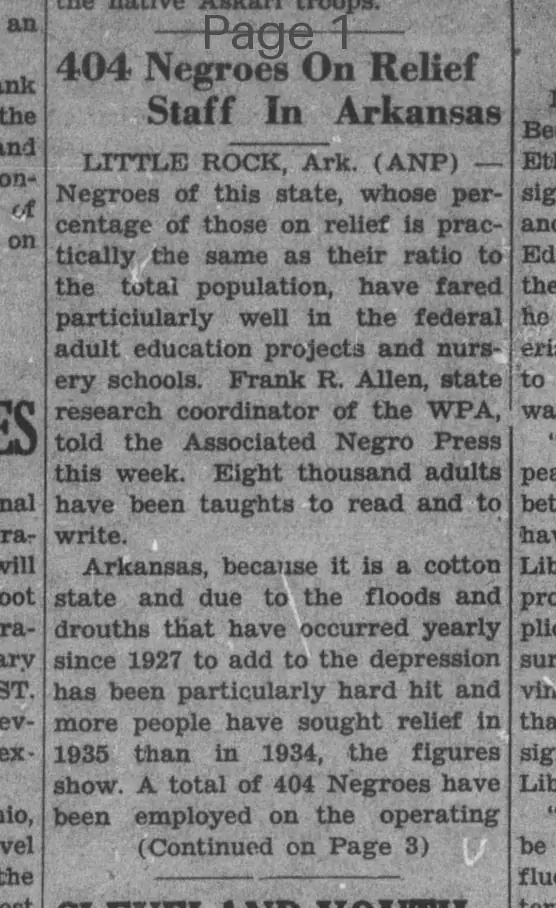
LITTLE ROCK, Ark. (ANP)—Negroes of this state, whose percentage of those on relief is practically the same as their ratio to the total population, have fared particularly well in the federal adult education projects and nursery schools. Frank R. Allen, state research coordinator of the WPA, told the Associated Negro Press this week. Eight thousand adults have been taught to read and to write.
Arkansas, because it is a cotton state and due to the floods and drouths that have occurred yearly since 1927 to add to the depression has been particularly hard hit and more people have sought relief in 1935 than in 1934, the figures show. A total of 404 Negroes have been employed on the operating
(Continued on Page 3)
400 Negroes on Relief
(Continued from Page 1)
staff, of which 54 are case workers and 350 teachers.
Around 98,500 of the state's 478,463 Negroes were on relief in 1935, Allen revealed. This was 25.4 per cent of the total of 393,052 given aid, almost a hundred more than received aid in 1934. With whites averaging 74.6 of those getting relief, the proportion as to race in Arkansas shows Negroes receiving over 1 per cent less of relief funds than in their 27 per cent of the whole population.
Hit Hard In Country
Ruralites of color have been the hardest hit by far. Eighty-two per cent of Arkansas' colored population are found on the farm, and these are 85 per cent of Negroes seeking relief. Only 15,071 of the 89,162 city dwellers of the race are on the rolls. Allen explains this by saying the urbanites 'embody most of the educated and skilled workers who are not dependent on cotton farming for their livelihood.
Negroes have shared without discrimination in the $53,920,550.36 spent by the U.S. on relief, the official declares. Eight districts administer the WPA, with Arkansas itself aiding through the state welfare commission. Negroes have been employed in white collar projects and on WPA which hires all eligibles at fixed federal pay scales in both skilled and unskilled types of labor. Percentages by race are not known, Allen asserts.
Excess In Education
In expenditures for education, Negroes came out far ahead because of the higher percentage of illiteracy. There were 350 colored teachers and 627 whites, all receiving the same salary basis.
During 1934-35, there were 8,000 Negro adults taught to read and write. Altogether, 20,153 colored received instruction in addition to the nursery and public schools.
All of the state's Negro public schools were operated under the educational program along with whites and for full school periods - something not ordinarily done because of interference with the cotton crop in rural areas.
The oldest man taught to read and write is Elijah Hookes, 94, and the oldest woman is Mary Bass, 104. At the other extreme, the nursery schools, there were equal accommodations with the U.S. providing an initial $450 for starting and $10 monthly for upkeep, according to Allen.
Very little change is seen in farming and manufacturing since relief has been given. Everything is dependent upon cotton. Lumbering, which once provided seasonal jobs, was practically terminated in 1928-29. Before the depression, sharecroppers, etc., could get off-season work by helping repair the plantation but hard times put a stop to this.
The floods and droughts since 1927 caused many rural people to receive practically continuous disaster relief and by the time the FERA went into operation found it easier to get relief than work for a living. This is true of both negroes and whites, Allen asserted.
Six-sevenths of colored ruralites are sharecroppers or farm laborers. They are accustomed to odd jobs after the cotton season ends.
As a result, they are able to secure more work than the average white and therefore do not get as much relief per case, the official stated.
What sub-type of article is it?
What keywords are associated?
What entities or persons were involved?
Where did it happen?
Domestic News Details
Primary Location
Arkansas
Event Date
1935
Key Persons
Outcome
98,500 of 478,463 negroes on relief (25.4% of total aid recipients); 404 employed on staff (54 case workers, 350 teachers); 8,000 adults taught to read/write; 20,153 received instruction; equitable sharing in $53,920,550.36 relief spending; rural negroes hardest hit, 85% of relief seekers from farms.
Event Details
Arkansas Negroes, 27% of population, received proportional relief amid Depression, floods, and droughts since 1927. WPA projects provided non-discriminatory employment and education, with higher focus on illiteracy; rural sharecroppers and farm laborers most affected, urban Blacks less dependent on cotton.