Thank you for visiting SNEWPapers!
Sign up free
Editorial
April 26, 1848
The North Carolina Standard
Raleigh, Wake County, North Carolina
What is this article about?
This editorial critiques the hereditary principle in monarchy, using the 1848 French Revolution as an example where Louis Philippe's abdication to his grandson failed. It praises republicanism, contrasts it with European monarchies like Britain's, and expresses optimism for global democratic progress.
Clipping
OCR Quality
95%
Excellent
Full Text
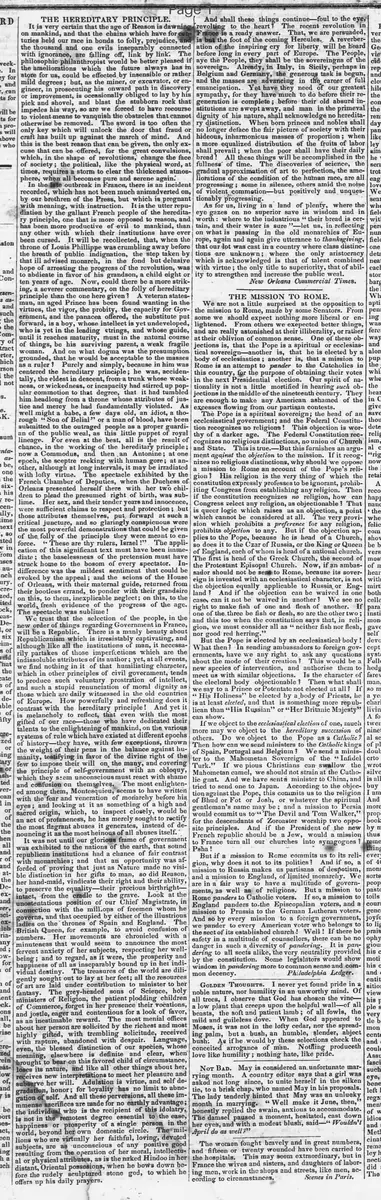
THE HEREDITARY PRINCIPLE.
It is very certain that the age of Reason is dawning on mankind, and that the chains which have for centuries held our race in bonds to folly, prejudice, and the thousand and one evils inseparably connected with ignorance, are falling off, link by link. The philosophic philanthropist would be better pleased if the ameliorations which the future always has in store for us, could be effected by insensible or rather mild degrees; but, as the miner, or excavator, or engineer, in prosecuting his onward path in discovery or improvement, is occasionally obliged to lay by his pick and shovel, and blast the stubborn rock that impedes his way, so are we forced to have recourse to violent means to vanquish the obstacles that cannot otherwise be removed. The sword is too often the only key which will unlock the door that fraud or craft has built up against the march of mind. And this is the best reason that can be given, the only excuse that can be offered, for the great convulsions, which, in the shape of revolutions, change the face of society; the political, like the physical world, at times, requires a storm to clear the thickened atmosphere, when all becomes pure and serene again.
In the late outbreak in France, there is an incident recorded, which has not been much animadverted on, by our brethren of the Press, but which is pregnant with meaning, with instruction. It is the utter repudiation by the gallant French people of the hereditary principle, one that is more opposed to reason, and has been more productive of evil to mankind, than any other with which their institutions have ever been cursed. It will be recollected, that, when the throne of Louis Phillippe was crumbling away before the breath of public indignation, the step taken by that ill advised monarch, in the fond but delusive hope of arresting the progress of the revolution, was to abdicate in favor of his grandson, a child eight or ten years of age. Now, could there be a more striking, a severer commentary, on the folly of hereditary principle than the one here given? A veteran statesman, an aged Prince has been found wanting in the virtues, the vigor, the probity, the capacity for Government, and the panacea offered, the substitute put forward, is a boy, whose intellect is yet undeveloped, who is yet in the leading strings, and whose guide, until it reaches maturity, must in the natural course of things, be his surviving parent, a weak fragile woman. And on what dogma was the presumption grounded, that he would be acceptable to the masses as a ruler? Purely and simply, because in him was centered the hereditary principle; he was, accidentally, the eldest in descent, from a trunk whose weakness, or wickedness, or incapacity had stirred up popular commotion to that degree, that it had tumbled him headlong from a throne whose attributes of justice and mercy he had fundamentally violated. As well might a babe, a few days old, an idiot, a thorough "Son of Belial" or a man of blood, have been submitted to the outraged people as a proper guardian of the public weal, as this little puppet of royal lineage. For even at the best, all is the result of chance, in the working of the hereditary principle; now a Commodus, and then an Antonine; at one epoch, the sceptre reeking with human gore; at another, although at long intervals, it may be irradiated with lofty virtue. The spectacle exhibited by the French Chamber of Deputies, when the Duchess of Orleans presented herself there with her two children to plead the presumed right of birth, was sublime. Her sex, and their tender years and innocence, were sufficient claims to respect and protection; but those attributes themselves, put forward at such a critical juncture, and so glaringly conspicuous were the most powerful demonstrations that could be given of the folly of the principle they were meant to enforce. "These are thy rulers, Israel!" The application of this significant text must have been immediate; the baselessness of the pretension must have struck home to the bosom of every spectator. Indifference was the mildest sentiment that could be evoked by the appeal; and the scions of the House of Orleans, with their maternal guide, returned from their bootless errand, to ponder with their grandsire on this, to them, inexplicable neglect; on this, to the world, fresh evidence of the progress of the age. The spectacle was sublime!
We trust that the selection of the people, in the new order of things regarding Government in France, will be a Republic. There is a manly beauty about Republicanism which is irresistibly captivating, and although like all the institutions of man, it necessarily partakes of those imperfections which are the indissoluble attributes of its author; yet, at all events, we find nothing in it of that humiliating character, which in other principles of civil government, tends to produce such voluntary prostration of intellect, and such a stupid renunciation of moral dignity as those which are daily witnessed in the old countries of Europe. How powerfully and refreshing does it contrast with the hereditary principle! And yet it is melancholy to reflect, that even with the most gifted of our race—those who have dedicated their talents to the enlightening of mankind, on the various systems of rule which have existed at different epochs of history—they have, with few exceptions, thrown the weight of their pens in the balance against humanity, testifying in favor of the divine right of the few to impose their will on the many, and covering the principle of self-government with an obloquy, which they seem unconscious must react with shame and confusion on themselves.
The most enlightened among them, Montesquieu, seems to have written with the fear and veneration of monarchy before his eyes; and looking at it as something of a high and sacred origin, which, to inspect closely, would be an act of profaneness, he has merely sought to rectify the most flagrant abuses it generates, instead of denouncing it as the most heinous of all abuses itself.
It was not until our glorious frame of government was exhibited to the nations of the earth, that sound republican institutions had a chance of fair contrast with monarchies; and that an opportunity was afforded of proving that just as Nature made no visible distinction in her gifts to man, so did Reason, her hand-maid, vindicate their right and their ability, to preserve the equality—their precious birthright intact, from the cradle to the grave. Look at the unostentatious position of our Chief Magistrate, in connection with the millions of freemen whom he governs, and that occupied by either of the illustrious Ladies on the thrones of Spain and England. The British Queen, for example, to avoid confusion of numbers. Her movements are chronicled with a minuteness that would seem to announce the most fervent anxiety of her subjects, respecting her well-being; and to regard, as it were, the prosperity and happiness of all as inseparably bound up in her individual destiny. The treasures of the world are diligently sought out to lay at her feet; all the resources of art are laid under contribution to minister to her fantasy. The grey-headed sons of Science, holy ministers of Religion, the patient plodding children of Commerce, forget in her presence their vocations, and jostle, eager and contentious for a look of favor, as an inestimable reward. The most menial offices about her person are solicited by the richest and most highly gifted, with trembling solicitude, received with rapture, abandoned with despair. Language, even, the blessed distinction of our species, whose meaning, elsewhere is definite and clear, when brought to bear on this favored child of circumstance, loses its nature, and like all other things about her, receives new interpretations to meet her pleasure and subserve her will. Adulation is virtue, and self-degradation honor; for loyalty has no limit to abnegation of self. And all these perversions, all these immense sacrifices are made for no earthly advantage; the individual who is the recipient of this idolatry, is not in the remotest degree essential to the ease, happiness or prosperity of a single person in the world, beyond her own domestic circle. The millions who are virtually her faithful, loving, devoted subjects, are as unconscious of any positive good resulting from the operation of her moral, intellectual or physical attributes, as is the naked Hindoo in her distant, Oriental possessions, when he bows down before the rudely sculptured stone god, to which he offers up his daily prayers.
And shall these things continue foul to the eye, revolting to the heart? The recent revolution in France is a ready answer. That, we are persuaded, is but the foot of the coming Hercules. A reverberation of the inspiring cry for liberty, will be heard before long in every part of Europe. The People, aye the People, they shall be the sovereigns of the sovereign. Already, in Italy, in Sicily, perhaps in Belgium and Germany, the generous task is begun, and the masses are advancing in the career of full emancipation. Yet have they need of our greatest sympathy, for they have much to do before their regeneration is complete; before their old absurd institutions are swept away, and man in the primeval dignity of his nature, shall acknowledge no hereditary distinction. When born princes and nobles shall no longer deface the fair picture of society with their hideous, inharmonious masses of proportion; when a more equalized distribution of the fruits of labor shall prevail; when the poor shall have their daily bread! All these things will be accomplished in the fullness of time. The discoveries of science, the gradual approximation of art to perfection, the ameliorations of the condition of the human race, are all progressing; some in silence, others amid the noise of violent commotion—but positively and unquestionably progressing.
As for us, living in a land of plenty, where the eye gazes on no superior save in wisdom and in worth: where to the industrious their bread is certain, and their water is sure—let us, in reflecting on what is passing in the old monarchies of Europe, again and again give utterance to thanksgiving, that our lot was cast in a country where class distinctions are unknown; where the only aristocracy which is acknowledged is that of talent combined with virtue; the only title to superiority, that of ability to strengthen and increase the public weal.
New Orleans Commercial Times.
It is very certain that the age of Reason is dawning on mankind, and that the chains which have for centuries held our race in bonds to folly, prejudice, and the thousand and one evils inseparably connected with ignorance, are falling off, link by link. The philosophic philanthropist would be better pleased if the ameliorations which the future always has in store for us, could be effected by insensible or rather mild degrees; but, as the miner, or excavator, or engineer, in prosecuting his onward path in discovery or improvement, is occasionally obliged to lay by his pick and shovel, and blast the stubborn rock that impedes his way, so are we forced to have recourse to violent means to vanquish the obstacles that cannot otherwise be removed. The sword is too often the only key which will unlock the door that fraud or craft has built up against the march of mind. And this is the best reason that can be given, the only excuse that can be offered, for the great convulsions, which, in the shape of revolutions, change the face of society; the political, like the physical world, at times, requires a storm to clear the thickened atmosphere, when all becomes pure and serene again.
In the late outbreak in France, there is an incident recorded, which has not been much animadverted on, by our brethren of the Press, but which is pregnant with meaning, with instruction. It is the utter repudiation by the gallant French people of the hereditary principle, one that is more opposed to reason, and has been more productive of evil to mankind, than any other with which their institutions have ever been cursed. It will be recollected, that, when the throne of Louis Phillippe was crumbling away before the breath of public indignation, the step taken by that ill advised monarch, in the fond but delusive hope of arresting the progress of the revolution, was to abdicate in favor of his grandson, a child eight or ten years of age. Now, could there be a more striking, a severer commentary, on the folly of hereditary principle than the one here given? A veteran statesman, an aged Prince has been found wanting in the virtues, the vigor, the probity, the capacity for Government, and the panacea offered, the substitute put forward, is a boy, whose intellect is yet undeveloped, who is yet in the leading strings, and whose guide, until it reaches maturity, must in the natural course of things, be his surviving parent, a weak fragile woman. And on what dogma was the presumption grounded, that he would be acceptable to the masses as a ruler? Purely and simply, because in him was centered the hereditary principle; he was, accidentally, the eldest in descent, from a trunk whose weakness, or wickedness, or incapacity had stirred up popular commotion to that degree, that it had tumbled him headlong from a throne whose attributes of justice and mercy he had fundamentally violated. As well might a babe, a few days old, an idiot, a thorough "Son of Belial" or a man of blood, have been submitted to the outraged people as a proper guardian of the public weal, as this little puppet of royal lineage. For even at the best, all is the result of chance, in the working of the hereditary principle; now a Commodus, and then an Antonine; at one epoch, the sceptre reeking with human gore; at another, although at long intervals, it may be irradiated with lofty virtue. The spectacle exhibited by the French Chamber of Deputies, when the Duchess of Orleans presented herself there with her two children to plead the presumed right of birth, was sublime. Her sex, and their tender years and innocence, were sufficient claims to respect and protection; but those attributes themselves, put forward at such a critical juncture, and so glaringly conspicuous were the most powerful demonstrations that could be given of the folly of the principle they were meant to enforce. "These are thy rulers, Israel!" The application of this significant text must have been immediate; the baselessness of the pretension must have struck home to the bosom of every spectator. Indifference was the mildest sentiment that could be evoked by the appeal; and the scions of the House of Orleans, with their maternal guide, returned from their bootless errand, to ponder with their grandsire on this, to them, inexplicable neglect; on this, to the world, fresh evidence of the progress of the age. The spectacle was sublime!
We trust that the selection of the people, in the new order of things regarding Government in France, will be a Republic. There is a manly beauty about Republicanism which is irresistibly captivating, and although like all the institutions of man, it necessarily partakes of those imperfections which are the indissoluble attributes of its author; yet, at all events, we find nothing in it of that humiliating character, which in other principles of civil government, tends to produce such voluntary prostration of intellect, and such a stupid renunciation of moral dignity as those which are daily witnessed in the old countries of Europe. How powerfully and refreshing does it contrast with the hereditary principle! And yet it is melancholy to reflect, that even with the most gifted of our race—those who have dedicated their talents to the enlightening of mankind, on the various systems of rule which have existed at different epochs of history—they have, with few exceptions, thrown the weight of their pens in the balance against humanity, testifying in favor of the divine right of the few to impose their will on the many, and covering the principle of self-government with an obloquy, which they seem unconscious must react with shame and confusion on themselves.
The most enlightened among them, Montesquieu, seems to have written with the fear and veneration of monarchy before his eyes; and looking at it as something of a high and sacred origin, which, to inspect closely, would be an act of profaneness, he has merely sought to rectify the most flagrant abuses it generates, instead of denouncing it as the most heinous of all abuses itself.
It was not until our glorious frame of government was exhibited to the nations of the earth, that sound republican institutions had a chance of fair contrast with monarchies; and that an opportunity was afforded of proving that just as Nature made no visible distinction in her gifts to man, so did Reason, her hand-maid, vindicate their right and their ability, to preserve the equality—their precious birthright intact, from the cradle to the grave. Look at the unostentatious position of our Chief Magistrate, in connection with the millions of freemen whom he governs, and that occupied by either of the illustrious Ladies on the thrones of Spain and England. The British Queen, for example, to avoid confusion of numbers. Her movements are chronicled with a minuteness that would seem to announce the most fervent anxiety of her subjects, respecting her well-being; and to regard, as it were, the prosperity and happiness of all as inseparably bound up in her individual destiny. The treasures of the world are diligently sought out to lay at her feet; all the resources of art are laid under contribution to minister to her fantasy. The grey-headed sons of Science, holy ministers of Religion, the patient plodding children of Commerce, forget in her presence their vocations, and jostle, eager and contentious for a look of favor, as an inestimable reward. The most menial offices about her person are solicited by the richest and most highly gifted, with trembling solicitude, received with rapture, abandoned with despair. Language, even, the blessed distinction of our species, whose meaning, elsewhere is definite and clear, when brought to bear on this favored child of circumstance, loses its nature, and like all other things about her, receives new interpretations to meet her pleasure and subserve her will. Adulation is virtue, and self-degradation honor; for loyalty has no limit to abnegation of self. And all these perversions, all these immense sacrifices are made for no earthly advantage; the individual who is the recipient of this idolatry, is not in the remotest degree essential to the ease, happiness or prosperity of a single person in the world, beyond her own domestic circle. The millions who are virtually her faithful, loving, devoted subjects, are as unconscious of any positive good resulting from the operation of her moral, intellectual or physical attributes, as is the naked Hindoo in her distant, Oriental possessions, when he bows down before the rudely sculptured stone god, to which he offers up his daily prayers.
And shall these things continue foul to the eye, revolting to the heart? The recent revolution in France is a ready answer. That, we are persuaded, is but the foot of the coming Hercules. A reverberation of the inspiring cry for liberty, will be heard before long in every part of Europe. The People, aye the People, they shall be the sovereigns of the sovereign. Already, in Italy, in Sicily, perhaps in Belgium and Germany, the generous task is begun, and the masses are advancing in the career of full emancipation. Yet have they need of our greatest sympathy, for they have much to do before their regeneration is complete; before their old absurd institutions are swept away, and man in the primeval dignity of his nature, shall acknowledge no hereditary distinction. When born princes and nobles shall no longer deface the fair picture of society with their hideous, inharmonious masses of proportion; when a more equalized distribution of the fruits of labor shall prevail; when the poor shall have their daily bread! All these things will be accomplished in the fullness of time. The discoveries of science, the gradual approximation of art to perfection, the ameliorations of the condition of the human race, are all progressing; some in silence, others amid the noise of violent commotion—but positively and unquestionably progressing.
As for us, living in a land of plenty, where the eye gazes on no superior save in wisdom and in worth: where to the industrious their bread is certain, and their water is sure—let us, in reflecting on what is passing in the old monarchies of Europe, again and again give utterance to thanksgiving, that our lot was cast in a country where class distinctions are unknown; where the only aristocracy which is acknowledged is that of talent combined with virtue; the only title to superiority, that of ability to strengthen and increase the public weal.
New Orleans Commercial Times.
What sub-type of article is it?
Constitutional
Foreign Affairs
Social Reform
What keywords are associated?
Hereditary Principle
French Revolution
Republicanism
Monarchy Critique
Political Equality
European Emancipation
What entities or persons were involved?
Louis Phillippe
Duchess Of Orleans
Montesquieu
British Queen
French People
House Of Orleans
Editorial Details
Primary Topic
Critique Of Hereditary Monarchy And Advocacy For Republicanism
Stance / Tone
Strongly Anti Hereditary Principle, Pro Republican And Optimistic About Democratic Progress
Key Figures
Louis Phillippe
Duchess Of Orleans
Montesquieu
British Queen
French People
House Of Orleans
Key Arguments
Hereditary Principle Is Irrational And Harmful, Leading To Unfit Rulers By Chance.
French Revolution Repudiated Hereditary Succession By Rejecting Louis Philippe's Grandson.
Republicanism Offers Equality And Moral Dignity, Contrasting With Monarchical Adulation.
European Monarchies Promote Self Degradation And Unnecessary Idolatry.
American Republic Exemplifies Natural Equality And Merit Based Leadership.
Global Revolutions Signal The End Of Hereditary Distinctions And Rise Of Popular Sovereignty.