Thank you for visiting SNEWPapers!
Sign up free
North Carolina Standard
Raleigh, Wake County, North Carolina
What is this article about?
In Boston, April 1851, Thomas Sims, a fugitive slave from Georgia, faces legal proceedings under the Fugitive Slave Act. Despite habeas corpus petitions by abolitionists like Charles Sumner, Judge Woodbury remands Sims to U.S. Marshal custody for return to his owner, amid public excitement and legislative investigations.
Clipping
OCR Quality
Full Text
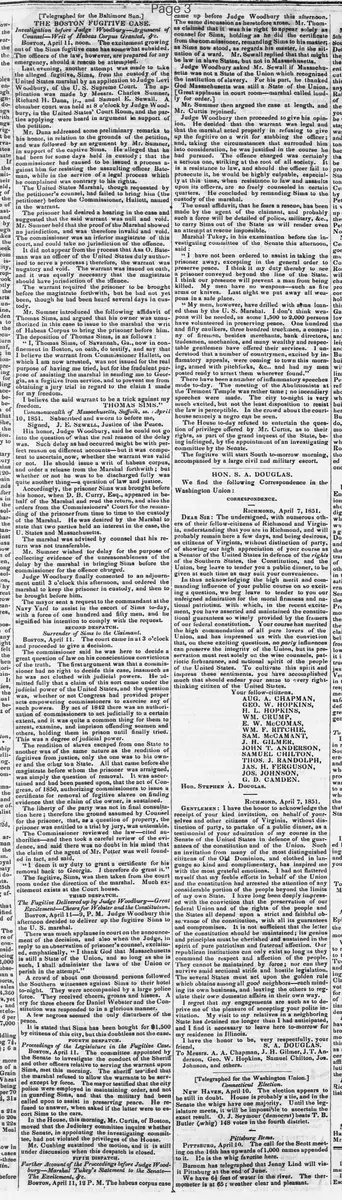
THE BOSTON FUGITIVE CASE.
Investigation before Judge Woodbury—Argument of Counsel—Writ of Habeas Corpus Granted, &c.
Boston, April 11, noon. The excitement growing out of the Sims fugitive case has somewhat subsided. The officers of the law, however, are prepared for any emergency, should a rescue be attempted.
Last evening, another attempt was made to take the alleged fugitive, Sims, from the custody of the United States marshal by an application to Judge Levi Woodbury, of the U. S. Supreme Court. The application was made by Messrs. Charles Sumner, Richard H. Dana, Jr., and Samuel E. Sewall. A chamber court was held at 8 o'clock by Judge Woodbury, in the United States' Court Room, and the parties applying were heard in argument in support of the petition.
Mr. Dana addressed some preliminary remarks to his honor, in relation to the grounds of the petition, and was followed by an argument by Mr. Sumner, in support of the captive Sims. He alleged that he had been for some days held in custody; that the commissioner had caused to be issued a process against him for resisting the assaulting officer Bateman, while in the service of a legal process which he complained was contrary to his rights.
The United States Marshal, though requested by the petitioner's counsel, had failed to bring him (the petitioner) before the Commissioner, Hallett, named in the warrant.
The prisoner had desired a hearing in the case and suggested that the said warrant was null and void.
Mr. Sumner held that the proof of the Marshal showed no jurisdiction, and was therefore invalid and void. The commissioner was an inferior magistrate of this court, and could take no jurisdiction of the offence.
It did not appear from the process that Asa O. Bateman was an officer of the United States duly authorized to serve a process; therefore, the warrant was nugatory and void. The warrant was issued on oath, and it was equally necessary that the magistrate should have jurisdiction of the offence.
The warrant required the prisoner to be brought before the magistrate forthwith, but he had not yet been, though he had been held several days in custody.
Mr. Sumner introduced the following affidavit of Thomas Sims, and argued that his owner was unauthorized in this case to issue to the marshal the writ of Habeas Corpus to bring the prisoner before him.
The deposition of Thomas Sims, is as follows:
"I, Thomas Sims, of Savannah, Ga., now in confinement in Boston, on oath, do testify, and say that I believe the warrant from Commissioner Hallett, on which I am now arrested, was not issued for the real purpose of having me tried, but for the fraudulent purpose of assisting the marshal in sending me to Georgia, as a fugitive from service, and to prevent me from obtaining a jury trial in regard to the claim I made for my freedom.
I believe the said warrant to be a trick against my freedom.
THOMAS SIMS."
Commonwealth of Massachusetts, Suffolk, ss.: April 10, 1851. Subscribed and sworn to before me,
Signed, J. E. SEWALL, Justice of the Peace.
His honor, Judge Woodbury, said he could not go into the question of what the real reason of the delay was. Such delay as had occurred might be with perfect reason on different accounts—but it was competent to ascertain now, whether the warrant was valid or not. He should issue a writ of habeas corpus, and order a release from the Marshal forthwith; but whether or not he was to be discharged fully was quite another thing—a question of law and justice.
Accordingly, the prisoner Sims was brought before his honor, when D. B. Curry, Esq., appeared in behalf of the Marshal and read the return, and also the orders from the Commissioners' Court for the remanding of the prisoner from time to time to the custody of the Marshal. He was desired by the Marshal to state that two parties held an interest in the case, the U. States and Massachusetts.
The marshal was advised by counsel that his return was not transferable.
Mr. Sumner wished for delay for the purpose of collecting evidence of the unreasonableness of the delay by the marshal in bringing Sims before the commissioner for the offence charged.
Judge Woodbury finally consented to an adjournment until 3 o'clock this afternoon, and ordered the marshal to keep the prisoner in custody, and then to be brought before him.
The mayor sent a request to the commandant at the Navy Yard to assist in the escort of Sims to-day, with a force of one hundred and fifty men, and he signified his intention to comply with the request.
SECOND DESPATCH.
Surrender of Sims to the Claimant.
Boston, April 11. The court came in at 3 o'clock and proceeded to give a decision.
The commissioner said he was here to decide a great question of law on his conscientious convictions of the truth. The first argument was that a commissioner had no right to decide this case, inasmuch as he was not clothed with judicial powers. He admitted fully that a claim of this sort came under the judicial power of the United States, and the question was, whether or not Congress had provided proper acts empowering commissioners to exercise any of such powers. By act of 1842 there was an authorization of commissioners to act judicially to a certain extent, and it was quite a common thing for them to arrest, examine, and imprison offending seamen and others, holding them in prison until finally tried. This was a degree of judicial power.
The rendition of slaves escaped from one State to another was of the same nature as the rendition of fugitives from justice, only the one was to his owner and the other to a State. All that came before the magistrate before whom the prisoner was arraigned, was simply the question of removal. It was ascertained and had been passed upon, that the act of Congress, of 1850, authorizing commissioners to issue a certificate for removal of fugitive slaves on finding evidence that the claim of the owner, is sustained.
The liberty of the party was not in final consultation here; therefore the ground assumed by Counsel for the prisoner, that, as a question of property, the prisoner was entitled to a trial by jury, was untenable.
The Commissioner reviewed the law—cited authorities—and then took a careful review of the evidence, and said there was no doubt in his mind that the claim of the agent of Mr. Potter was well founded in fact, and said,
"I deem it my duty to grant a certificate for his removal back to Georgia. I therefore do grant it."
The fugitive, Sims, was then taken from the court room under the direction of the marshal. Much excitement exists at the Court house.
THIRD DESPATCH.
The Fugitive Delivered up by Judge Woodbury—Great Excitement—Cheers for Webster and the Constitution.
Boston, April 11—9, P. M. Judge Woodbury this afternoon decided to deliver up the fugitive Sims to the U. S. marshal.
There was much applause in court on the announcement of the decision, and also when the Judge, in reply to an observation of prisoner's counsel, exclaimed, emphatically, "I thank God that Massachusetts is still a State of the Union, and so long as she is such, I shall administer the laws of the Union or perish in the attempt."
A crowd of about one thousand persons followed the Southern witnesses against Sims to their hotel to-night. They were accompanied by a large police force. They received cheers, groans and hisses. A cry for three cheers for Daniel Webster and the Constitution was responded to in a glorious manner.
A few negroes seemed the only disturbers of the peace.
It is stated that Sims has been bought for $1,500 by citizens of this city, but this doubtless not the case.
FOURTH DESPATCH.
Proceedings of the Legislature in the Fugitive Case.
Boston, April 11. The committee appointed by the Senate to investigate the conduct of the Sheriff and other officers relative to serving the warrant upon Sims, met this morning. The sheriff testified that the marshal refused to allow the warrants to be served except by force. The mayor testified that the city police were employed in maintaining order, and not in guarding Sims, and that the military had been called upon to assist in preserving peace. He refused to answer, when asked if the latter were to escort Sims to the cars.
In the House, this morning, Mr. Curtis, of Boston, moved that the Judiciary committee inquire whether the Senate, in appointing the investigating committee, had not violated the privileges of the House.
Mr. Cushing sustained the motion, and it is still under discussion when this despatch is closed.
FIFTH DISPATCH.
Further Account of the Proceedings before Judge Woodbury—Marshal Tukey's Statement to the Senate— The Excitement, &c.
Boston, April 11, 12 P. M. The habeas corpus case came up before Judge Woodbury this afternoon.
The same discussion as heretofore arose. Mr. Thomas claimed that it was his right to appear solely as counsel for Sims, holding as he did the certificate from the commissioner, remanding Sims to his master; as Sims now stood, as regards his master, in the situation of a ward. Mr. Sewall replied that that might be law in slave States, but not in Massachusetts.
Judge Woodbury asked Mr. Sewall if Massachusetts was not a State of the Union which recognized the institution of slavery. For his part, he thanked God Massachusetts was still a State of the Union.
[Great applause in court room—marshal called loudly for order.]
Mr. Sumner then argued the case at length, and Mr. Curtis rejoined.
Judge Woodbury then proceeded to give his opinion. He decided that the warrant was legal and that the marshal acted properly in refusing to give up the fugitive on a writ for stabbing the officer; and, taking the circumstances that surrounded him into consideration, he was justified in the course he had pursued. The offence charged was certainly a serious one, striking at the root of all society. It is a resistance to law, and should the officer fail to prosecute it, he would be highly culpable, especially at this time, when resistance to law and assaults upon its officers, are so freely counseled in certain quarters. He concluded by remanding Sims to the custody of the marshal.
The usual affidavit, that he fears a rescue, has been made by the agent of the claimant, and probably such a force will be detailed of police, military, &c., to carry Sims out of the State as will render even an attempt at rescue impossible.
Marshal Tukey, in his examination before the investigating committee of the Senate this afternoon, said:
"I have not been ordered to assist in taking the prisoner away, excepting in the general order to preserve peace. I think it my duty thereby to see a prisoner conveyed beyond the line of the State. I think our presence will prevent a man from being killed. My men have no weapons—such as fire arms or knives. Last night we put away all weapons in a safe place.
"My men, however, have drilled with arms loaned them by the U. S. Marshal. I don't think weapons will be needed, as some 1,500 to 2,000 persons have volunteered in preserving peace. One hundred and fifty caulkers, three hundred truckmen, a company of firemen, besides merchants, bank directors, tradesmen, mechanics, and many wealthy and respectable gentlemen have offered their services. Understood that a number of countrymen, excited by inflammatory appeals, were coming to town this morning, armed with pitchforks, &c., and had my men posted ready to arrest them wherever found."
There have been a number of inflammatory speeches made to-day. The meeting of the Abolitionists at the Tremont Temple was rather tame; no incendiary speeches were made. The city to-night is very much excited, but not the least disposition to resist the law is perceptible. In the crowd about the courthouse scarcely a negro can be seen.
The House to-day refused to entertain the question of privilege offered by Mr. Curtis, as to their rights, as part of the grand inquest of the State, being infringed, by the appointment of an investigating committee by the Senate.
The fugitive will start South to-morrow morning, accompanied by a large civil and military escort.
What sub-type of article is it?
What themes does it cover?
What keywords are associated?
What entities or persons were involved?
Where did it happen?
Story Details
Key Persons
Location
Boston, Massachusetts
Event Date
April 10 11, 1851
Story Details
Thomas Sims, arrested as a fugitive slave in Boston, is held by U.S. Marshal. Abolitionist lawyers petition Judge Woodbury for habeas corpus, arguing illegal detention and warrant invalidity. After hearings, commissioner grants removal certificate to owner in Georgia; Judge remands Sims to marshal for transport south amid public excitement and security measures.