Thank you for visiting SNEWPapers!
Sign up free
Norfolk Gazette And Publick Ledger
Norfolk, Virginia
What is this article about?
Account of Dr. Gall's craniology, focusing on his 1805 travels in Germany, lectures, and examinations of prisoners and lunatics at Torgau to demonstrate brain organs linked to traits like thievery and mechanics. Includes royal interest and scientific validations.
Merged-components note: Merged continuation of the article on Dr. Gall's Craniology across pages; relabeled second part from story to literary as it is an essay-like account.
Clippings
1 of 2
OCR Quality
Full Text
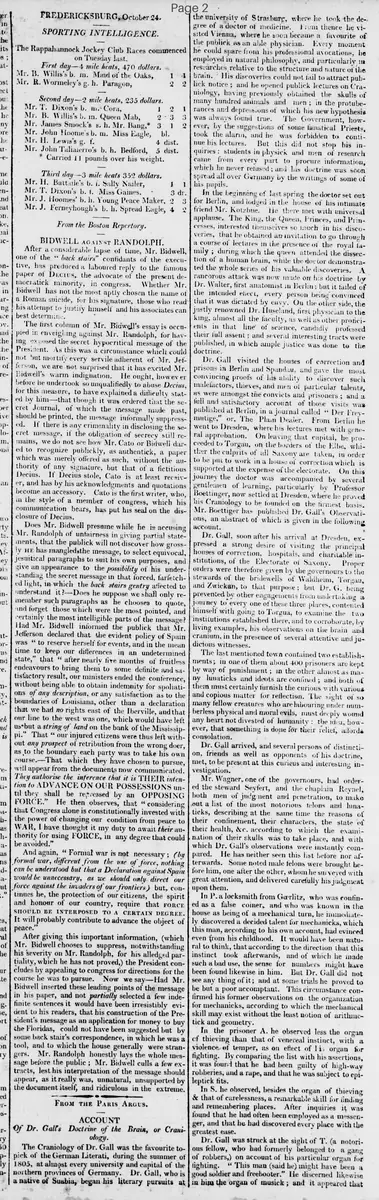
ACCOUNT
Of Dr. Gall's Doctrine of the Brain, or Craniology.
The Craniology of Dr. Gall was the favourite topic of the German Literati, during the summer of 1805, at almost every university and capital of the northern provinces of Germany. Dr. Gall, who is a native of Suabia, began his literary pursuits at the university of Strasburg, where he took the degree of a doctor of medicine. From thence he visited Vienna, where he soon became a favourite of the publick as an able physician. Every moment he could spare from his professional avocations, he employed in natural philosophy, and particularly in researches relative to the structure and nature of the brain. His discoveries could not fail to attract publick notice; and he opened publick lectures on Craniology, having previously obtained the skulls of many hundred animals and men; in the protuberances and depressions of which his new hypothesis was always found true. The Government, however, by the suggestions of some fanatical Priests, took the alarm, and he was forbidden to continue his lectures. But this did not stop his inquiries: students in physick and men of research came from every part to procure information, which he never refused; and his doctrine was soon spread all over Germany by the writings of some of his pupils.
In the beginning of last spring the doctor set out for Berlin, and lodged in the house of his intimate friend Mr. Kotzebue. He there met with universal applause. The King, the Queen, Princes, and Princesses, interested themselves so much in his discoveries, that he obtained an invitation to go through a course of lectures in the presence of the royal family; during which the queen attended the dissection of a human brain, while the doctor demonstrated the whole series of his valuable discoveries. A rancorous attack was now made on his doctrine by Dr. Walter, first anatomist in Berlin; but it failed of the intended effect, every person being convinced that it was dictated by envy. On the other side, the justly renowned Dr. Hufeland, first physician to the king, almost all the faculty, as well as other proficient in that line of science, candidly professed their full assent: and several interesting tracts were published, in which ample justice was done to the doctrine.
Dr. Gall visited the houses of correction and prisons in Berlin and Spandau, and gave the most convincing proofs of his ability to discover such malefactors, thieves, and men of particular talents, as were amongst the convicts and prisoners; and a full and satisfactory account of those visits was published at Berlin, in a journal called "Der Freymutige," or, The Plain Dealer. From Berlin he went to Dresden, where his lectures met with general approbation. On leaving that capital, he proceeded to Torgau, on the borders of the Elbe, whither the culprits of all Saxony are taken, in order to be put to work in a house of correction which is supported at the expense of the electorate. On this journey the doctor was accompanied by several gentlemen of learning, particularly by Professor Boettiger, now settled at Dresden, where he proved his Craniology to be founded on the firmest basis. Mr. Boettiger has published Dr. Gall's Observations, an abstract of which is given in the following account.
Dr. Gall, soon after his arrival at Dresden, expressed a strong desire of visiting the principal houses of correction, hospitals, and charitable institutions, of the Electorate of Saxony. Proper orders were therefore given by the governours to the stewards of the bridewells of Waldheim, Torgau, and Zwickau, to that purpose; but Dr. G. being prevented by other engagements from undertaking a journey to every one of these three places, contented himself with going to Torgau, to examine the two institutions established there, and to corroborate, by living examples, his observations on the brain and cranium, in the presence of several attentive and judicious witnesses.
The last mentioned town contained two establishments; in one of them about 400 prisoners are kept by way of punishment; in the other almost as many lunaticks and idiots are confined; and both of them must certainly furnish the curious with various and copious matter for reflection. The sight of so many fellow creatures who are labouring under numberless physical and moral evils, must deeply wound any heart not divested of humanity: the idea, however, that something is done for their relief, affords consolation.
Dr. Gall arrived, and several persons of distinction, friends as well as opponents of his doctrine, met, to be present at this curious and interesting investigation.
Mr. Wagner, one of the governours, had ordered the steward Seyfert, and the chaplain Reynel, both men of judgment and penetration, to make out a list of the most notorious felons and lunaticks, describing at the same time the reasons of their confinement, their characters, the state of their health, &c. according to which the examination of their skulls was to take place, and with which Dr. Gall's observations were instantly compared. He has neither seen this list before nor afterwards. Some noted male felons were brought before him, one after the other, whom he surveyed with great attention, and delivered carefully his judgment upon them.
In P. a locksmith from Görlitz, who was confined as a false coiner, and who was known in the house as being of a mechanical turn, he immediately discovered a decided talent for mechanicks, which this man, according to his own account, had evinced even from his childhood. It would have been natural to think, that according to the direction that this instinct took afterwards, and of which he made such a bad use, the sense for numbers might have been found likewise in him. But Dr. Gall did not see any thing of it; and at some trials he proved to be but a poor accountant. This circumstance confirmed his former observations on the organization for mechanicks, according to which the mechanical skill may exist without the least notion of arithmetick and geometry.
In the prisoner A. he observed less the organ of thieving than that of venereal instinct, with a violence of temper, as an effect of his organ for fighting. By comparing the list with his assertions, it was found that he had been guilty of high-way robberies, and a rape, and that he was subject to epileptick fits.
In S. he observed, besides the organ of thieving & that of carelessness, a remarkable skill for finding and remembering places. After inquiries it was found that he had often been employed as a messenger, and that he had discovered every place with the greatest ease.
Dr. Gall was struck at the sight of T. (a notorious fellow, who had formerly belonged to a gang of robbers,) on account of his particular organ for fighting. "This man (said he) might have been a good soldier and freebooter." He discerned likewise in him the organ of musick; and it appeared that...
he had learned to play on the violin without any instruction.
Every person was desirous to know what Dr. Gall would say about T. who was known in the house as a thief full of cunning, and who, having made several times his escape, wore an additional iron. It was surprising that he saw in him far less the organ of cunning than in many of the other prisoners. However, it was proved that examples and conversation with other thieves in the house had suggested to him the plan for his escape, and that his own stupidity was the cause of his being retaken.
The Doctor examined with the utmost attention the prisoners who were confined as incendiaries, as this crime is not to be met with in Austria, which is so very frequent in Saxony. He observed, that the inclination for it, which is said to be often almost irresistible, was the effect of several co-operating organs. In one of these incendiaries, who was about forty-nine years of age, he discovered the organs for cunning, for thieving, for finding and remembering places easily, for recollecting words, and the flat and unfortunate organization, which he says is calculated for every thing that is bad.
In another he met with the organ for thieving and cunning in a superior degree, with all the other symptoms which characterise avaricious and envious people; but in none of them did he distinguish the instinct for murder, or any other organ leading to violence.
Whilst the observations upon single individuals were continued, the steward had drawn up all the rest of the prisoners of both sexes in two separate ranks, for which purpose the large yard adjoining to the house was very convenient. The Doctor, with penetrating looks, walked through this very numerous company of thieves and rogues, making proper remarks upon every thing which he found particularly striking. In the whole number, at least seven out of eight had been brought there for having committed greater or smaller thefts; and that no innocent person was amongst them, could be easily proved by their organs for thieving, which were seen or felt at the first look or touch. Even the most obstinate sceptics were obliged to yield to the convincing proofs of this organ. Whoever cannot read these characters, will hardly be able to read any thing which the finger of nature has written. But here Dr. Gall protested, in the most solemn manner, against all misinterpretations, by repeating several times to those who were present, that though the organ for thieving was prominent in most of the prisoners, it would be wrong and dangerous to judge that every person provided with the same organ must be a thief. (*) It was, however, remarkable, that in most of the whole company of rogues, the organ for reflection, which is placed on both sides of the upper part of the skull, was scarcely to be seen at all; as on the contrary, the organ of lust was eminently disclosed in many of them. The want of the former makes careless beggars and vagabonds, and the stronger existence of the latter leads often to pilfering and cheating, particularly in servants.
Whenever Dr. G. met with some organizations either very fortunate or unfortunate, he did not fail to make judicious observations upon them, and ordered to those whose skulls and organs were similar, to stand next to each other, that they might be readier for inspection and comparison. This happened with four particularly distinguished heads, whose depressed and flat skulls seemed to shew something particularly sullen and beastly. Dr. G. took this opportunity to explain how these people might have been assisted by an early education, and by a prudent choice of their professions. However, he and Dr. Spurzheim, his fellow-traveller, declared, that besides, those four very unfavourably formed heads, there was in the whole number not another to be found who had such a dejected and distorted face and skull as he had generally met with in the prisons and houses of correction in Berlin, and that what was an exception here was a rule there. It was surprising to him to find so many prisoners at Torgau who were confined on delicta carnalia, as in the Austrian and Prussian dominions crimes of this sort are not so severely punished. Some very favourably organized persons justified their exterior at a minute's investigation. "Why did you resist so obstinately your superior?" exclaimed Dr. Gall, at the sight of a man who was only punished for seditious speeches and obstinacy; and really the upper and back part of his skull, where Dr. G. finds the organ of the desire for glory and firmness, which degenerates so often into obstinacy, were uncommonly prominent. In another he met with the organs of wit, and called that construction a very grand and promising one which was to be found in great poets. The man was really notorious for wit; and a person who had known him before his confinement, assured us, that he recollected his making verses extempore. Besides the organ of thieving and cunning, which shewed itself in spite of every disguise, no other distinguished itself so much as that of representation, which, according to Dr. Gall's doctrine, is conspicuous in actors, mimics, and wags.
Thus ended this interesting inspection of skulls and organs, which is highly instructive to the observer of mankind, and to the philosophical physician. We lost much by the absence of the experienced physician Dr. Michaelis, who could have explained many things which appeared to us enigmatical.—This loss was more severely felt on our visiting next the female idiots and lunatics. What a field for a psychological physician and anatomist! In the lower rooms of the right wing were found those whose state required to be put in chains. It had already been resolved to introduce more generally the use of strait waistcoats. Only two of them were in violent paroxysms, but they shewed by their misery. that is to say, extravagant lust. One of them suffered Dr. Gall to touch her skull, and this produced the usual effect of her disordered instinct. It was observed, that the most frequent effect of phrenzy was the volubility of the tongue, and an inclination to bruise and destroy, which they shewed by breaking every thing in their reach, and by tearing to pieces their clothes, if they had got their hands at liberty. In two persons who distinguished themselves particularly in that manner, the angle behind and below the ossa bregmatis was found particularly prominent. In a female lunatic, who usually sits silent on the lower part of a window, and who fancies she looks down from Königstein. (†) and to lie in the page's bed, (†) all those who were made attentive to it discovered the organ of finding and recollecting places strongly marked. As we returned across the yard, Dr. G. saw several idiots leaning against the wall, and basking there. Two sisters among them, of the name of Bolutchen, made rude and unmannerly demonstration of joy at the sight of some feathers which an officer of cavalry, who was in our company, wore in his cap. Dr. G. took this opportunity to make some very judicious observations relative to the confinement of these wretched creatures.
Towards the evening the electoral hospital for the poor and orphans, situated in another part of the town, was inspected, where three hundred and forty two poor persons and orphans are supported.—Under the name of poor are understood idiots, melancholists, cripples, and persons afflicted with some incurable disease. The orphans are provided for after the fifteenth year of their age, the boys being apprenticed and the girls put to service; only those children who are incapable of any other destination, are kept in the house amongst the poor. The hospital contained thirty incurable blind persons, fourteen others born deaf and dumb, and many more who, on account of their natural stupidity, rendered every attempt of instruction unsuccessful, but could nevertheless furnish materials for many physiological and craniological remarks. Dr. G. was struck at the sight of a man born blind, of the name of Girellman, a very assiduous instructor of the orphans, as he discovered in him a peculiar organ for mechanical arts; he spends his leisure hours in making bird-cages, and other things for which the measure of proportion is particularly required. The existence of the very prominent organ for musick in a person deaf and dumb was extremely surprising.—No one had paid attention to it till then; and the question arose, how this organ could shew its effects in a deaf and dumb person. After inquiry it was found that he used to do every thing by time, and that he was not quite insensible to the sound of a drum.
(To be concluded in our next.)
(†) Königstein is a fortress situated upon a high rock, about twenty-four miles from Dresden, near the river Elbe, and the frontiers of Bohemia.
(†) The page's bed is a narrow projecting part of the steep rock upon which the fortress of Königstein is built—It is related, that many years ago a page of the king of Poland, in a drunken fit, went to sleep upon it. The king ordered him to be fastened with ropes, to prevent his falling down an immense precipice.
(*) According to Gall's doctrine, organs point out prominent innate propensities and mental powers, but involve not the necessity of their being exerted or cultivated.
What sub-type of article is it?
What themes does it cover?
What keywords are associated?
What entities or persons were involved?
Literary Details
Title
Account Of Dr. Gall's Doctrine Of The Brain, Or Craniology.
Author
From The Paris Argus.
Subject
Dr. Gall's Craniology Demonstrations In Germany, Particularly At Torgau Prison And Hospital.
Key Lines