Thank you for visiting SNEWPapers!
Sign up free
The Daily Morning Journal And Courier
New Haven, New Haven County, Connecticut
What is this article about?
Special train from Plymouth to London derailed in Salisbury, England, on July 1, killing 23 American passengers from steamer New York and 4 crew; 12 injured. Victims include editor Louis Cassier, horseman John E. McDonald, newlywed Frederick H. Cossitt. Mayor McClellan escaped by chance. Cause under investigation.
Merged-components note: These components form a single continued foreign news story about the train wreck in Salisbury, England, spanning page 1 (main article and victim details) to page 8 (continuation). The label is unified as foreign_news, changing from 'story' on page 8.
Clippings
1 of 2
OCR Quality
Full Text
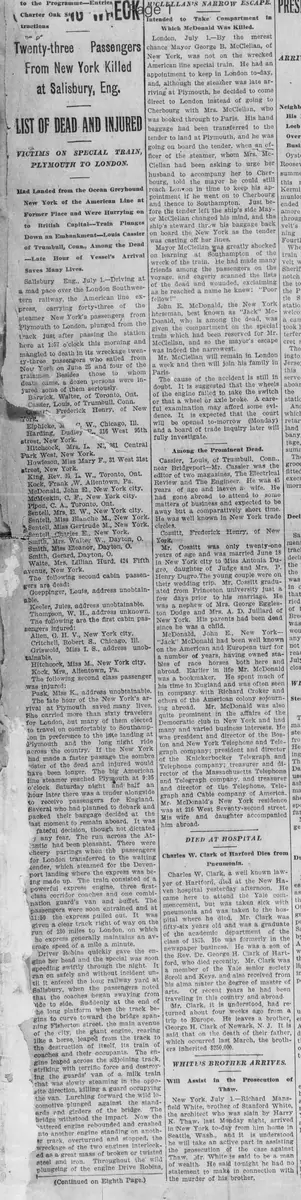
LIST OF DEAD AND INJURED
VICTIMS ON SPECIAL TRAIN, PLYMOUTH TO LONDON.
Had Landed from the Ocean Greyhound New York of the American Line at Former Place and Were Hurrying on to British Capital--Train Plunges Down an Embankment--Louis Cassier of Trumbull, Conn., Among the Dead--Late Hour of Vessel's Arrival Saves Many Lives.
Salisbury, Eng., July 1.--Driving at a mad pace over the London Southwestern railway, the American line express, carrying forty-three of the steamer New York's passengers from Plymouth to London, plunged from the track just after passing the station here at 1:57 o'clock this morning and mangled to death in its wreckage twenty-three passengers who sailed from New York on June 25 and four of the trainmen. Besides those to whom death came, a dozen persons were injured, some of them seriously.
Barwick, Walter, of Toronto, Ont.
Cassier, Louis, of Trumbull, Conn.
Cossitt, Frederick Henry, of New York.
Harding, Dudley P., 316 West 95th street, New York.
Elphicke, M. W., Chicago, Ill.
Hitchcock, Mrs. L. N., 261 Central Park West, New York.
Howieson, Miss Mary F., 31 West 31st street, New York.
King, Rev. E. L. W., Toronto, Ont.
Kock, Frank W., Allentown, Pa.
McDonald, John E., New York city.
McMeekin, C. F., New York city.
Pipon, C. A., Toronto, Ont.
Sentell, Mrs. E. W., New York city.
Sentell, Miss Blanche M., New York.
Sentell, Miss Gertrude M., New York.
Sentell, Charles E., New York.
Smith, Mrs. Walter W., Dayton, O.
Smith, Miss Eleanor, Dayton, O.
Smith, Gerard, Dayton, O.
Waite, Mrs. Lillian Hurd, 424 Fifth avenue, New York.
The following second cabin passengers are dead:
Goeppinger, Louis, address unobtainable.
Keeler, Jules, address unobtainable.
Thompson, W. H., address unknown.
The following are the first cabin passengers injured:
Allen, G. H. V., New York city.
Critchell, Robert S., Chicago, Ill.
Griswold, Miss I. S., address unobtainable.
Hitchcock, Miss M., New York city.
Kock, Mrs., Allentown, Pa.
The following second class passenger was injured:
Pask, Miss K., address unobtainable.
The late hour of the New York's arrival at Plymouth saved many lives. She carried more than sixty travelers for London, but many of them elected to travel on comfortably to Southampton in preference to the late landing at Plymouth and the long night ride across the country. If the New York had made a faster passage the roster of the dead and injured would have been longer. The big American line steamer reached Plymouth at 9:35 o'clock Saturday night and half an hour later there was a tender alongside to receive passengers for England. Several who had planned to debark and packed their baggage decided at the last moment to remain aboard. It was a fateful decision, though not dictated by any fear. The run across the Atlantic had been pleasant. There were cheery partings when the passengers for London transferred to the waiting tender, which steamed for the Devonport landing where the express was being made up. The train consisted of a powerful express engine, three first-class corridor coaches and one combination guard's van and buffet. The passengers were soon entrained and at 11:50 the express pulled out. It was given a clear track right of way on the run of 230 miles to London, on which the express generally maintains an average speed of a mile a minute.
Driver Robins quickly gave the engine her head and the special was soon running on safely and without incident until it entered the long railway yard at Salisbury, when the passengers noted that the coaches began swaying from side to side. Suddenly at the end of the long platform when the track begins to curve toward the bridge spanning Fisherton street, the main avenue of the city, the giant engine, rearing like a horse, leaped from the track to the destruction of itself, its train of coaches and their occupants. The engine, striking with terrific force and destroying the guards' van of a milk train that was slowly steaming in the opposite direction, killing a guard occupying the van. Lurching forward the wild locomotive plunged against the standards and girders of the bridge. The bridge withstood the impact. Now the shattered engine rebounded and crashed into another engine standing on another track. Overturned and stopped, the wreckage of the two engines interlocked as a great mass of broken or twisted steel and iron. Throughout the wild plunging of the engine Driver Robins,
(Continued on Eighth Page.)
Intended to Take Compartment In Which McDonald Was Killed.
London, July 1.--By the merest chance Mayor George B. McClellan, of New York, was not on the wrecked American line special train. He had an appointment to keep in London to-day, and, although the steamer was late arriving at Plymouth, he decided to come direct to London instead of going to Cherbourg with Mrs. McClellan, who was booked through to Paris. His hand baggage had been transferred to the tender to land at Plymouth, and he was going on board the tender, when an officer of the steamer, whom Mrs. McClellan had been asking to urge her husband to accompany her to Cherbourg, told the mayor he could still reach London in time to keep his appointment if he went on to Cherbourg and thence to Southampton. Just before the tender left the ship's side Mayor McClellan changed his mind, and the ship's steward threw his baggage back on board the New York as the tender was casting off her lines.
Mayor McClellan was greatly shocked on learning at Southampton of the wreck of the train. He had made many friends among the passengers on the voyage, and eagerly scanned the lists of the dead and wounded, exclaiming as he reached a name he knew: "Poor fellow!"
John E. McDonald, the New York horseman, best known as "Jack" McDonald, who is among the dead, was given the compartment on the special train which had been reserved for Mr. McClellan, and so the mayor's escape was indeed the narrowest.
Mr. McClellan will remain in London a week and then will join his family in Paris.
The cause of the accident is still in doubt. It is suggested that the wheels of the engine failed to take the switch or that a wheel or axle broke. A careful examination may afford some evidence. It is expected that the court will be opened to-morrow (Monday) and a board of trade inquiry later will fully investigate.
Cassier, Louis, of Trumbull, Conn., near Bridgeport--Mr. Cassier was the editor of two magazines, The Electrical Review and The Engineer. He was 45 years of age and leaves a wife. He had gone abroad to attend to some matters of business and expected to be away but a comparatively short time. He was well known in New York trade circles.
Cossitt, Frederick Henry, of New York.
Mr. Cossitt was only twenty-one years of age and was married June 18 in New York city to Miss Antonia Dugro, daughter of Judge and Mrs. P. Henry Dugro. The young couple were on their wedding trip. Mr. Cossitt graduated from Princeton university just a few days prior to his marriage. He was a nephew of Mrs. George Eggleston Dodge and Mrs. A. D. Juilliard of New York. His parents had been dead since he was a child.
McDonald, John E., New York--
"Jack" McDonald had been well known on the American and European turf for a number of years, having owned stables of race horses both here and abroad. Earlier in life Mr. McDonald was a bookmaker. He spent much of his time in England and was often seen in company with Richard Croker and others of the American colony sojourning abroad. Mr. McDonald was also quite prominent in the affairs of the Democratic club in New York and had many and varied business interests. He was president and director of the Boston and New York Telephone and Telegraph company; president and director of the Knickerbocker Telegraph and Telephone company; treasurer and director of the Massachusetts Telephone and Telegraph company, and treasurer and director of the Telephone, Telegraph and Cable company of America.
Mr. McDonald's New York residence was at 216 West Seventy-second street. His wife and daughter accompanied him abroad.
SHOCKING WRECK.
(Continued from First Page.)
it is not known whether alive or dead, remained in his cab. Hours afterwards his charred body was found grilled over the firebox.
The first coach shot over the engine, the first shock having wrecked the connections and careened onward until it was hurled against the parapet of the bridge and smashed into fragments, killing or maiming almost every occupant. One man was shot through the window, cleared the parapet and fell dead in the street below.
The second coach lurched forward and rolled towards a stationary train and practically destroyed itself before its wild flight was ended.
The third coach dashed forward with the rest, left the rails and encountered some obstruction, overturned and collapsed.
The guards' van and buffet, the rearmost car of the train, was saved by the courage and quickness of Guard Richardson. With the first shock Richardson jumped forward and set the brakes and saved himself and his comrades.
The van ploughed forward, injuring some of its occupants but practically maintained its equilibrium.
The surviving passengers and trainmen describe the sound of the wreck as like the discharge of a series of heavy guns of varied calibre, and when the crashing of the wreck was past there came calls of the injured, some shrieking with pain and fear, and others moaning as if bewildered by the shock.
Relief came quickly, although it was an hour before the last body was dragged from the wreck. The police, attracted by the noise, called ambulances and surgeons and warned the hospitals to prepare to receive the injured. The railway yard quickly filled with police, doctors, nurses, trainmen and volunteers. The darkness and indescribable destruction made the work of rescue exceedingly difficult. Lamps and torches were brought to light the desolate scene. The station was converted into a surgery and the platform was made a mortuary. Several of the dead and injured were imprisoned in coaches and it was necessary to saw away the partitions to effect their release. Others were caught under heavy wreckage. Several of the bodies were badly mangled and one woman was decapitated.
The first bodies recovered and identified included that of John E. McDonald of New York, W. H. Thompson, address unknown, and G. F. McMeekin of New York; Frank W. Koch of Allentown, Pa.; Jules Keeler, address unknown; Charles E. Sentell of New York; Rev. E. L. King of Toronto, Miss Mary F. Howleson of New York, Mrs. G. W. Elpicke of Chicago and Mrs. Lillian Hurd Waite of New York.
Dudley F. Harding of New York, Louis Cassier of Trumbull, Conn., and F. H. Cossit of New York were alive when they were removed from the wreck, but died at the infirmary soon after their admittance.
Early reports had it that William Payne Thompson of New York was among the killed, but this proved to be untrue. Mr. Thompson was not among the passengers on board the train. W. H. Thompson, who was killed, was a second class cabin passenger, whose residence is unknown.
What sub-type of article is it?
What keywords are associated?
What entities or persons were involved?
Where did it happen?
Foreign News Details
Primary Location
Salisbury, Eng.
Event Date
July 1
Key Persons
Outcome
twenty-three passengers and four trainmen killed; a dozen persons injured, some seriously.
Event Details
The American Line express train, carrying forty-three passengers from the steamer New York from Plymouth to London, derailed at high speed just after passing Salisbury station at 1:57 a.m. on July 1, plunging down an embankment and causing the deaths of 23 passengers who had sailed from New York on June 25 and four train crew members. The train consisted of an engine, three first-class coaches, and a guards' van. The engine jumped the track during a curve near a bridge, colliding with other trains and wreckage. Rescue efforts followed quickly, with bodies recovered and injured treated. The cause is uncertain, possibly a switch failure or broken wheel; an investigation is expected. Mayor George B. McClellan narrowly escaped by changing plans.