Thank you for visiting SNEWPapers!
Sign up free
Story
November 27, 1846
The Ottawa Free Trader
Ottawa, La Salle County County, Illinois
What is this article about?
D. Zollikoffer shares personal experiments showing that cutting hickory timber before June or in August prevents worm damage, unlike later cuts. He explains this via Liebig's chemistry, suggesting optimal felling times for durability, and urges trials to benefit agriculture and shipping.
Clipping
OCR Quality
95%
Excellent
Full Text
From the American Farmer.
CUTTING TIMBER.
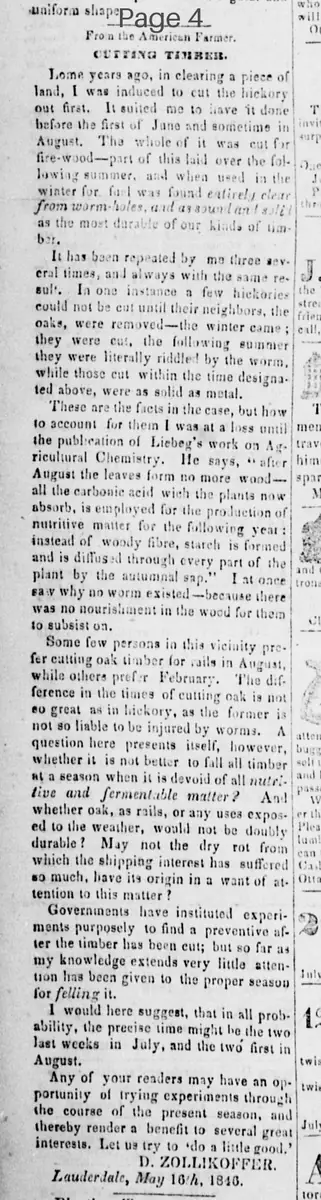
Some years ago, in clearing a piece of land, I was induced to cut the hickory out first. It suited me to have it done before the first of June and sometime in August. The whole of it was cut for fire-wood--part of this laid over the following summer, and when used in the winter for fuel was found entirely clear from worm-holes, and as sound and as solid as the most durable of our kinds of timber.
It has been repeated by me three several times, and always with the same result. In one instance a few hickories could not be cut until their neighbors, the oaks, were removed--the winter came; they were cut the following summer they were literally riddled by the worm, while those cut within the time designated above, were as solid as metal.
These are the facts in the case, but how to account for them I was at a loss until the publication of Liebig's work on Agricultural Chemistry. He says, 'after August the leaves form no more wood--all the carbonic acid which the plants now absorb, is employed for the production of nutritive matter for the following year: instead of woody fibre, starch is formed and is diffused through every part of the plant by the autumnal sap.' I at once saw why no worm existed--because there was no nourishment in the wood for them to subsist on.
Some few persons in this vicinity prefer cutting oak timber for rails in August, while others prefer February. The difference in the times of cutting oak is not so great as in hickory, as the former is not so liable to be injured by worms. A question here presents itself, however, whether it is not better to fell all timber at a season when it is devoid of all nutritive and fermentable matter? And whether oak, as rails, or any uses exposed to the weather, would not be doubly durable? May not the dry rot from which the shipping interest has suffered so much, have its origin in a want of attention to this matter?
Governments have instituted experiments purposely to find a preventive after the timber has been cut; but so far as my knowledge extends very little attention has been given to the proper season for felling it.
I would here suggest, that in all probability, the precise time might be the two last weeks in July, and the two first in August.
Any of your readers may have an opportunity of trying experiments through the course of the present season, and thereby render a benefit to several great interests. Let us try to 'do a little good.'
D. ZOLLIKOFFER.
Lauderdale, May 16th, 1840.
CUTTING TIMBER.
Some years ago, in clearing a piece of land, I was induced to cut the hickory out first. It suited me to have it done before the first of June and sometime in August. The whole of it was cut for fire-wood--part of this laid over the following summer, and when used in the winter for fuel was found entirely clear from worm-holes, and as sound and as solid as the most durable of our kinds of timber.
It has been repeated by me three several times, and always with the same result. In one instance a few hickories could not be cut until their neighbors, the oaks, were removed--the winter came; they were cut the following summer they were literally riddled by the worm, while those cut within the time designated above, were as solid as metal.
These are the facts in the case, but how to account for them I was at a loss until the publication of Liebig's work on Agricultural Chemistry. He says, 'after August the leaves form no more wood--all the carbonic acid which the plants now absorb, is employed for the production of nutritive matter for the following year: instead of woody fibre, starch is formed and is diffused through every part of the plant by the autumnal sap.' I at once saw why no worm existed--because there was no nourishment in the wood for them to subsist on.
Some few persons in this vicinity prefer cutting oak timber for rails in August, while others prefer February. The difference in the times of cutting oak is not so great as in hickory, as the former is not so liable to be injured by worms. A question here presents itself, however, whether it is not better to fell all timber at a season when it is devoid of all nutritive and fermentable matter? And whether oak, as rails, or any uses exposed to the weather, would not be doubly durable? May not the dry rot from which the shipping interest has suffered so much, have its origin in a want of attention to this matter?
Governments have instituted experiments purposely to find a preventive after the timber has been cut; but so far as my knowledge extends very little attention has been given to the proper season for felling it.
I would here suggest, that in all probability, the precise time might be the two last weeks in July, and the two first in August.
Any of your readers may have an opportunity of trying experiments through the course of the present season, and thereby render a benefit to several great interests. Let us try to 'do a little good.'
D. ZOLLIKOFFER.
Lauderdale, May 16th, 1840.
What sub-type of article is it?
Curiosity
Biography
What themes does it cover?
Nature
Triumph
What keywords are associated?
Timber Cutting
Hickory Wood
Worm Damage
Agricultural Chemistry
Liebig
Oak Rails
Dry Rot
What entities or persons were involved?
D. Zollikoffer
Where did it happen?
Lauderdale
Story Details
Key Persons
D. Zollikoffer
Location
Lauderdale
Event Date
May 16th, 1840
Story Details
Personal experiments demonstrate that hickory cut before June or in August remains worm-free and solid due to lack of nutritive starch, as explained by Liebig's chemistry; suggests optimal felling times for timber durability and calls for trials.