Thank you for visiting SNEWPapers!
Sign up free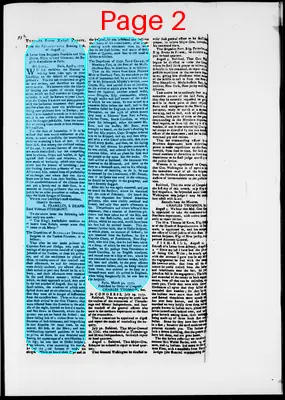
The Newport Gazette
Newport, Newport County, Rhode Island
What is this article about?
Benjamin Franklin and Silas Deane write to Lord Stormont protesting the cruel treatment of American prisoners by British forces, including close confinement, forced labor on ships, flogging, and deportation to Africa and Asia. Includes depositions from Eliphalet Downer and Capt. Seth Clark detailing abuses, published by Congress order.
Clipping
OCR Quality
Full Text
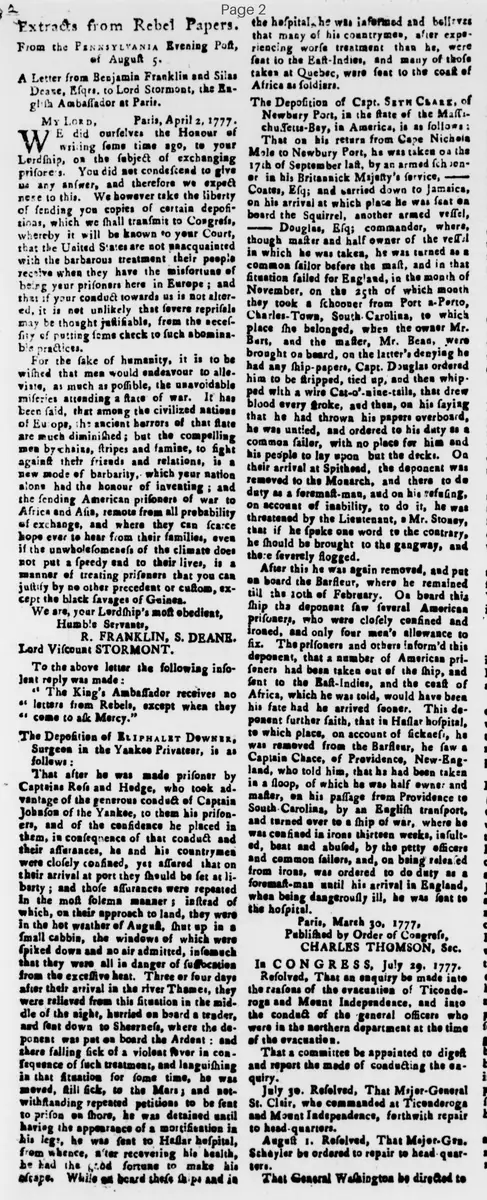
From the Pennsylvania Evening Post, of August 5.
A Letter from Benjamin Franklin and Silas Deane, Esqs. to Lord Stormont, the English Ambassador at Paris.
My Lord,
Paris, April 2, 1777.
We did ourselves the Honour of writing some time ago, to your Lordship, on the subject of exchanging prisoners. You did not condescend to give us any answer, and therefore we expect none to this. However we take the liberty of sending you copies of certain depositions, which we shall transmit to Congress, whereby it will be known to your Court, that the United States are not unacquainted with the barbarous treatment their people receive when they have the misfortune of being your prisoners here in Europe; and that if your conduct towards us is not altered, it is not unlikely that severe reprisals may be thought justifiable, from the necessity of putting some check to such abominable practices.
For the sake of humanity, it is to be wished that men would endeavour to alleviate, as much as possible, the unavoidable miseries attending a state of war. It has been said, that among the civilized nations of Europe, the ancient horrors of that state are much diminished; but the compelling men by chains, stripes and famine, to fight against their friends and relations, is a new mode of barbarity, which your nation alone had the honour of inventing; and the sending American prisoners of war to Africa and Asia, remote from all probability of exchange, and where they can scarce hope ever to hear from their families, even if the unwholesomeness of the climate does not put a speedy end to their lives, is a manner of treating prisoners that you can justify by no other precedent or custom, except the black savages of Guinea.
We are, your Lordship's most obedient,
Humble Servants,
B. FRANKLIN, S. DEANE.
Lord Viscount STORMONT.
To the above letter the following insolent reply was made:
The King's Ambassador receives no letters from Rebels, except when they come to ask Mercy.
The Deposition of Eliphalet Downer, Surgeon in the Yankee Privateer, is as follows:
That after he was made prisoner by Captains Ross and Hodge, who took advantage of the generous conduct of Captain Johnson of the Yankee, to them his prisoners, and of the confidence he placed in them, in consequence of that conduct and their assurances, he and his countrymen were closely confined, yet assured that on their arrival at port they should be set at liberty: and those assurances were repeated in the most solemn manner; instead of which, on their approach to land, they were in the hot weather of August shut up in a small cabin, the windows of which were spiked down and no air admitted, insomuch that they were all in danger of suffocation from the excessive heat. Three or four days after their arrival in the river Thames, they were relieved from this situation in the middle of the night, hurried on board a tender, and sent down to Sheerness, where the deponent was put on board the Ardent: and there falling sick of a violent fever in consequence of such treatment, and languishing in that situation for some time, he was moved, still sick, to the Mars; and notwithstanding repeated petitions to be sent to prison on shore, he was detained until having the appearance of a mortification in his leg, he was sent to Haslar hospital, from whence, after recovering his health, he had the good fortune to make his escape. While on board these ships and in the hospital he was informed and believes that many of his countrymen, after experiencing worse treatment than he, were sent to the East-Indies, and many of those taken at Quebec, were sent to the coast of Africa as soldiers.
The Deposition of Capt. Seth Clark, of Newbury Port, in the state of the Massachusetts-Bay, in America, is as follows:
That on his return from Cape Nicholas Mole to Newbury Port, he was taken on the 17th of September last, by an armed schooner in his Britannick Majesty's service, Coates, Esq; and carried down to Jamaica, on his arrival at which place he was sent on board the Squirrel, another armed vessel, Douglas, Esq; commander, where, though master and half owner of the vessel in which he was taken, he was turned to as a common sailor before the mast, and in that situation sailed for England, in the month of November, on the 25th of which month they took a schooner from Port a Paix, Charles-Town, South Carolina, to which place she belonged, when the owner Mr. Burt, and the master, Mr. Bean, were brought on board, on the latter's denying he had any Ship-papers, Capt. Douglas ordered him to be stripped, tied up, and then whipped with a wire Cat-o'-nine-tails, that drew blood every stroke, and then, on his saying that he had thrown his papers overboard, he was untied, and ordered to his duty as a common sailor, with no place for him and his people to lay upon but the decks. On their arrival at Spithead, the deponent was removed to the Monarch, and there to do duty as a foremast-man, and on his refusing, on account of inability, to do it, he was threatened by the Lieutenant, a Mr. Stoney, that if he spoke one word to the contrary, he should be brought to the gangway, and there severely flogged. After this he was again removed, and put on board the Barfleur, where he remained till the 20th of February. On board this ship the deponent saw several American prisoners, who were closely confined and ironed, and only four men's allowance to six. The prisoners and others informed this deponent, that a number of American prisoners had been taken out of the Ship, and sent to the East-Indies, and the coast of Africa, which he was told, would have been his fate had he arrived sooner. This deponent further saith, that in Haslar hospital, to which place, on account of sickness, he was removed from the Barfleur, he saw a Captain Chase, of Providence, New-England, who told him, that he had been taken in a sloop, of which he was half owner and master, on his passage from Providence to South-Carolina, by an English transport, and turned over to a ship of war, where he was confined in irons thirteen weeks, insulted, beat and abused, by the petty officers and common sailors, and, on being released from irons, was ordered to do duty as a foremast-man until his arrival in England, when being dangerously ill, he was sent to the hospital.
Paris, March 30, 1777:
Published by Order of Congress,
CHARLES THOMSON, Sec.
What sub-type of article is it?
What keywords are associated?
What entities or persons were involved?
Where did it happen?
Foreign News Details
Primary Location
Paris
Event Date
April 2, 1777
Key Persons
Outcome
threats of severe reprisals if treatment not altered; many american prisoners sent to east-indies and coast of africa; instances of illness, escape, and forced labor on british ships.
Event Details
Franklin and Deane send letter to Stormont protesting barbarous treatment of American prisoners in Europe, including chains, stripes, famine, forced fighting against relations, and deportation to Africa and Asia. Stormont replies insolently. Depositions detail captures at sea, false assurances, suffocating confinement, fever, forced sailor duty, flogging, ironing, reduced rations, and threats of flogging.