Thank you for visiting SNEWPapers!
Sign up free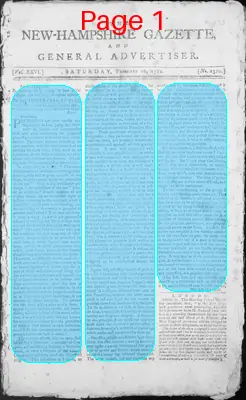
Letter to Editor
February 16, 1782
The New Hampshire Gazette And General Advertiser
Portsmouth, Exeter, Rockingham County, New Hampshire
What is this article about?
An inhabitant critiques the proposed state constitution's religious restrictions, arguing for equal legal protection for all peaceful residents regardless of faith and removal of Protestant-only qualifications for public offices, proposing morality and social virtues as the sole criteria for eligibility.
Clipping
OCR Quality
95%
Excellent
Full Text
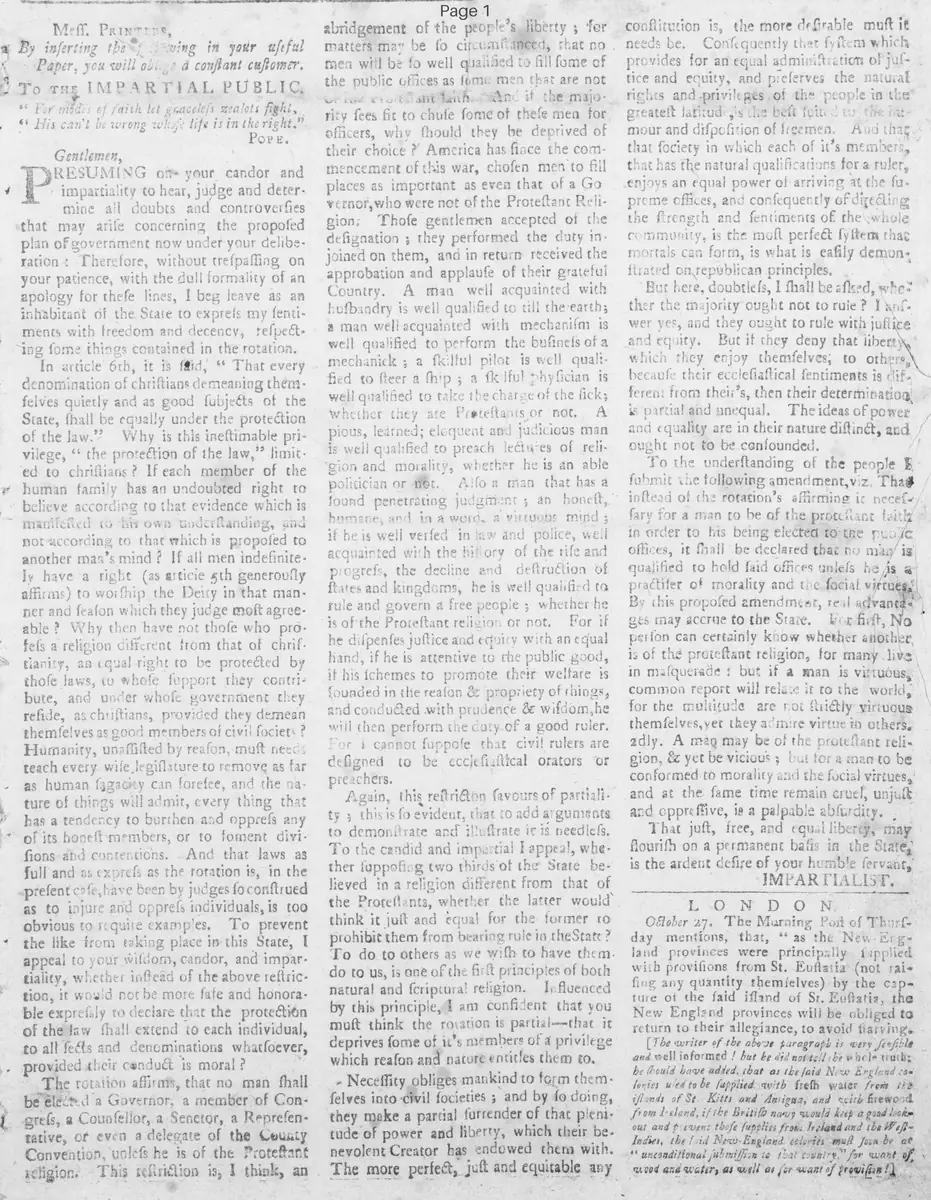
Mess. Printers,
By inserting the foregoing in your useful Paper, you will oblige a constant customer.
TO THE IMPARTIAL PUBLIC.
"For modes of faith let graceless zealots fight,
His can't be wrong whose life is in the right."
POPE.
Gentlemen,
Presuming on your candor and impartiality to hear, judge and determine all doubts and controversies that may arise concerning the proposed plan of government now under your deliberation: Therefore, without trespassing on your patience, with the dull formality of an apology for these lines, I beg leave as an inhabitant of the State to express my sentiments with freedom and decency, respecting some things contained in the rotation.
In article 6th. it is said, That every denomination of christians demeaning themselves quietly and as good subjects of the State, shall be equally under the protection of the law." Why is this inestimable privilege, "the protection of the law." limited to christians? If each member of the human family has an undoubted right to believe according to that evidence which is manifested to his own Understanding, and not according to that which is proposed to another man's mind? If all men indefinitely have a right (as article 9th generously affirms) to worship the Deity in that manner and season which they judge most agreeable? Why then have not those who profess a religion different from that of christianity, an equal right to be protected by those laws, to whose support they contribute, and under whose government they reside, as christians, provided they demean themselves as good members of civil society?
Humanity, unassisted by reason, must needs teach every wise legislature to remove as far as human sagacity can foresee, and the nature of things will admit, every thing that has a tendency to burthen and oppress any of its honest members, or to foment divisions and contentions. And that laws as full and as express as the rotation is, in the present case, have been by judges so construed as to injure and oppress individuals, is too obvious to require examples. To prevent the like from taking place in this State, I appeal to your wisdom, candor, and impartiality, whether instead of the above restriction, it would not be more safe and honorable expressly to declare that the protection of the law shall extend to each individual, to all sects and denominations whatsoever, provided their conduct is moral?
The rotation affirms, that no man shall be elected a Governor, a member of Congress, a Counsellor, a Senator, a Representative, or even a delegate of the County Convention, unless he is of the Protestant religion. This restriction is, I think, an abridgement of the people's liberty; for matters may be so circumstanced, that no men will be so well qualified to fill some of the public offices as some men that are not of the protestant faith, if the majority sees fit to choose some of these men for officers, why should they be deprived of their choice? America has since the commencement of this war, chosen men to fill places as important as even that of a Governor, who were not of the Protestant Religion: Those gentlemen accepted of the designation; they performed the duty enjoined on them, and in return received the approbation and applause of their grateful Country. A man well acquainted with husbandry is well qualified to till the earth: a man well acquainted with mechanism is well qualified to perform the business of a mechanic: a skilful pilot is well qualified to steer a ship; a skilful physician is well qualified to take the charge of the sick: whether they are Protestants or not.
A pious, learned, eloquent and judicious man is well qualified to preach lectures of religion and morality, whether he is an able politician or not. Also a man that has a sound penetrating judgment; an honest, humane, and in a word, a virtuous mind; if he is well versed in law and police, well acquainted with the history of the rise and progress, the decline and destruction of states and kingdoms, he is well qualified to rule and govern a free people; whether he is of the Protestant religion or not. For if he dispenses justice and equity with an equal hand, if he is attentive to the public good, if his schemes to promote their welfare is founded in the reason & propriety of things, and conducted with prudence & wisdom, he will then perform the duty of a good ruler.
For I cannot suppose that civil rulers are designed to be ecclesiastical orators or preachers.
Again, this restriction savors of partiality; this is so evident, that to add arguments to demonstrate and illustrate it is needless. To the candid and impartial I appeal, whether supposing two thirds of the State believed in a religion different from that of the Protestants, whether the latter would think it just and equal for the former to prohibit them from bearing rule in the State? To do to others as we wish to have them do to us, is one of the first principles of both natural and scriptural religion. Influenced by this principle, I am confident that you must think the rotation is partial--that it deprives some of it's members of a privilege which reason and nature entitles them to.
Necessity obliges mankind to form themselves into civil societies; and by so doing, they make a partial surrender of that plenitude of power and liberty, which their benevolent Creator has endowed them with. The more perfect, just and equitable any constitution is, the more desirable must it needs be. Consequently that system which provides for an equal administration of justice and equity, and preserves the natural rights and privileges of the people in the greatest latitude 's the best suited to the temper and disposition of freemen. And that society in which each of it's members, that has the natural qualifications for a ruler, enjoys an equal power of arriving at the supreme offices, and consequently of directing the strength and sentiments of the whole community, is the most perfect system that mortals can form, as what is easily demonstrated on republican principles.
But here, doubtless, I shall be asked, whether the majority ought not to rule? I answer yes, and they ought to rule with justice and equity. But if they deny that liberty which they enjoy themselves; to others, because their ecclesiastical sentiments is different from theirs, then their determination is partial and unequal. The ideas of power and equality are in their nature distinct, and ought not to be confounded.
To the understanding of the people I submit the following amendment, viz, That instead of the rotation's affirming it necessary for a man to be of the protestant faith in order to his being elected to the ruling offices, it shall be declared that no man is qualified to hold said offices unless he is a practiser of morality and the social virtues.
By this proposed amendment, real advantages may accrue to the State. For first, No person can certainly know whether another is of the protestant religion, for many live in masquerade: but if a man is virtuous, common report will relate it to the world, for the multitude are not strictly virtuous themselves, yet they admire virtue in others.
Secondly. A man may be of the protestant religion, & yet be vicious; but for a man to be conformed to morality and the social virtues, and at the same time remain cruel, unjust and oppressive, is a palpable absurdity.
That just, free, and equal liberty, may flourish on a permanent basis in the State, is the ardent desire of your humble servant,
IMPARTIALIST.
By inserting the foregoing in your useful Paper, you will oblige a constant customer.
TO THE IMPARTIAL PUBLIC.
"For modes of faith let graceless zealots fight,
His can't be wrong whose life is in the right."
POPE.
Gentlemen,
Presuming on your candor and impartiality to hear, judge and determine all doubts and controversies that may arise concerning the proposed plan of government now under your deliberation: Therefore, without trespassing on your patience, with the dull formality of an apology for these lines, I beg leave as an inhabitant of the State to express my sentiments with freedom and decency, respecting some things contained in the rotation.
In article 6th. it is said, That every denomination of christians demeaning themselves quietly and as good subjects of the State, shall be equally under the protection of the law." Why is this inestimable privilege, "the protection of the law." limited to christians? If each member of the human family has an undoubted right to believe according to that evidence which is manifested to his own Understanding, and not according to that which is proposed to another man's mind? If all men indefinitely have a right (as article 9th generously affirms) to worship the Deity in that manner and season which they judge most agreeable? Why then have not those who profess a religion different from that of christianity, an equal right to be protected by those laws, to whose support they contribute, and under whose government they reside, as christians, provided they demean themselves as good members of civil society?
Humanity, unassisted by reason, must needs teach every wise legislature to remove as far as human sagacity can foresee, and the nature of things will admit, every thing that has a tendency to burthen and oppress any of its honest members, or to foment divisions and contentions. And that laws as full and as express as the rotation is, in the present case, have been by judges so construed as to injure and oppress individuals, is too obvious to require examples. To prevent the like from taking place in this State, I appeal to your wisdom, candor, and impartiality, whether instead of the above restriction, it would not be more safe and honorable expressly to declare that the protection of the law shall extend to each individual, to all sects and denominations whatsoever, provided their conduct is moral?
The rotation affirms, that no man shall be elected a Governor, a member of Congress, a Counsellor, a Senator, a Representative, or even a delegate of the County Convention, unless he is of the Protestant religion. This restriction is, I think, an abridgement of the people's liberty; for matters may be so circumstanced, that no men will be so well qualified to fill some of the public offices as some men that are not of the protestant faith, if the majority sees fit to choose some of these men for officers, why should they be deprived of their choice? America has since the commencement of this war, chosen men to fill places as important as even that of a Governor, who were not of the Protestant Religion: Those gentlemen accepted of the designation; they performed the duty enjoined on them, and in return received the approbation and applause of their grateful Country. A man well acquainted with husbandry is well qualified to till the earth: a man well acquainted with mechanism is well qualified to perform the business of a mechanic: a skilful pilot is well qualified to steer a ship; a skilful physician is well qualified to take the charge of the sick: whether they are Protestants or not.
A pious, learned, eloquent and judicious man is well qualified to preach lectures of religion and morality, whether he is an able politician or not. Also a man that has a sound penetrating judgment; an honest, humane, and in a word, a virtuous mind; if he is well versed in law and police, well acquainted with the history of the rise and progress, the decline and destruction of states and kingdoms, he is well qualified to rule and govern a free people; whether he is of the Protestant religion or not. For if he dispenses justice and equity with an equal hand, if he is attentive to the public good, if his schemes to promote their welfare is founded in the reason & propriety of things, and conducted with prudence & wisdom, he will then perform the duty of a good ruler.
For I cannot suppose that civil rulers are designed to be ecclesiastical orators or preachers.
Again, this restriction savors of partiality; this is so evident, that to add arguments to demonstrate and illustrate it is needless. To the candid and impartial I appeal, whether supposing two thirds of the State believed in a religion different from that of the Protestants, whether the latter would think it just and equal for the former to prohibit them from bearing rule in the State? To do to others as we wish to have them do to us, is one of the first principles of both natural and scriptural religion. Influenced by this principle, I am confident that you must think the rotation is partial--that it deprives some of it's members of a privilege which reason and nature entitles them to.
Necessity obliges mankind to form themselves into civil societies; and by so doing, they make a partial surrender of that plenitude of power and liberty, which their benevolent Creator has endowed them with. The more perfect, just and equitable any constitution is, the more desirable must it needs be. Consequently that system which provides for an equal administration of justice and equity, and preserves the natural rights and privileges of the people in the greatest latitude 's the best suited to the temper and disposition of freemen. And that society in which each of it's members, that has the natural qualifications for a ruler, enjoys an equal power of arriving at the supreme offices, and consequently of directing the strength and sentiments of the whole community, is the most perfect system that mortals can form, as what is easily demonstrated on republican principles.
But here, doubtless, I shall be asked, whether the majority ought not to rule? I answer yes, and they ought to rule with justice and equity. But if they deny that liberty which they enjoy themselves; to others, because their ecclesiastical sentiments is different from theirs, then their determination is partial and unequal. The ideas of power and equality are in their nature distinct, and ought not to be confounded.
To the understanding of the people I submit the following amendment, viz, That instead of the rotation's affirming it necessary for a man to be of the protestant faith in order to his being elected to the ruling offices, it shall be declared that no man is qualified to hold said offices unless he is a practiser of morality and the social virtues.
By this proposed amendment, real advantages may accrue to the State. For first, No person can certainly know whether another is of the protestant religion, for many live in masquerade: but if a man is virtuous, common report will relate it to the world, for the multitude are not strictly virtuous themselves, yet they admire virtue in others.
Secondly. A man may be of the protestant religion, & yet be vicious; but for a man to be conformed to morality and the social virtues, and at the same time remain cruel, unjust and oppressive, is a palpable absurdity.
That just, free, and equal liberty, may flourish on a permanent basis in the State, is the ardent desire of your humble servant,
IMPARTIALIST.
What sub-type of article is it?
Persuasive
Political
Ethical Moral
What themes does it cover?
Constitutional Rights
Religion
Politics
What keywords are associated?
Religious Freedom
Constitutional Restrictions
Protestant Requirement
Moral Qualifications
Equal Protection
Public Offices
State Constitution
What entities or persons were involved?
Impartialist
To The Impartial Public
Letter to Editor Details
Author
Impartialist
Recipient
To The Impartial Public
Main Argument
the proposed constitution's religious restrictions limit legal protection and office eligibility to christians and protestants, abridging liberty; instead, extend protection to all moral individuals and qualify rulers by morality and virtues, not faith.
Notable Details
Quotes Pope On Faith And Life
References Articles 6th And 9th Of The Rotation
Appeals To Golden Rule
Proposes Amendment For Moral Qualifications