Thank you for visiting SNEWPapers!
Sign up free
Story
August 31, 1953
Trainman News
Indianapolis, Marion County, Indiana
What is this article about?
The standard 4'-8.5" gauge of American railroads originated from English wagon tracks, which followed Roman chariot wheel spacing of 4'-8", based on the 28-inch stride of Caesar's soldiers. Modern taller US soldiers have a 30-inch stride, potentially leading to a 5'-0" gauge if Romans were similarly tall.
Clipping
OCR Quality
98%
Excellent
Full Text
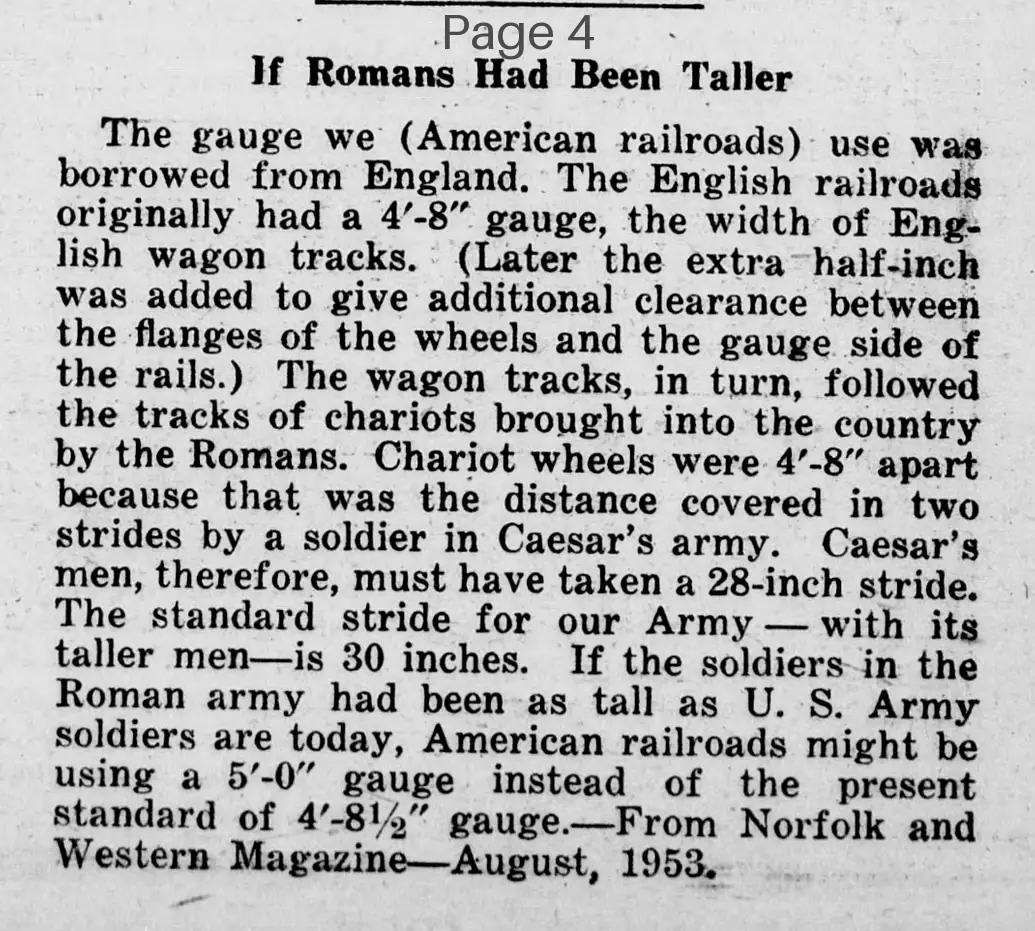
If Romans Had Been Taller
The gauge we (American railroads) use was borrowed from England. The English railroads originally had a 4'-8" gauge, the width of English wagon tracks. (Later the extra-half-inch was added to give additional clearance between the flanges of the wheels and the gauge side of the rails.) The wagon tracks, in turn, followed the tracks of chariots brought into the country by the Romans. Chariot wheels were 4'-8" apart because that was the distance covered in two strides by a soldier in Caesar's army. Caesar's men, therefore, must have taken a 28-inch stride. The standard stride for our Army --with its taller men --is 30 inches. If the soldiers in the Roman army had been as tall as U. S. Army soldiers are today, American railroads might be using a 5'-0" gauge instead of the present standard of 4'-81/2" gauge.--From Norfolk and Western Magazine--August, 1953.
The gauge we (American railroads) use was borrowed from England. The English railroads originally had a 4'-8" gauge, the width of English wagon tracks. (Later the extra-half-inch was added to give additional clearance between the flanges of the wheels and the gauge side of the rails.) The wagon tracks, in turn, followed the tracks of chariots brought into the country by the Romans. Chariot wheels were 4'-8" apart because that was the distance covered in two strides by a soldier in Caesar's army. Caesar's men, therefore, must have taken a 28-inch stride. The standard stride for our Army --with its taller men --is 30 inches. If the soldiers in the Roman army had been as tall as U. S. Army soldiers are today, American railroads might be using a 5'-0" gauge instead of the present standard of 4'-81/2" gauge.--From Norfolk and Western Magazine--August, 1953.
What sub-type of article is it?
Curiosity
Historical Event
What keywords are associated?
Railroad Gauge
Roman Chariots
Soldier Stride
Historical Influence
Caesar Army
What entities or persons were involved?
Caesar
Where did it happen?
England, Rome
Story Details
Key Persons
Caesar
Location
England, Rome
Event Date
Roman Era
Story Details
American railroad gauge traces to Roman chariot wheels spaced by Caesar's soldiers' 28-inch strides; taller modern soldiers suggest a wider gauge if Romans matched their height.