Thank you for visiting SNEWPapers!
Sign up free
The Times News
Hendersonville, Henderson County, North Carolina
What is this article about?
In Geneva on May 11, British economist A.J.S. Baster warns that neutral states cannot escape the economic slump brewing from the global arms race, as international trade links expansions and contractions. He urges an armaments truce with economic clauses to promote trade and prevent war or hardship.
Clipping
OCR Quality
Full Text
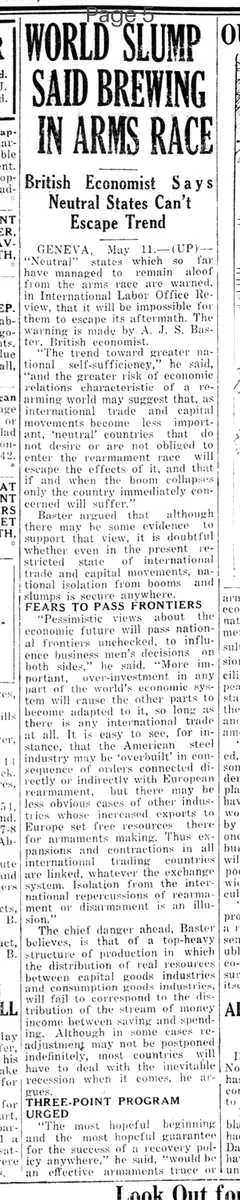
British Economist Says Neutral States Can't Escape Trend
GENEVA. May 11.--(UP)-- "Neutral" states which so far have managed to remain aloof from the arms race are warned, in International Labor Office Review, that it will be impossible for them to escape its aftermath. The warning is made by A. J. S. Baster, British economist.
"The trend toward greater national self-sufficiency," he said, "and the greater risk of economic relations characteristic of a rearming world may suggest that, as international trade and capital movements become less important, 'neutral' countries that do not desire or are not obliged to enter the rearmament race will escape the effects of it, and that if and when the boom collapses only the country immediately concerned will suffer."
Baster argued that although there may be some evidence to support that view, it is doubtful whether even in the present restricted state of international trade and capital movements, national isolation from booms and slumps is secure anywhere.
FEARS TO PASS FRONTIERS
"Pessimistic views about the economic future will pass national frontiers unchecked, to influence business men's decisions on both sides," he said. "More important, over-investment in any part of the world's economic system will cause the other parts to become adapted to it, so long as there is any international trade at all. It is easy to see, for instance, that the American steel industry may be 'overbuilt' in consequence of orders connected directly or indirectly with European rearmament, but there may be less obvious cases of other industries whose increased exports to Europe set free resources there for armaments making. Thus expansions and contractions in all international trading countries are linked, whatever the exchange system. Isolation from the international repercussions of rearmament or disarmament is an illusion."
The chief danger ahead, Baster believes, is that of a top-heavy structure of production in which the distribution of real resources between capital goods industries and consumption goods industries, will fail to correspond to the distribution of the stream of money income between saving and spending. Although in some cases re-adjustment may not be postponed indefinitely, most countries will have to deal with the inevitable recession when it comes, he argues.
THREE-POINT PROGRAM URGED
"The most hopeful beginning and the most hopeful guarantee for the success of a recovery policy anywhere," he said, "would be an effective armaments truce or armaments convention containing economic clauses embodying international agreement." The agreement would aim at three main results: the liberation and expansion of international trade to facilitate diversion of war plants to peace-time production; a plain statement of national policy by the principal economic countries. and an exchange of information among them.
"The alternatives," he concluded, "to an armaments truce and some international economic understanding such as suggested are plain. Either rearmament will have its natural consequence in a world war. precipitated perhaps by the economic breakdown of one of the competitors. or the burden of armaments expenditure will become so intolerable in the poorer countries as to produce widespread hardship, with incalculable political consequences.
"It is certain that the economic problems that would be raised by a return to international common-sense in this matter are so insoluble, given the modest degree of co-operation which would be assured by an armaments truce itself."
What sub-type of article is it?
What keywords are associated?
What entities or persons were involved?
Where did it happen?
Foreign News Details
Primary Location
Geneva
Event Date
May 11
Key Persons
Outcome
potential world slump, world war, or widespread hardship in poorer countries; proposed armaments truce with economic clauses to expand trade and prevent recession.
Event Details
British economist A. J. S. Baster warns in the International Labor Office Review that neutral states cannot escape the economic effects of the global arms race due to linked international trade and capital movements. He argues that over-investment and pessimistic views will spread, leading to a top-heavy production structure and inevitable recession. Baster urges an international armaments truce or convention with economic clauses to liberate trade, state national policies, and exchange information, warning that alternatives could lead to war or political hardship.