Thank you for visiting SNEWPapers!
Sign up free
The New Hampshire Gazette And Historical Chronicle
Portsmouth, Greenland, Rockingham County, New Hampshire
What is this article about?
Report from London Gazette on King George III's speech to Parliament on Nov 15, 1763, addressing post-war peace, commerce, and debt. Includes Lords and Commons addresses congratulating on prince's birth and peace. Covers parliamentary actions on libels 'Essay on Woman' and 'North Briton No. 45' implicating John Wilkes, leading to his arrest, duel with Martin (wounded but recovering), and resolutions condemning the publications.
Merged-components note: These components form a continuous narrative on British parliamentary proceedings, the Wilkes scandal, and details of the libel 'Essay on Woman', all under foreign news from London.
Clippings
1 of 3
OCR Quality
Full Text
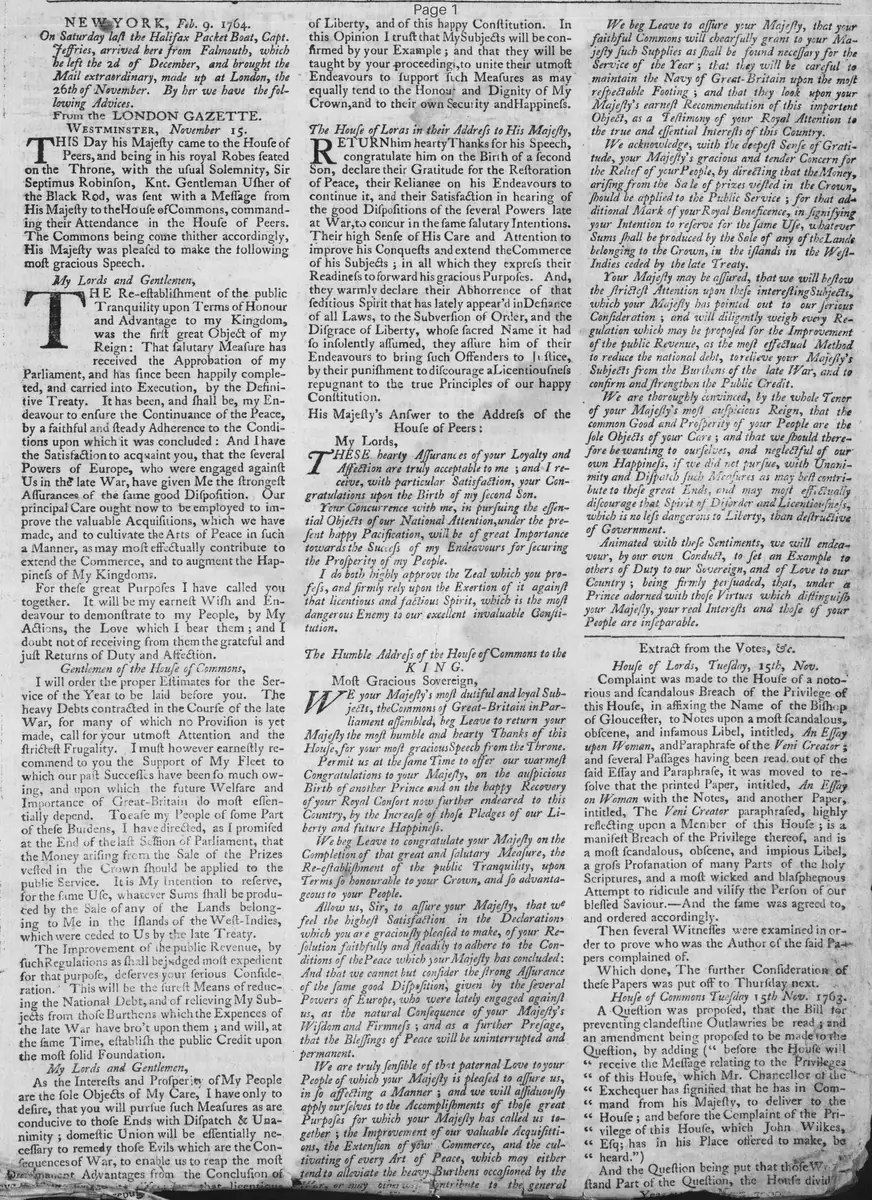
On Saturday last the Halifax Packet Boat, Capt. Jeffries, arrived here from Falmouth, which he left the 2d of December, and brought the Mail extraordinary, made up at London, the 26th of November. By her we have the following Advices.
From the LONDON GAZETTE.
WESTMINSTER, November 15.
This Day his Majesty came to the House of Peers, and being in his royal Robes seated on the Throne, with the usual Solemnity, Sir Septimus Robinson, Knt. Gentleman Usher of the Black Rod, was sent with a Message from His Majesty to the House of Commons, commanding their Attendance in the House of Peers. The Commons being come thither accordingly, His Majesty was pleased to make the following most gracious Speech.
My Lords and Gentlemen,
The Re-establishment of the public Tranquility upon Terms of Honour and Advantage to my Kingdom, was the first great Object of my Reign: That salutary Measure has received the Approbation of my Parliament, and has since been happily completed, and carried into Execution, by the Definitive Treaty. It has been, and shall be, my Endeavour to ensure the Continuance of the Peace, by a faithful and steady Adherence to the Conditions upon which it was concluded: And I have the Satisfaction to acquaint you, that the several Powers of Europe, who were engaged against Us in the late War, have given Me the strongest Assurances of the same good Disposition. Our principal Care ought now to be employed to improve the valuable Acquisitions, which we have made, and to cultivate the Arts of Peace in such a Manner, as may most effectually contribute to extend the Commerce, and to augment the Happiness of My Kingdoms.
For these great Purposes I have called you together. It will be my earnest Wish and Endeavour to demonstrate to my People, by My Actions, the Love which I bear them; and I doubt not of receiving from them the grateful and just Returns of Duty and Affection.
Gentlemen of the House of Commons,
I will order the proper Estimates for the Service of the Year to be laid before you. The heavy Debts contracted in the Course of the late War, for many of which no Provision is yet made, call for your utmost Attention and the strictest Frugality. I must however earnestly recommend to you the Support of My Fleet, to which our past Successes have been so much owing, and upon which the future Welfare and Importance of Great-Britain do most essentially depend. To ease my People of some Part of these Burdens, I have directed, as I promised at the End of the last Session of Parliament, that the Money arising from the Sale of the Prizes vested in the Crown should be applied to the public Service. It is My Intention to reserve, for the same Use, whatever Sums shall be produced by the Sale of any of the Lands belonging to Me in the Islands of the West-Indies, which were ceded to Us by the late Treaty.
The Improvement of the public Revenue, by such Regulations as shall be judged most expedient for that purpose, deserves your serious Consideration. This will be the surest Means of reducing the National Debt, and of relieving My Subjects from those Burthens which the Expences of the late War have brought upon them; and will, at the same Time, establish the public Credit upon the most solid Foundation.
My Lords and Gentlemen,
As the Interests and Prosperity of My People are the sole Objects of My Care, I have only to desire, that you will pursue such Measures as are conducive to those Ends with Dispatch & Unanimity; domestic Union will be essentially necessary to remedy those Evils which are the Consequences of War, to enable us to reap the most permanent Advantages from the Conclusion of of Liberty, and of this happy Constitution. In this Opinion I trust that My Subjects will be confirmed by your Example; and that they will be taught by your Proceedings, to unite their utmost Endeavours to support such Measures as may equally tend to the Honour and Dignity of My Crown, and to their own Security and Happiness.
The House of Lords in their Address to His Majesty, return him hearty Thanks for his Speech, congratulate him on the Birth of a second Son, declare their Gratitude for the Restoration of Peace, their Reliance on his Endeavours to continue it, and their Satisfaction in hearing of the good Dispositions of the several Powers late at War, to concur in the same salutary Intentions. Their high Sense of His Care and Attention to improve his Conquests and extend the Commerce of his Subjects; in all which they express their Readiness to forward his gracious Purposes. And they warmly declare their Abhorrence of that seditious Spirit that has lately appeared in Defiance of all Laws, to the Subversion of Order, and the Disgrace of Liberty, whose sacred Name it had so insolently assumed, they assure him of their Endeavours to bring such Offenders to Justice, by their punishment to discourage a Licentiousness repugnant to the true Principles of our happy Constitution.
His Majesty's Answer to the Address of the House of Peers:
My Lords,
These hearty Assurances of your Loyalty and Affection are truly acceptable to me; and I receive, with particular Satisfaction, your Congratulations upon the Birth of my second Son. Your Concurrence with me, in pursuing the essential Objects of our National Attention, under the present happy Pacification, will be of great Importance towards the Success of my Endeavours for securing the Prosperity of my People.
I do both highly approve the Zeal which you profess, and firmly rely upon the Exertion of it against that licentious and factious Spirit, which is the most dangerous Enemy to our excellent invaluable Constitution.
The Humble Address of the House of Commons to the KING.
Most Gracious Sovereign,
We your Majesty's most dutiful and loyal Subjects, the Commons of Great-Britain in Parliament assembled, beg Leave to return your Majesty the most humble and hearty Thanks of this House, for your most gracious Speech from the Throne. Permit us at the Same Time to offer our warmest Congratulations to your Majesty, on the auspicious Birth of another Prince and on the happy Recovery of your Royal Consort now further endeared to this Country, by the Increase of those Pledges of our Liberty and future Happiness.
We beg Leave to congratulate your Majesty on the Completion of that great and Salutary Measure, the Re-establishment of the public Tranquility, upon Terms so honourable to your Crown, and so advantageous to your People.
Allow us, Sir, to assure your Majesty, that we feel the highest Satisfaction in the Declaration which you are graciously pleased to make, of your Resolution faithfully and steadily to adhere to the Conditions of the Peace which your Majesty has concluded: And that we cannot but consider the strong Assurance of the same good Disposition, given by the several Powers of Europe, who were lately engaged against us, as the natural Consequence of your Majesty's Wisdom and Firmness; and as a further Presage, that the Blessings of Peace will be uninterrupted and permanent.
We are truly Sensible of that paternal Love to your People of which your Majesty is pleased to assure us, in so affecting a Manner; and we will assiduously apply ourselves to the Accomplishments of those great Purposes for which your Majesty has called us together; the Improvement of our valuable Acquisitions, the Extension of your Commerce, and the cultivating of every Art of Peace, which may either tend to alleviate the heavy Burthens occasioned by the contribute to the general We beg Leave to assure your Majesty, that your faithful Commons will cheerfully grant to your Majesty such Supplies as shall be found necessary for the Service of the Year; that they will be careful to maintain the Navy of Great-Britain upon the most respectable Footing; and that they look upon your Majesty's earnest Recommendation of this important Object, as a Testimony of your Royal Attention to the true and essential Interests of this Country.
We acknowledge, with the deepest Sense of Gratitude, your Majesty's gracious and tender Concern for the Relief of your People, by directing that the Money, arising from the Sale of prizes vested in the Crown, should be applied to the Public Service; for that additional Mark of your Royal Beneficence, in signifying your Intention to reserve for the same Use, whatever Sums shall be produced by the Sale of any of the Lands belonging to the Crown, in the Islands in the West-Indies ceded by the late Treaty.
Your Majesty may be assured, that we will bestow the strictest Attention upon these interesting Subjects, which your Majesty has pointed out to our serious Consideration; and will diligently weigh every Regulation which may be proposed for the Improvement of the public Revenue, as the most effectual Method to reduce the national debt, to relieve your Majesty's Subjects from the Burthens of the late War, and to confirm and strengthen the Public Credit.
We are thoroughly convinced, by the whole Tenor of your Majesty's most auspicious Reign, that the common Good and Prosperity of your People are the sole Objects of your Care; and that we should therefore be wanting to ourselves, and neglectful of our own Happiness, if we did not pursue, with Unanimity and Dispatch such Measures as may best contribute to these great Ends, and may most effectually discourage that Spirit of Disorder and Licentiousness, which is no less dangerous to Liberty, than destructive of Government.
Animated with these Sentiments, we will endeavour, by our own Conduct, to set an Example to others of Duty to our Sovereign, and of Love to our Country; being firmly persuaded, that, under a Prince adorned with those Virtues which distinguish your Majesty, your real Interests and those of your People are inseparable.
Extract from the Votes, &c.
House of Lords, Tuesday, 15th, Nov.
Complaint was made to the House of a notorious and scandalous Breach of the Privilege of this House, in affixing the Name of the Bishop of Gloucester, to Notes upon a most scandalous, obscene, and infamous Libel, intitled, An Essay upon Woman, and Paraphrase of the Veni Creator; and several Passages having been read out of the said Essay and Paraphrase, it was moved to resolve that the printed Paper, intitled, An Essay on Woman with the Notes, and another Paper, intitled, The Veni Creator paraphrased, highly reflecting upon a Member of this House; is a manifest Breach of the Privilege thereof, and is a most scandalous, obscene, and impious Libel, a gross Profanation of many Parts of the holy Scriptures, and a most wicked and blasphemous Attempt to ridicule and vilify the Person of our blessed Saviour.--And the same was agreed to, and ordered accordingly.
Then several Witnesses were examined in order to prove who was the Author of the said Papers complained of.
Which done, The further Consideration of these Papers was put off to Thursday next.
House of Commons Tuesday 15th Nov. 1763.
A Question was proposed, that the Bill for preventing clandestine Outlawries be read: and an amendment being proposed to be made to the Question, by adding (" before the House will receive the Message relating to the Privileges " of this House, which Mr. Chancellor of the Exchequer has signified that he has in Command from his Majesty, to deliver to the " House; and before the Complaint of the Privilege of this House, which John Wilkes, " Esq; has in his Place offered to make, be " heard.")
And the Question being put that those Words be inserted in the Question, : the: House divided
Mr. Chancellor of the Exchequer, by his Majesty's Command, presented the following Message to the House.
I am commanded by his Majesty to acquaint this House, that his Majesty having received Information that John Wilkes, Esq; a Member of this House, was the Author of a most seditious and dangerous Libel, published since the last Session of Parliament: He had caused the said John Wilkes, Esq: to be apprehended and secured, in order to his being tried for the same by due Course of Law; and Mr. Wilkes having been discharged out of Custody by the Court of Common Pleas, upon Account of his Privilege as a Member of this House; and having been called upon by the legal Process of the Court of King's Bench, stood out and declined to appear, and answer to an Information, which has since been exhibited against him, by His Majesty's Attorney General, for the same Offence. In this Situation his Majesty being desirous to shew all possible Attention to the Privileges of the House of Commons, in every Instance wherein they can be supposed to be concerned, and at the Same Time thinking it of the utmost Importance not to suffer the public Justice of the Kingdom to be eluded, has chosen to direct the said Libel, and also Copies of the Examinations, upon which Mr. Wilkes was apprehended and secured, to be laid before this House, for their Consideration.
Resolved, That an humble Address be presented to his Majesty, to return his Majesty the Thanks of this House, for his most gracious Message, and for the tender Regard therein expressed for the Privileges of this House; and to assure his Majesty that this House will forthwith take into their most serious Consideration the very important Matter, communicated by his Majesty's Message.
And a Question being proposed, that the Paper, intitled the North Briton No. 45 is a false, scandalous, and seditious Libel, containing Expressions of the most unexampled Insolence, and Contumely towards his Majesty; the grossest Aspersions upon both Houses of Parliament, and the most audacious Defiance of the Authority of the whole Legislature, and most manifestly tending to alienate the Affections of the People from his Majesty, to withdraw them from their Obedience to the Laws of the Realm, and to excite them to traitorous Insurrections against his Majesty's Government.
A Motion was made, and the Question put to leave out the Words, "and to excite them to traitorous Insurrections against his Majesty's Government."
The House divided, Yeas 111, Noes 273.
Then the Question, as first proposed, was agreed to; and the said Paper ordered to be burnt by the Hands of the common Hangman.
The further Consideration of the Message, adjourned till To-morrow at 12 o'Clock.
The Matter of the Complaint made by Mr. Wilkes of his Imprisonment, is adjourned till Thursday.
House of Lords, Thursday 17th Nov. 1763. It was moved, that an humble Address be presented to his Majesty, to lay before him the Resolution of this House, of the 15th inst. relative to a certain infamous and blasphemous Libel, and humbly to desire his Majesty, that he will be graciously pleased to give the most effectual Orders for the Prosecution of the Authors of the said scandalous and impious Libel, and for bringing them to condign Punishment. And the same was agreed to and ordered to be presented to his Majesty, by the Lords with white Staves.
Ordered, That the further Consideration of the said Papers be put off till Tuesday next, and the Lords summon'd.
As Mr. Wilkes, and the Matters in which he has been concern'd, have chiefly engrossed the public Attention, we shall collect together the whole Substance of our Accounts by the last Packet relative to those Matters:
Mr. Wilkes, before the Meeting of the Parliament on the 15th of November, had certainly lost a great deal of his Popularity, by the restless Endeavours of the numerous and powerful Enemies he had brought upon himself.--His private Character was scrutinized, and every Action of his Life, that Wit, Power, or Malice could represent in a blameable, or ridiculous Light, was exposed to the Public. And though it is no certain Rule to judge of a Person's public Character, by the Virtues or Vices of his private Life; yet it is certain, that the World do very seldom mistake. And tho' Mr. Wilkes was certainly justifiable in his refusal to fight with Mr. Forbes, yet from thence his Courage came suspected, and he received many Affronts upon a presumption that he had not Spirit to resent them. But the greatest Blow to his popularity was a monstrously obscene, blasphemous Pamphlet, imputed to him, and said to be printed at his House in Great George-street, with Annotations under the Name of the Bishop of Glocester. Of this the Bishop complained in the House of Lords, as a Breach of Privilege by Mr. Wilkes the Publisher, and Witnesses were ordered to be examined.
In the House of Commons Mr. Wilkes stood up and began to set forth his Grievances, but was interrupted by Mr. Grenville, who told the Speaker he had a Message from the King. It is customary to break off all Debates in order to give due Attention and Respect to the King's, Message, Yet Mr. Wilkes was heard, on this a Debate arose, and it was carried for receiving the Message by 300 against 111. Then the Message was read [see the Votes] complaining of the North-Briton, &c. A warm Contest arose, Lord North in Support of the Message, was answered by Mr. Pitt, who, they say, spoke long in Favour of Mr. Wilkes.
They sat till Morning, when it was voted by the Majority, that the North-Briton, No. 45, was a false, seditious, factious Libel, and order'd to be burnt by the Hand of the Common Hangman: And Mr. Wilkes, the supposed Author order'd to attend at the Bar of the House the next Day. In the Course of the Debate, Mr. Martin, late Secretary of the Treasury, said that the Author of that Paper was a Scoundrel, a Villain, and a Coward, and seem'd to apply these Expressions to Mr. Wilkes. It is said a Challenge was given as soon as the Parties were in private together, and that when the House adjourned, in the Lobby, Mr. Wilkes address'd himself to Mr. Martin in the following Words, "Sir, after 14 Hours hard Duty I shall go home and take a little Rest, and about 12 at Noon, remember we are to proceed to Business." Next Morning Mr. Wilkes set out in his Boots, and saw some of his most intimate Friends, to whom he did not give the least Hint of the intended Duel, tho' it is said one Gentleman, and only one knew of it. After this he called at a Poulterer's at Charing-Cross, and order'd some Wood Cocks to be sent him; and then with the utmost seeming unconcern, went to Hyde Park, where, about 12 o'Clock the Duel began.
Both their Pistols, at the first Attack mis'd Fire, at the second Mr. Martin fired at Mr. Wilkes and miss'd him.
One Account says, Mr. Martin's Pistol mis'd Fire again. Mr. Wilkes suspended his Fire. Mr. Martin's Pistol (probably the second Pistol) miss'd Fire, Mr. Wilkes (still) retarded his Fire, and generously offer'd Mr. Martin the Choice of his Pistols, which he refused. They then turn'd Back to Back, and turning about Mr. Martin fired his Pistol, and Shot Mr. Wilkes in the Belly, about half an Inch below the Navel.
The Ball sunk obliquely down, towards the Groin, on the right side: It is supposed it struck short on one of the Buttons of Mr. Wilkes's Coat, which changed the Direction, and prevented its penetrating the Intestines. He immediately fell, and said, Mr. Martin take Care of yourself, for you have done for me. Mr. Martin reply'd he would get him what Assistance he could, and perceiving a Chariot at a Distance, ran to it, and told the Person in it, that a Gentleman lay wounded on the Grass, and begg'd they would immediately drive out of the Park, and get a Chair. After this Mr. Martin instantly stepp'd into a Post Chaise, which stood ready for him, and, it is said, is gone to France. Mr. Wilkes bled very much, a Chair arrived, and he was carried to his own House. When he came home he said to his Servant, I am wounded, and if I die, I die satisfied: for I have hurt neither Man, Woman nor Child.
A Surgeon immediately attended, extracted the Ball, and was of Opinion that it had not penetrated the Abdomen, it would be attended with no bad Consequences. Mr. Wilkes was in great spirits during the Operation, & declared his Adversary behaved like a Gentleman.--It is said Mr. Wilkes and Martin were reconciled before they parted.--Mr. Wilkes was visited as soon as he got home, by his Grace the Duke of Bolton, the Right Hon. the Earl Temple, and Mr. Pitt.
Some dangerous Symptoms attended Mr. Wilkes's Wound for some Days, but by the last Accounts he was in a fair Way of Recovery, tho' not well enough to attend at the Bar of the Houses of Lords or Commons, to answer for the Pieces laid to his Charge.
The "Essay on Woman," endeavoured to be father'd on him, is an old Thing, wrote originally in France, and translated into English by the Son of a late Archbishop: and since printed with Notes in the Name of its Reverend Author.
Likewise said that a great Personage, who has lately been remarkably severe upon it, was shewn it 7 Years ago, at the Beef-steak Club, and expressed at that Time the greatest Admiration of it.
Sherburne Mercury.
The following Account and Specimen of the monstrous Piece, before mentioned; imputed to Mr. Wilkes, may gratify the Curious.]
Extract from A Genuine and Succinct Narrative of a scandalous, and exceedingly profane Libel, entitled An ESSAY on WOMAN. Submitted to the Candour of the Public. By the Rev. Mr. Kidgell Rector of Horne, in Surry, Preacher of Berkeley Chapel and Chaplain to the Right Hon. the Earl of March and Ruglen.
HIS Essay on Woman is a Parody on Mr. Pope's Essay on Man, almost line for line, printed in red.
The Frontispiece, engraved curiously on copper, contains the Title of the Poem, An Essay on Woman; a Motto, very suitable to a work which is calculated to depreciate the sex; a most obscene Print, by way of decoration under which is engraved in the Greek language and character, The Saviour of the World. Beneath that inscription, something too scandalous and defamatory of private character, to endure a repetition. And it is added, (with an effrontery and ungentlemanlike scurrility, which I confess myself too dull to comprehend the humour of) that there is also a Commentary. (To which is affixed the Name of a Personage, one of the most distinguished and eminent for learning and character, this day in England.)
The title is succeeded by a few pages entitled, Advertisement and Design, in which every degree of decency is renounced, in order to prepare a welcome and familiar reception to the foulest of all language, and a species of impiety which is incredible: To expressions, throughout the whole work, in every page, and almost every word of it shameful and obscene, without any manner of concealment or reserve: To a most descriptive representation of the lewdest thoughts in nature: To scurrility beyond all precedent: To reflections upon the fair sex, opprobrious, immodest, insulting, and infinitely degrading: To observations upon Animal Increase ineffably impure, descending even to the minuteness of a Description truly brutal, of the Nudities of Beasts and Reptiles; and this in a stile- and language of so copious and indelicacy, that the slender share of praise which the luxuriancy of the Author's imagination might expect, is taken from him by the excess of his impurity.
In the Variations and Notes upon this obscene Parody, the Holy Scriptures are illiberally prostituted to illustrate the gross ideas of a libidinous Blasphemer.
The profaneness throughout the work is of a shocking, new, and wonderful invention: Many of the most serious and interesting passages of the Gospel are dishonoured to serve the low lascivious purpose of an impure double entendre, which I am persuaded the Reader will excuse me, if I do not defile my pen with: More especially that pathetic exclamation of St. Paul, O Death where is thy Sting! O Grave where is thy Victory! is impiously debased into a brutal signification at which infernal angels might rejoice.
In another of his horrid elucidations, the natural Abilities of the Ass are made the subject of his unclean Description, the blameless Scripture being still hawled in to be responsible. Then with a degree of confidence unheard of in any Protestant community, the unknowing Reader is informed that "that Animal was once held in great esteem, but that since he had been the vehicle of Godhead into Jerusalem, he was become ridiculous."
To crown this united effort of obscenity and profaneness, the end of the Universal Prayer, written by Mr. Pope, is perverted to serve the vilest purpose of unchastity, and that memorable soliloquy of the Emperor Adrian, which Mr. Pope has considered in a paraphrase, as the words of the dying Christian to his Soul, this shameless Author entitles without a blush, The Dying Lover to his Pudenda.
And, as if he was determined experimentally to be convinced to what an extravagancy of insult the lenity of the Government, the candor of the public, and the Mercy of God himself may be abused, he boldly presumes upon an inimitably profane Paraphrase of Veni Creator, which he ludicrously affects to call the Maids Prayer.
Here is the supreme exertion of his original abilities to blaspheme. The holy Name and Attributes of the DEITY are vilified in an unexampled manner; the blessed Spirit /God is ludicrously insulted by a repetition of the most carnal obscenities in form of a Supplication: and that sacred expression, THRICE BLESSED.
impious similitude, to convey an idea to the Reader, impure, astonishing, and horrible.
With this extreme hyperbole of lewdness and Impiety, behold an affectation of vivacity and humour, the volatile saline effluvia of the unchaste imagination of a prurient Debauchee.
Is there that one individual in the kingdom so lost to every sense of goodness, as even to wish encouragement and success to the pen of this prostituted Author? The Evil Genius of the age, if any, speak; for him I have offended.
Deliberately, and in a few words, for what one valuable consideration upon earth, would a serious or a good man permit an hour's perusal of this execrable Essay to his Children? I reason but from what I feel within my own breast;
for could I be persuaded to believe that such a misfortune would probably happen to a child of mine, I should be the most afflicted parent in the world....
As the Measures by which this iniquitous and shameful Work was discovered, are now under Consideration, it is hoped, says Mr. Kingell, that the Public will excuse an absolute declaration from me who the Author of it is till the Law has taken farther cognizance of the matter.
What sub-type of article is it?
What keywords are associated?
What entities or persons were involved?
Where did it happen?
Foreign News Details
Primary Location
Westminster
Event Date
November 15, 1763
Key Persons
Outcome
john wilkes wounded in duel with mr. martin but recovering; 'north briton no. 45' condemned as seditious libel and ordered burnt; 'essay on woman' resolved as obscene and impious libel, breach of privilege; addresses congratulate king on peace and prince's birth.
Event Details
King George III delivers speech to Parliament on peace after war, acquisitions, commerce, debt relief, and fleet support. Lords and Commons address thanking him, congratulating on second son's birth, and abhorring seditious spirit. Parliamentary proceedings on libels: Lords condemn 'Essay on Woman' as obscene blasphemy; Commons receive king's message on Wilkes as author of 'North Briton No. 45', resolve it seditious, order burning. Wilkes wounded in duel with Martin over insults.