Thank you for visiting SNEWPapers!
Sign up free
The Hawaiian Star
Honolulu, Honolulu County, Hawaii
What is this article about?
In the December Ladies' World, U.S. Supreme Court Justice David J. Brewer argues female suffrage is inevitable, will uplift politics without harming homes, and benefit criminal justice, citing Colorado's success. (178 characters)
Clipping
OCR Quality
Full Text
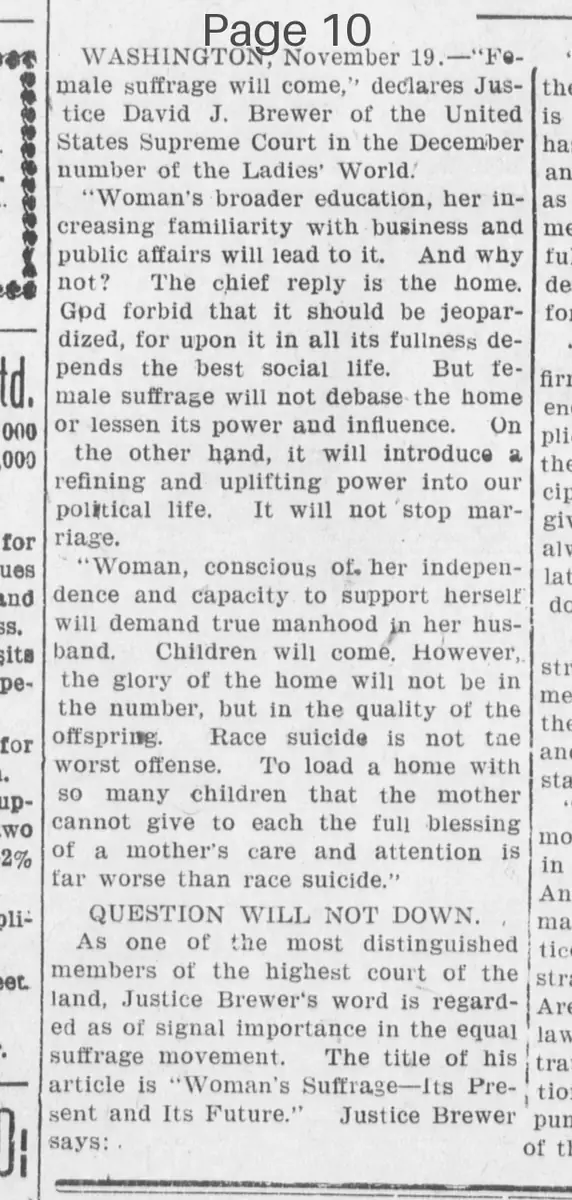
"Woman's broader education, her increasing familiarity with business and public affairs will lead to it. And why not? The chief reply is the home. God forbid that it should be jeopardized, for upon it in all its fullness depends the best social life. But female suffrage will not debase the home or lessen its power and influence. On the other hand, it will introduce a refining and uplifting power into our political life. It will not 'stop marriage.'
"Woman, conscious of her independence and capacity to support herself will demand true manhood in her husband. Children will come. However, the glory of the home will not be in the number, but in the quality of the offspring. Race suicide is not the worst offense. To load a home with so many children that the mother cannot give to each the full blessing of a mother's care and attention is far worse than race suicide."
QUESTION WILL NOT DOWN.
As one of the most distinguished members of the highest court of the land, Justice Brewer's word is regarded as of signal importance in the equal suffrage movement. The title of his article is "Woman's Suffrage-Its Present and Its Future."
Justice Brewer says:.
"The question of female suffrage, like the ghost of Banquo, will not down. It is now a living, practical question. It has passed beyond the stage of ridicule and we hear no more of its advocates as short-haired women and long-haired men. It is being considered by thoughtful men and women, animated by the desire of doing that which shall be for the best interests of all.
"The consent of the governed, affirmed in the Declaration of Independence, is not always of immediate application. By the late amendments to the national Constitution the emancipated slaves were made citizens and given the right of suffrage, yet it has always been a question whether the latter grant was then the part of wisdom for them or the nation.
"Many of our English sisters are striving to secure the ballot, but the means which, according to the papers, they take would not be tolerated here, and to say the least, are offensive. We stand no 'fighting Amazons.'
"My experience tells me that the most dangerous adversary a man has in a law suit is an attractive woman. And sympathy especially in criminal matters, is always an enemy of justice.
"The quality of mercy is not strained,' and 'merely seasons justice.' Are we sure that our rigid criminal laws and their equally rigid administration are perfect? Is not reformation as much an object of the law as punishment? Is not mother love one of the strongest forces in a man's life? And may we not well believe that woman's gentle touch upon our criminal law in all its varied processes of administration will do more for the criminal's reformation than masculine rigor and adherence to the letter of the statutes?
"Colorado is the significant state. the woman's suffrage in Colorado has not been hurtful. It has helped a little; perhaps more than can easily be particularized."
What sub-type of article is it?
What keywords are associated?
What entities or persons were involved?
Where did it happen?
Domestic News Details
Primary Location
Washington
Event Date
November 19
Key Persons
Event Details
Justice David J. Brewer declares that female suffrage will come due to women's broader education and familiarity with business and public affairs. He argues it will not jeopardize the home but introduce refining power into political life, demand true manhood in husbands, and prioritize quality over quantity in children. The question of female suffrage is now serious, considered by thoughtful people. He references the Declaration of Independence, emancipated slaves' suffrage, English suffragettes' methods, women's potential influence on criminal law through mercy and reformation, and Colorado's experience where it has not been hurtful.