Thank you for visiting SNEWPapers!
Sign up free
National Gazette
Philadelphia, Philadelphia County, Pennsylvania
What is this article about?
In a speech to the House of Representatives, Mr. Baldwin opposes the general assumption of remaining state debts by the federal government. He argues it would overburden the young nation, disrupt state economies by draining circulating medium, and violate constitutional principles of state equality. He urges waiting for the commissioners' final equitable settlement to ensure justice.
Clipping
OCR Quality
Full Text
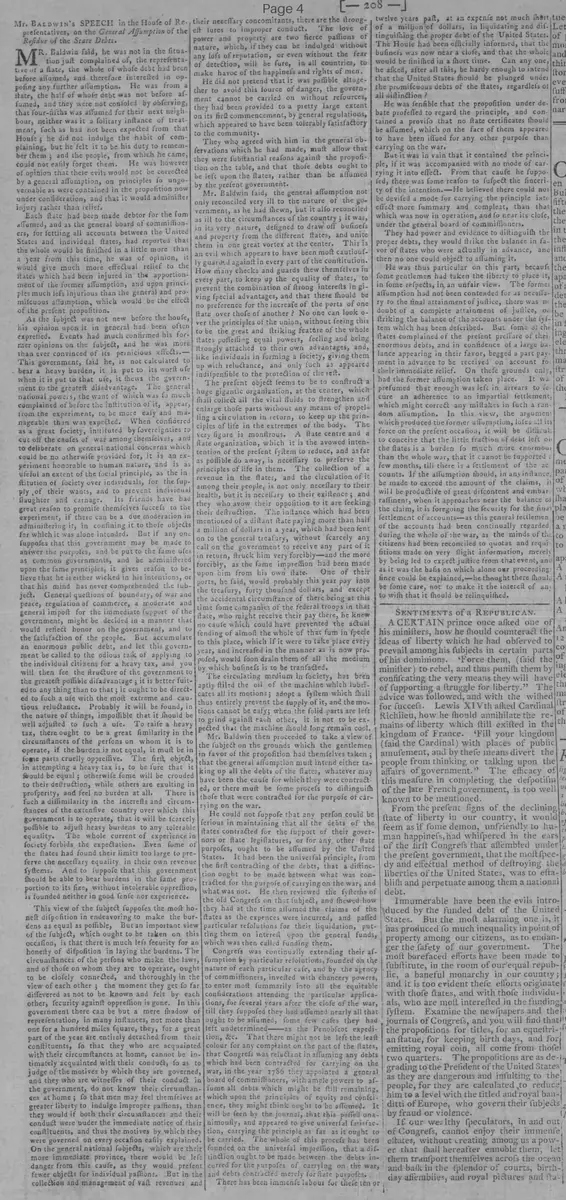
Mr. Baldwin said, he was not in the situation just complained of, the representative of a state, the whole of whose debt had been before assumed, and therefore interested in opposing any further assumption. He was from a state, one half of whose debt was not before assumed, and they were not consoled by observing, that four-fifths was assumed for their next neighbour, neither was it a solitary instance of treatment, such as had not been expected from that House; he did not indulge the habit of complaining, but he felt it to be his duty to remember them; and the people, from which he came, could not easily forget them. He was however of opinion that these evils would not be corrected by a general assumption, on principles so ungovernable as were contained in the proposition now under consideration, and that it would administer injury rather than relief.
Each state had been made debtor for the sum assumed, and as the general board of commissioners, for settling all accounts between the United States and individual states, had reported that the whole would be finished in a little more than a year from this time, he was of opinion, it would give much more effectual relief to the states which had been injured in the apportionment of the former assumption, and upon principles much less injurious than the general and promiscuous assumption, which would be the effect of the present proposition.
As the subject was not new before the house, his opinion upon it in general had been often expressed. Events had much confirmed his former opinions on the subject, and he was more than ever convinced of its pernicious effects. This government, said he, is not calculated to bear a heavy burden, it is put to its worst use when it is put to that use, it shows the government to the greatest disadvantage. The general national powers, the want of which was so much complained of before the institution of it, appear, from the experiment, to be more easy and manageable than was expected. When considered as a great society, instituted by sovereignties to cut off the causes of war among themselves, and to deliberate on general national concerns which could be no otherwise provided for, it is an experiment honorable to human nature, and is as useful an extent of the social principle, as the institution of society over individuals, for the supply of their wants, and to prevent individual slaughter and carnage. Its friends have had great reason to promise themselves success to the experiment, if there can be a due moderation in administering it, in confining it to those objects for which it was alone intended. But if any one supposes that this government may be made to answer the purposes, and be put to the same uses as common governments, and be administered upon the same principles, it gives reason to believe that he is either wicked in his intentions, or that his mind has never comprehended the subject. General questions of boundary, of war and peace, regulation of commerce, a moderate and general impost for the immediate support of the government, might be decided in a manner that would reflect honor on the government, and to the satisfaction of the people. But accumulate an enormous public debt, and let this government be called to the odious task of applying to the individual citizens for a heavy tax, and you will then see the structure of the government to the greatest possible disadvantage; it is better suited to any thing than to that; it ought to be directed to such a use with the most extreme and cautious reluctance. Probably it will be found, in the nature of things, impossible that it should be well adjusted to such a use. To raise a heavy tax, there ought to be a great similarity in the circumstances of the persons on whom it is to operate, if the burden is not equal, it must be in one part cruelly oppressive. The first object, in attempting a heavy tax is, to be sure that it should be equal; otherwise some will be crowded to their destruction, while others are exulting in prosperity, and feel no burden at all. There is such a dissimilarity in the interests and circumstances of the extensive country over which this government is to operate, that it will be scarcely possible to adjust heavy burdens to any tolerable equality. The whole current of experience in society forbids the expectation. Even some of the states had found their limits too large to preserve the necessary equality in their own revenue systems. And to suppose that this government should be able to bear burdens in the same proportion to its size, without intolerable oppression, is founded neither in good sense nor experience.
This view of the subject supposes the most honest disposition in endeavoring to make the burdens as equal as possible. But an important view of the subject, which ought to be taken on this occasion, is that there is much less security for an honesty of disposition in laying the burdens. The circumstances of the persons who make the laws, and of those on whom they are to operate, ought to be closely connected, and thoroughly in the view of each other; the moment they get so far dissevered as not to be known and felt by each other, security against oppression is gone. In this government there can be but a mere shadow of representation, in many instances, not more than one for a hundred miles square, they, for a great part of the year are entirely detached from their constituents, so that they who are acquainted with their circumstances at home, cannot be intimately acquainted with their conduct, so as to judge of the motives by which they are governed, and they who are witness of their conduct in the government, do not know their circumstances at home; so that men may feel themselves at greater liberty to indulge improper passions, than they would if both their circumstances and their conduct were under the immediate notice of their constituents, and thus the motives by which they were governed on every occasion easily explained.
On the general national subjects, which are their more immediate province, there would be less danger from this cause, as they would present fewer objects for individual passions. But in the collection and management of vast revenues and their necessary concomitants, there are the strongest lures to improper conduct. The love of power and property are two fierce passions of nature, which, if they can be indulged without any loss of reputation, or even without the fear of detection, will be sure, in all countries, to make havoc of the happiness and rights of men.
He did not pretend that it was possible altogether to avoid this source of danger, the government cannot be carried on without resources, they had been provided to a pretty large extent on its first commencement, by general regulations, which appeared to have been tolerably satisfactory to the community. They who agreed with him in the general observations which he had made, must allow that they were substantial reasons against the proposition on the table, and that those debts ought to be left upon the states, rather than be assumed by the present government.
Mr. Baldwin said, the general assumption not only reconciled very ill to the nature of the government, as he had shown, but it also reconciled as ill to the circumstances of the country; it was, in its very nature, designed to draw off business and property from the different states, and unite them in one great vortex at the center. This is an evil which appears to have been most cautiously guarded against in every part of the constitution. How many checks and guards show themselves in every part, to keep up the equality of states, to prevent the combination of strong interests in giving special advantages, and that there should be no preference for the increase of the ports of one state over those of another? No one can look over the principles of the union, without seeing this to be the great and striking feature of the whole states possessing equal powers, feeling and being strongly attached to their own advantages, and, like individuals in forming a society, giving them up with reluctance, and only such as appeared indispensable to the protection of the rest.
The present object seems to be to construct a huge gigantic organization, at the center, which shall collect all the vital fluids to strengthen and enlarge those parts without any means of propelling a circulation in return, to keep up the principles of life in the extremes of the body. The very figure is monstrous. A state centre and a state organization, which it is the avowed intention of the present system to reduce, and as far as possible do away, is necessary to preserve the principles of life in them. The collection of a revenue in the states, and the circulation of it among their people, is not only necessary to their health, but it is necessary to their existence; and they who avow their opposition to it are seeking their destruction. The instance which had been mentioned of a distant state paying more than half a million of dollars in a year, which had been sent on to the general treasury, without scarcely any call on the government to receive any part of it in return, struck him very forcibly—and the more forcibly, as the same impression had been made upon him from his own state. One of their ports, he said, would probably this year pay into the treasury, forty thousand dollars, and except the accidental circumstance of there being at this time some companies of the federal troops in that state, who might receive their pay there, he knew no cause which could have prevented the actual sending of almost the whole of that sum in specie to this place, which if it were to take place every year, and increased in the manner as is now proposed, would soon drain them of all the medium by which business is to be transacted.
The circulating medium in society, has been aptly styled the oil of the machine which lubricates all its motions; adopt a system which shall thus entirely prevent the supply of it, and the motions cannot be easy; when the solid parts are left to grind against each other, it is not to be expected that the machine should long remain cool.
Mr. Baldwin then proceeded to take a view of the subject on the grounds which the gentlemen in favor of the proposition had themselves taken; that the general assumption must intend either taking up all the debts of the states, whatever may have been the cause for which they were contracted, or there must be some process to distinguish those that were contracted for the purpose of carrying on the war.
He could not suppose that any person could be serious in maintaining that all the debts of the states contracted for the support of their governors or state legislatures, or for any other state purposes, ought to be assumed by the United States. It had been the universal principle, from the first contracting of the debts, that a distinction ought to be made between what was contracted for the purpose of carrying on the war, and what was not. He then reviewed the systems of the old Congress on that subject, and showed how they had at the time assumed the claims of the states as the expenses were incurred, and passed particular resolutions for their liquidation, putting them on interest upon the general funds, which was then called funding them. Congress was continually extending their assumption by particular resolutions, founded on the nature of each particular case, and by the agency of commissioners, invested with chancery powers, to enter most summarily into all the equitable considerations attending the particular applications, for several years after the close of the war, till they supposed they had assumed nearly all that ought to be assumed, some few cases they had left undetermined—as the Penobscot expedition, &c. That there might not be left the least colour for any complaint on the part of the states, that Congress was reluctant in assuming any debts which had been contracted for carrying on the war, in the year 1786 they appointed a general board of commissioners, with ample powers to assume all debts which might be still remaining, which upon the principles of equity and conscience, they might think ought to be assumed. It will be seen by the journal, that this passed unanimously, and appeared to give universal satisfaction, carrying the principle as far as it ought to be carried. The whole of this process has been founded on the universal impression, that a distinction ought to be made between the debts incurred for the purposes of carrying on the war, and debts contracted merely for state purposes.
There has been immense labour these ten or twelve years past, at an expense not much short of a million of dollars, in liquidating and distinguishing the proper debt of the United States. The House had been officially informed, that the business was now near a close, and that the whole would be finished in a short time. Can any one, he asked, after all this, be hardy enough to intend that the United States should be plunged under the promiscuous debts of the states, regardless of all distinction?
He was sensible that the proposition under debate professed to regard the principle, and contained a proviso that no state certificates should be assumed, which on the face of them appeared to have been issued for any other purpose than carrying on the war. But it was in vain that it contained the principle, if it was accompanied with no mode of carrying it into effect. From that cause he supposed, there was some reason to suspect the sincerity of the intention. He believed there could not be devised a mode for carrying the principle into effect more summary and complete, than that which was now in operation, and so near its close, under the general board of commissioners. They had power and evidence to distinguish the proper debts, they would strike the balance in favor of states who were actually in advance, and then no one could object to assuming it.
He was thus particular on this part, because some gentlemen had taken the liberty to place it, in some respects, in an unfair view. The former assumption had not been contended for as necessary to the final attainment of justice, there was no doubt of a complete attainment of justice, on striking the balance of the accounts under the system which has been described. But some of the states complained of the present pressure of their enormous debts, and in confidence of a large balance appearing in their favor, begged a part payment in advance to be received on account for their immediate relief. On these grounds only, had the former assumption taken place. It was presumed that enough was left in arrears to secure an adherence to an impartial settlement, which might correct any mistakes in such a random assumption. In this view, the argument which produced the former assumption, loses all its force on the present occasion, it will be difficult to conceive that the little fraction of debt left on the states is a burden so much more enormous than the whole war, that it cannot be supported a few months, till there is a settlement of the accounts. If the assumption should, in any instance, be made to exceed the amount of the claims, it will be productive of great discontent and embarrassment, when it approaches near the balance of the claim, it is foregoing the security for the final settlement of accounts—as this general settlement of the accounts had been continually regarded during the whole of the war, as the minds of the citizens had been reconciled to quotas and requisitions made on very slight information, merely by being led to expect justice from that event, and as it was the basis on which alone our proceedings since could be explained,—he thought there should be some care, not to make it the interest of any to wish that it should be relinquished.
What sub-type of article is it?
What themes does it cover?
What keywords are associated?
What entities or persons were involved?
Where did it happen?
Story Details
Key Persons
Location
House Of Representatives
Story Details
Mr. Baldwin delivers a speech opposing the general assumption of the residue of state debts by the federal government, arguing it mismatches the government's design, risks oppression through unequal taxation, drains state economies of circulating medium, and undermines constitutional state equality. He reviews historical assumptions, advocates distinguishing war-related debts via ongoing commissioners' process, and warns against hasty action before final settlement.