Thank you for visiting SNEWPapers!
Sign up free
Editorial
October 10, 1912
The Citizen
Berea, Madison County, Kentucky
What is this article about?
The editor of The Citizen defends new congressional postal regulations requiring disclosure of newspaper stockholders and marking paid editorial content as advertisements, arguing they promote transparency in press influences amid concerns of muzzling free speech.
Clipping
OCR Quality
98%
Excellent
Full Text
WE DON'T OBJECT
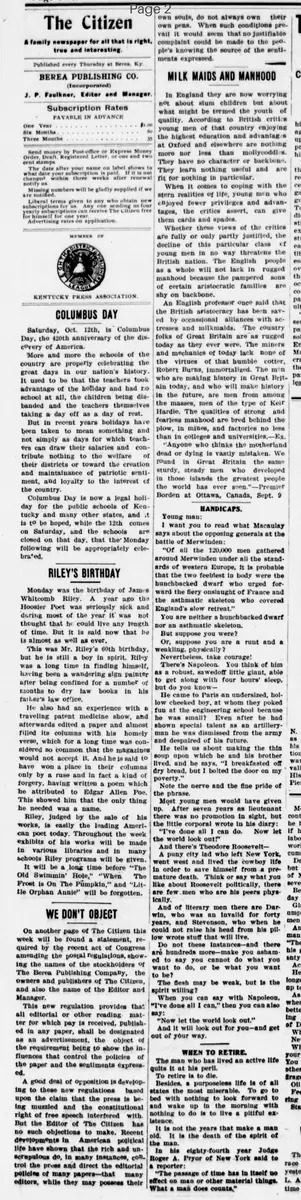
On another page of The Citizen this week will be found a statement, required by the recent act of Congress amending the postal regulations, showing the names of the stockholders of The Berea Publishing Company, the owners and publishers of The Citizen, and also the name of the Editor and Manager.
This new regulation provides that all editorial or other reading matter for which pay is received, published in any paper, shall be designated as an advertisement, the object of the requirement being to show the influences that control the policies of the paper and the sentiments expressed.
A good deal of opposition is developing to these new regulations based upon the claim that the press is being muzzled and the constitutional right of free speech interfered with.
But the Editor of The Citizen has no such objections to make. Recent developments in American political life have shown that the rich and unscrupulous do, in many instances, control the press and direct the editorial policies of many papers—that many editors, while they may possess their own souls, do not always own their own pens. When such conditions prevail it would seem that no justifiable complaint could be made to the people's knowing the source of the sentiments expressed.
On another page of The Citizen this week will be found a statement, required by the recent act of Congress amending the postal regulations, showing the names of the stockholders of The Berea Publishing Company, the owners and publishers of The Citizen, and also the name of the Editor and Manager.
This new regulation provides that all editorial or other reading matter for which pay is received, published in any paper, shall be designated as an advertisement, the object of the requirement being to show the influences that control the policies of the paper and the sentiments expressed.
A good deal of opposition is developing to these new regulations based upon the claim that the press is being muzzled and the constitutional right of free speech interfered with.
But the Editor of The Citizen has no such objections to make. Recent developments in American political life have shown that the rich and unscrupulous do, in many instances, control the press and direct the editorial policies of many papers—that many editors, while they may possess their own souls, do not always own their own pens. When such conditions prevail it would seem that no justifiable complaint could be made to the people's knowing the source of the sentiments expressed.
What sub-type of article is it?
Press Freedom
What keywords are associated?
Postal Regulations
Press Transparency
Free Speech
Editorial Disclosure
Press Control
What entities or persons were involved?
The Citizen
Berea Publishing Company
Congress
Editorial Details
Primary Topic
Support For Postal Regulations On Press Disclosure
Stance / Tone
Supportive Of Transparency Requirements
Key Figures
The Citizen
Berea Publishing Company
Congress
Key Arguments
New Regulations Require Disclosure Of Stockholders And Marking Paid Content As Ads To Reveal Influences On Press Policies.
Opposition Claims Regulations Muzzle The Press And Interfere With Free Speech.
Editor Has No Objections, As Rich And Unscrupulous Often Control Press And Editorial Policies.
Transparency Is Justified Given Conditions Where Editors Do Not Own Their Own Pens.