Thank you for visiting SNEWPapers!
Sign up free
The Harlem News
Harlem, Blaine County, Montana
What is this article about?
US War Department plans shared Allied occupation of Germany by US, British, and Soviet forces post-WWII armistice, enabling rapid demobilization of troops home while freeing others for Japan war. Includes GI tours of Europe and educational opportunities, with disciplined but relaxed awaiting transports.
Clipping
OCR Quality
Full Text
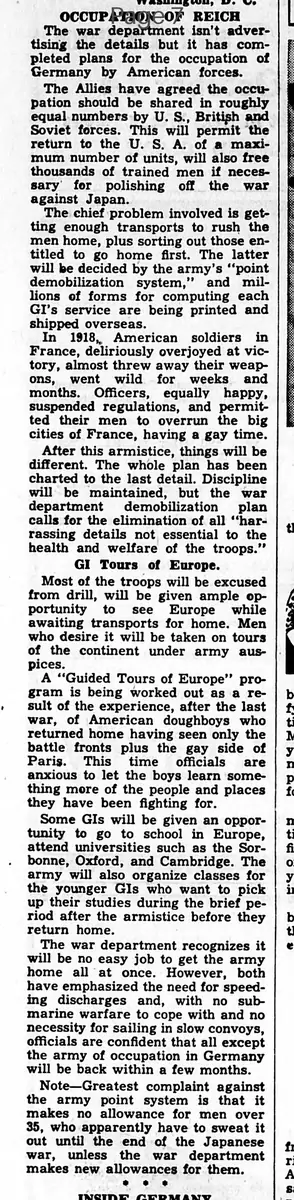
The Allies have agreed the occupation should be shared in roughly equal numbers by U. S., British and Soviet forces. This will permit the return to the U. S. A. of a maximum number of units, will also free thousands of trained men if necessary for polishing off the war against Japan.
The chief problem involved is getting enough transports to rush the men home, plus sorting out those entitled to go home first. The latter will be decided by the army's point demobilization system, and millions of forms for computing each GI's service are being printed and shipped overseas.
In 1918, American soldiers in France, deliriously overjoyed at victory, almost threw away their weapons, went wild for weeks and months. Officers, equally happy, suspended regulations, and permitted their men to overrun the big cities of France, having a gay time.
After this armistice, things will be different. The whole plan has been charted to the last detail. Discipline will be maintained, but the war department demobilization plan calls for the elimination of all harassing details not essential to the health and welfare of the troops.
GI Tours of Europe.
Most of the troops will be excused from drill, will be given ample opportunity to see Europe while awaiting transports for home. Men who desire it will be taken on tours of the continent under army auspices.
A "Guided Tours of Europe" program is being worked out as a result of the experience, after the last war, of American doughboys who returned home having seen only the battle fronts plus the gay side of Paris. This time officials are anxious to let the boys learn something more of the people and places they have been fighting for.
Some GIs will be given an opportunity to go to school in Europe, attend universities such as the Sorbonne, Oxford, and Cambridge. The army will also organize classes for the younger GIs who want to pick up their studies during the brief period after the armistice before they return home.
The war department recognizes it will be no easy job to get the army home all at once. However, both have emphasized the need for speeding discharges and, with no submarine warfare to cope with and no necessity for sailing in slow convoys, officials are confident that all except the army of occupation in Germany will be back within a few months.
Note—Greatest complaint against the army point system is that it makes no allowance for men over 35, who apparently have to sweat it out until the end of the Japanese war, unless the war department makes new allowances for them.
What sub-type of article is it?
What keywords are associated?
Where did it happen?
Foreign News Details
Primary Location
Germany
Outcome
occupation of germany to be shared roughly equally by u.s., british, and soviet forces; maximum return of u.s. units to usa; thousands of trained men freed for war against japan; demobilization by army's point system; all except occupation army back within a few months.
Event Details
The war department has completed plans for U.S. occupation of Germany, with Allies agreeing to share occupation in roughly equal numbers by U.S., British, and Soviet forces. This allows maximum return of U.S. units home and freeing men for the war against Japan. Challenges include transports and sorting by point system. Unlike 1918, discipline will be maintained but non-essential details eliminated. Troops will have opportunities for GI tours of Europe, guided tours, schooling at universities like Sorbonne, Oxford, Cambridge, and classes. Officials confident in speedy discharges without submarine threats.