Thank you for visiting SNEWPapers!
Sign up free
Story
June 19, 1821
Alexandria Gazette & Daily Advertiser
Alexandria, Virginia
What is this article about?
A rare yellowish or orange mole, similar to the brown mole, was captured on Timothy Matlack's farm in Bay-side, Long Island, and presented to Dr. Mitchell. Detailed description includes its size, color, anatomy, and classification as a shrew (Sorex) rather than true mole, noting its destructive habits to crops.
Clipping
OCR Quality
95%
Excellent
Full Text
AGRICULTURAL.
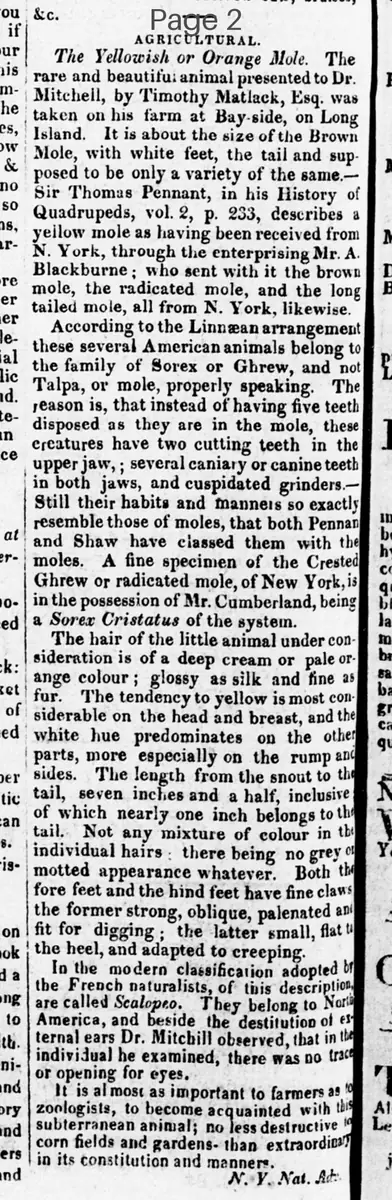
The Yellowish or Orange Mole. The rare and beautiful animal presented to Dr. Mitchell, by Timothy Matlack, Esq. was taken on his farm at Bay-side, on Long Island. It is about the size of the Brown Mole, with white feet, the tail and supposed to be only a variety of the same. Sir Thomas Pennant, in his History of Quadrupeds, vol.2, p. 233, describes a yellow mole as having been received from N. York, through the enterprising Mr. A. Blackburne: who sent with it the brown mole, the radicated mole, and the long tailed mole, all from N. York, likewise. According to the Linnæan arrangement these several American animals belong to the family of Sorex or Shrew, and not Talpa, or mole, properly speaking. The reason is, that instead of having five teeth disposed as they are in the mole, these creatures have two cutting teeth in the upper jaw, several canary or canine teeth in both jaws, and cuspidated grinders. Still their habits and manners so exactly resemble those of moles, that both Pennant and Shaw have classed them with the moles. A fine specimen of the Crested Shrew or radicated mole. of New York, is in the possession of Mr. Cumberland, being a Sorex Cristatus of the system. The hair of the little animal under consideration is of a deep cream or pale orange colour; glossy as silk and fine as fur. The tendency to yellow is most considerable on the head and breast. and the white hue predominates on the other parts, more especially on the rump and sides. The length from the snout to the tail, seven inches and a half. inclusive of which nearly one inch belongs to the tail. Not any mixture of colour in the individual hairs : there being no grey or motted appearance whatever. Both the fore feet and the hind feet have fine claws the former strong, oblique, palenated and fit for digging : the latter small, flat to the heel, and adapted to creeping. In the modern classification adopted by the French naturalists, of this description, are called Scalopeo. They belong to North America, and beside the destitution of external ears Dr. Mitchill observed, that in the individual he examined, there was no trace or opening for eyes. It is almost as important to farmers as to zoologists, to become acquainted with this subterranean animal; no less destructive to corn fields and gardens-- than extraordinary in its constitution and manners.
The Yellowish or Orange Mole. The rare and beautiful animal presented to Dr. Mitchell, by Timothy Matlack, Esq. was taken on his farm at Bay-side, on Long Island. It is about the size of the Brown Mole, with white feet, the tail and supposed to be only a variety of the same. Sir Thomas Pennant, in his History of Quadrupeds, vol.2, p. 233, describes a yellow mole as having been received from N. York, through the enterprising Mr. A. Blackburne: who sent with it the brown mole, the radicated mole, and the long tailed mole, all from N. York, likewise. According to the Linnæan arrangement these several American animals belong to the family of Sorex or Shrew, and not Talpa, or mole, properly speaking. The reason is, that instead of having five teeth disposed as they are in the mole, these creatures have two cutting teeth in the upper jaw, several canary or canine teeth in both jaws, and cuspidated grinders. Still their habits and manners so exactly resemble those of moles, that both Pennant and Shaw have classed them with the moles. A fine specimen of the Crested Shrew or radicated mole. of New York, is in the possession of Mr. Cumberland, being a Sorex Cristatus of the system. The hair of the little animal under consideration is of a deep cream or pale orange colour; glossy as silk and fine as fur. The tendency to yellow is most considerable on the head and breast. and the white hue predominates on the other parts, more especially on the rump and sides. The length from the snout to the tail, seven inches and a half. inclusive of which nearly one inch belongs to the tail. Not any mixture of colour in the individual hairs : there being no grey or motted appearance whatever. Both the fore feet and the hind feet have fine claws the former strong, oblique, palenated and fit for digging : the latter small, flat to the heel, and adapted to creeping. In the modern classification adopted by the French naturalists, of this description, are called Scalopeo. They belong to North America, and beside the destitution of external ears Dr. Mitchill observed, that in the individual he examined, there was no trace or opening for eyes. It is almost as important to farmers as to zoologists, to become acquainted with this subterranean animal; no less destructive to corn fields and gardens-- than extraordinary in its constitution and manners.
What sub-type of article is it?
Curiosity
Animal Story
What themes does it cover?
Nature
What keywords are associated?
Yellow Mole
Orange Shrew
Long Island
Natural History
Agricultural Pest
Linnæan Classification
What entities or persons were involved?
Dr. Mitchell
Timothy Matlack, Esq.
Sir Thomas Pennant
Mr. A. Blackburne
Mr. Cumberland
Dr. Mitchill
Where did it happen?
Bay Side, On Long Island; N. York
Story Details
Key Persons
Dr. Mitchell
Timothy Matlack, Esq.
Sir Thomas Pennant
Mr. A. Blackburne
Mr. Cumberland
Dr. Mitchill
Location
Bay Side, On Long Island; N. York
Story Details
Rare yellowish or orange mole captured on farm in Bay-side, Long Island, presented to Dr. Mitchell; described physically, classified as shrew variant destructive to crops, compared to specimens from New York in natural history texts.