Thank you for visiting SNEWPapers!
Sign up free
Editorial
July 13, 1951
The East Hartford Gazette
New Britain, Hartford County, Connecticut
What is this article about?
The Senate passed a controversial mild anti-inflation bill led by Sen. Maybank after an all-night session, despite Administration calls for stronger measures due to rising defense spending. Southern Democrats and Republicans supported it with minimal exemptions, while also extending old controls for 30 days.
Clipping
OCR Quality
98%
Excellent
Full Text
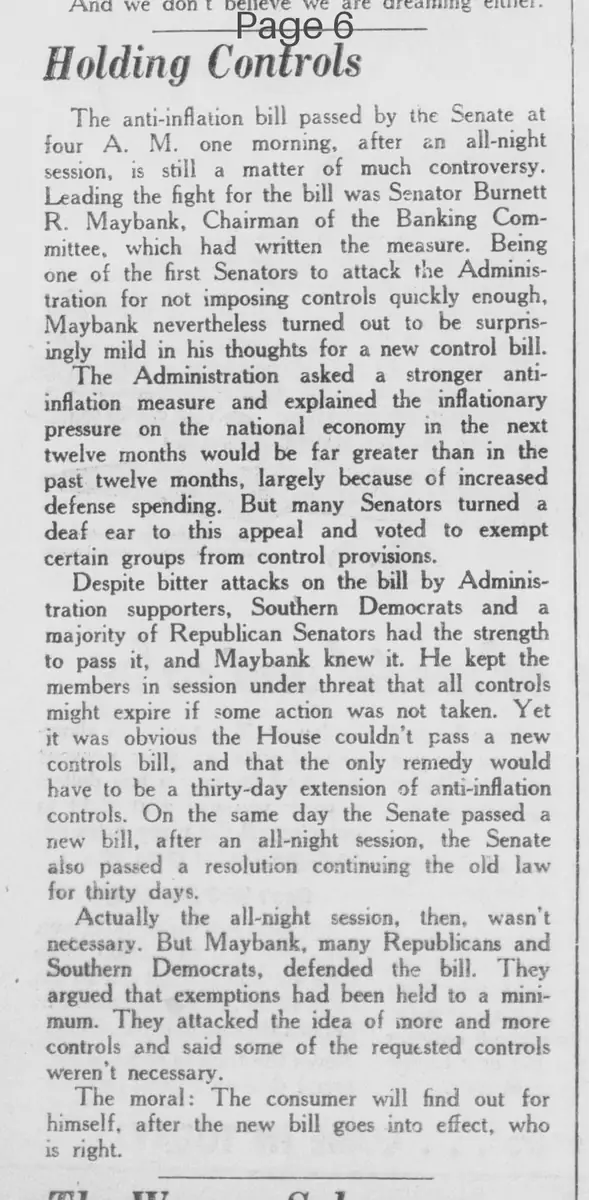
Holding Controls
The anti-inflation bill passed by the Senate at four A. M. one morning, after an all-night session, is still a matter of much controversy.
Leading the fight for the bill was Senator Burnett R. Maybank, Chairman of the Banking Committee, which had written the measure. Being one of the first Senators to attack the Administration for not imposing controls quickly enough, Maybank nevertheless turned out to be surprisingly mild in his thoughts for a new control bill.
The Administration asked a stronger anti-inflation measure and explained the inflationary pressure on the national economy in the next twelve months would be far greater than in the past twelve months, largely because of increased defense spending. But many Senators turned a deaf ear to this appeal and voted to exempt certain groups from control provisions.
Despite bitter attacks on the bill by Administration supporters, Southern Democrats and a majority of Republican Senators had the strength to pass it, and Maybank knew it. He kept the members in session under threat that all controls might expire if some action was not taken. Yet it was obvious the House couldn't pass a new controls bill, and that the only remedy would have to be a thirty-day extension of anti-inflation controls. On the same day the Senate passed a new bill, after an all-night session, the Senate also passed a resolution continuing the old law for thirty days.
Actually the all-night session, then, wasn't necessary. But Maybank, many Republicans and Southern Democrats, defended the bill. They argued that exemptions had been held to a minimum. They attacked the idea of more and more controls and said some of the requested controls weren't necessary.
The moral: The consumer will find out for himself, after the new bill goes into effect, who is right.
The anti-inflation bill passed by the Senate at four A. M. one morning, after an all-night session, is still a matter of much controversy.
Leading the fight for the bill was Senator Burnett R. Maybank, Chairman of the Banking Committee, which had written the measure. Being one of the first Senators to attack the Administration for not imposing controls quickly enough, Maybank nevertheless turned out to be surprisingly mild in his thoughts for a new control bill.
The Administration asked a stronger anti-inflation measure and explained the inflationary pressure on the national economy in the next twelve months would be far greater than in the past twelve months, largely because of increased defense spending. But many Senators turned a deaf ear to this appeal and voted to exempt certain groups from control provisions.
Despite bitter attacks on the bill by Administration supporters, Southern Democrats and a majority of Republican Senators had the strength to pass it, and Maybank knew it. He kept the members in session under threat that all controls might expire if some action was not taken. Yet it was obvious the House couldn't pass a new controls bill, and that the only remedy would have to be a thirty-day extension of anti-inflation controls. On the same day the Senate passed a new bill, after an all-night session, the Senate also passed a resolution continuing the old law for thirty days.
Actually the all-night session, then, wasn't necessary. But Maybank, many Republicans and Southern Democrats, defended the bill. They argued that exemptions had been held to a minimum. They attacked the idea of more and more controls and said some of the requested controls weren't necessary.
The moral: The consumer will find out for himself, after the new bill goes into effect, who is right.
What sub-type of article is it?
Economic Policy
Partisan Politics
What keywords are associated?
Anti Inflation Bill
Senate Session
Price Controls
Congressional Politics
Defense Spending
Economic Controls
What entities or persons were involved?
Senator Burnett R. Maybank
Senate Banking Committee
Administration
Southern Democrats
Republican Senators
Editorial Details
Primary Topic
Senate Passage Of Mild Anti Inflation Bill Amid Controversy
Stance / Tone
Observational With Skeptical Undertone Toward Mild Controls
Key Figures
Senator Burnett R. Maybank
Senate Banking Committee
Administration
Southern Democrats
Republican Senators
Key Arguments
Senate Passed A Mild Anti Inflation Bill After All Night Session
Maybank Led The Fight Despite Earlier Criticism Of Slow Controls
Administration Sought Stronger Measures Due To Increased Defense Spending
Senators Exempted Certain Groups From Controls
Bill Passed With Support From Southern Democrats And Republicans
Senate Also Passed 30 Day Extension Of Old Controls
Defenders Argued Exemptions Minimal And More Controls Unnecessary
Consumer Will Judge Effectiveness