Thank you for visiting SNEWPapers!
Sign up free
The Virginia Gazette
Richmond, Williamsburg, Richmond County, Virginia
What is this article about?
In June-July 1779, French forces under Count d'Estaing captured St. Vincent from the British, aided by Caraibs, and launched an expedition against defenceless Grenada. Admiral Byron's British fleet, after escorting convoys, failed to retake St. Vincent and rushed to Grenada's aid, but was likely too late. French received reinforcements of 5 ships, 4 frigates, and 2000 troops.
Clipping
OCR Quality
Full Text
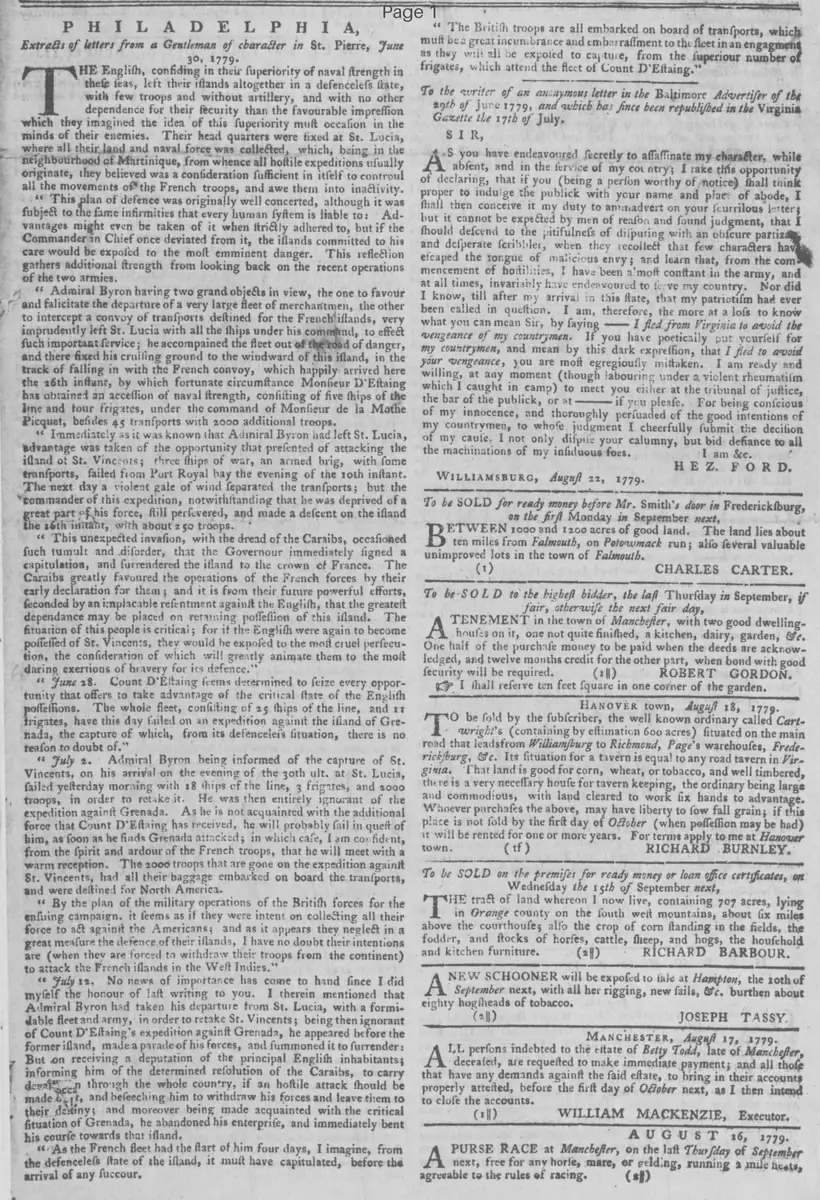
Extracts of letters from a Gentleman of character in St. Pierre, June 30, 1779.
The English, confiding in their superiority of naval strength in these seas, left their islands altogether in a defenceless state, with few troops and without artillery, and with no other dependence for their security than the favourable impression which they imagined the idea of this superiority must occasion in the minds of their enemies. Their head quarters were fixed at St. Lucia, where all their land and naval force was collected, which, being in the neighbourhood of Martinique, from whence all hostile expeditions usually originate, they believed was a consideration sufficient in itself to controul all the movements of the French troops, and awe them into inactivity.
This plan of defence was originally well concerted, although it was subject to the same infirmities that every human system is liable to: Advantages might even be taken of it when strictly adhered to, but if the Commander in Chief once deviated from it, the islands committed to his care would be exposed to the most eminent danger. This reflection gathers additional strength from looking back on the recent operations of the two armies.
Admiral Byron having two grand objects in view, the one to favour and facilitate the departure of a very large fleet of merchantmen, the other to intercept a convoy of transports destined for the French islands, very imprudently left St. Lucia with all the ships under his command, to effect such important service; he accompanied the fleet out of the road of danger, and there fixed his cruising ground to the windward of this island, in the track of falling in with the French convoy, which happily arrived here the 26th instant, by which fortunate circumstance Monsieur D'Estaing has obtained an accession of naval strength, consisting of five ships of the line and four frigates, under the command of Monsieur de la Mothe Picquet, besides 45 transports with 2000 additional troops.
Immediately as it was known that Admiral Byron had left St. Lucia, advantage was taken of the opportunity that presented of attacking the island of St. Vincents; three ships of war, an armed brig, with some transports, sailed from Port Royal bay the evening of the 20th instant. The next day a violent gale of wind separated the transports; but the commander of this expedition, notwithstanding that he was deprived of a great part of his force, still persevered, and made a descent on the island the 16th instant, with about 250 troops.
This unexpected invasion, with the dread of the Caraibs, occasioned such tumult and disorder, that the Governor immediately signed a capitulation, and surrendered the island to the crown of France. The Caraibs greatly favoured the operations of the French forces by their early declaration for them; and it is from their future powerful efforts, seconded by an implacable resentment against the English, that the greatest dependence may be placed on retaining possession of this island. The situation of this people is critical; for if the English were again to become possessed of St. Vincents, they would be exposed to the most cruel persecution, the consideration of which will greatly animate them to the most daring exertions of bravery for its defence.
June 28. Count D'Estaing seems determined to seize every opportunity that offers to take advantage of the critical state of the English possessions. The whole fleet, consisting of 25 ships of the line, and 11 frigates, have this day sailed on an expedition against the island of Grenada, the capture of which, from its defenceless situation, there is no reason to doubt of.
July 2. Admiral Byron being informed of the capture of St. Vincents, on his arrival on the evening of the 30th ult. at St. Lucia, sailed yesterday morning with 18 ships of the line, 3 frigates, and 2000 troops, in order to retake it. He was then entirely ignorant of the expedition against Grenada. As he is not acquainted with the additional force that Count D'Estaing has received, he will probably sail in quest of him, as soon as he finds Grenada attacked; in which case, I am confident, from the spirit and ardour of the French troops, that he will meet with a warm reception. The 2000 troops that are gone on the expedition against St. Vincents, had all their baggage embarked on board the transports, and were destined for North America.
By the plan of the military operations of the British forces for the ensuing campaign, it seems as if they were intent on collecting all their force to act against the Americans; and as it appears they neglect in a great measure the defence of their islands, I have no doubt their intentions are (when they are forced to withdraw their troops from the continent) to attack the French islands in the West Indies.
July 12. No news of importance has come to hand since I did myself the honour of last writing to you. I therein mentioned that Admiral Byron had taken his departure from St. Lucia, with a formidable fleet and army, in order to retake St. Vincents; being then ignorant of Count D'Estaing's expedition against Grenada, he appeared before the former island, made a parade of his forces, and summoned it to surrender: But on receiving a deputation of the principal English inhabitants; informing him of the determined resolution of the Caraibs, to carry devastation through the whole country, if an hostile attack should be made upon it, and beseeching him to withdraw his forces and leave them to their destiny; and moreover being made acquainted with the critical situation of Grenada, he abandoned his enterprise, and immediately bent his course towards that island.
As the French fleet had the start of him four days, I imagine, from the defenceless state of the island, it must have capitulated, before the arrival of any succour.
The British troops are all embarked on board of transports, which must be a great incumbrance and embarrasment to the fleet in an engagement as they will all be exposed to capture, from the superior number of frigates, which attend the fleet of Count D'Estaing.
What sub-type of article is it?
What keywords are associated?
What entities or persons were involved?
Where did it happen?
Foreign News Details
Primary Location
West Indies
Event Date
June 30 July 12, 1779
Key Persons
Outcome
st. vincent surrendered to france with french landing 250 troops; grenada expected to capitulate due to defenceless state; british retake attempt on st. vincent abandoned upon learning of grenada attack; no specific casualties reported.
Event Details
British left West Indies islands defenceless relying on naval superiority at St. Lucia. Admiral Byron departed to escort merchant fleet and intercept French convoy, allowing French reinforcements of 5 ships of the line, 4 frigates, and 2000 troops to arrive safely on June 26. French exploited absence to invade St. Vincent on June 16 with 250 troops despite gale separating transports; island surrendered due to Caraib support and disorder. On June 28, d'Estaing's fleet of 25 ships of the line and 11 frigates sailed against Grenada. Byron, upon learning of St. Vincent capture, sailed July 1 with 18 ships, 3 frigates, and 2000 troops to retake it but diverted to Grenada after deputation warned of Caraib resistance; French had four-day lead, island likely fallen.