Thank you for visiting SNEWPapers!
Sign up free
Boon's Lick Times
Fayette, Howard County, Missouri
What is this article about?
The Boston Atlas praises Gen. William Henry Harrison's authentic republicanism, highlighting his 1819 role as chairman of a Cincinnati society that adopted a declaration urging retrenchment in living expenses to alleviate national financial difficulties, portraying him as the ideal 'Poor Man's Candidate.'
Clipping
OCR Quality
Full Text
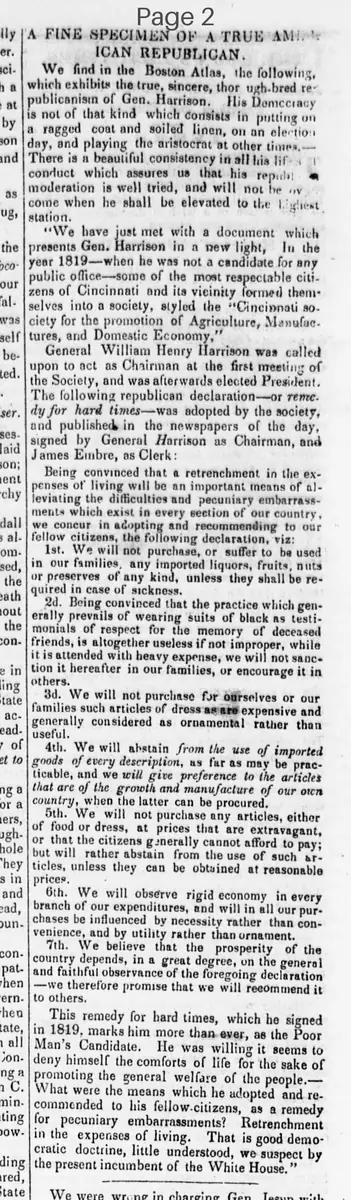
We find in the Boston Atlas, the following, which exhibits the true, sincere, thorough-bred republicanism of Gen. Harrison. His Democracy is not of that kind which consists in putting on a ragged coat and soiled linen, on an election day, and playing the aristocrat at other times.— There is a beautiful consistency in all his life-conduct which assures us that his republican moderation is well tried, and will not be "vitiated" when he shall be elevated to the highest station.
"We have just met with a document which presents Gen. Harrison in a new light. In the year 1819—when he was not a candidate for any public office—some of the most respectable citizens of Cincinnati and its vicinity formed themselves into a society, styled the "Cincinnati society for the promotion of Agriculture, Manufactures, and Domestic Economy,
General William Henry Harrison was called upon to act as Chairman at the first meeting of the Society, and was afterwards elected President. The following republican declaration—or remedy for hard times—was adopted by the society, and published in the newspapers of the day, signed by General Harrison as Chairman, and James Embrce, as Clerk:
Being convinced that a retrenchment in the expenses of living will be an important means of alleviating the difficulties and pecuniary embarrassments which exist in every section of our country, we concur in adopting and recommending to our fellow citizens, the following declaration, viz:
1st. We will not purchase, or suffer to be used in our families, any imported liquors, fruits, nuts or preserves of any kind, unless they shall be required in case of sickness.
2d. Being convinced that the practice which generally prevails of wearing suits of black as testimonials of respect for the memory of deceased friends, is altogether useless if not improper, while it is attended with heavy expense, we will not sanction it hereafter in our families, or encourage it in others.
3d. We will not purchase for ourselves or our families such articles of dress as are expensive and generally considered as ornamental rather than useful.
4th. We will abstain from the use of imported goods of every description, as far as may be practicable, and we will give preference to the articles that are of the growth and manufacture of our own country, when the latter can be procured.
5th. We will not purchase any articles, either of food or dress, at prices that are extravagant or that the citizens generally cannot afford to pay; but will rather abstain from the use of such articles, unless they can be obtained at reasonable prices.
6th. We will observe rigid economy in every branch of our expenditures, and will in all our purchases be influenced by necessity rather than convenience, and by utility rather than ornament.
7th. We believe that the prosperity of the country depends, in a great degree, on the general and faithful observance of the foregoing declaration—we therefore promise that we will recommend it to others.
This remedy for hard times, which he signed in 1819, marks him more than ever, as the Poor Man's Candidate. He was willing it seems to deny himself the comforts of life for the sake of promoting the general welfare of the people.— What were the means which he adopted and recommended to his fellow-citizens, as a remedy for pecuniary embarrassments? Retrenchment in the expenses of living. That is good democratic doctrine, little understood, we suspect by the present incumbent of the White House."
What sub-type of article is it?
What themes does it cover?
What keywords are associated?
What entities or persons were involved?
Where did it happen?
Story Details
Key Persons
Location
Cincinnati And Its Vicinity
Event Date
1819
Story Details
The article from the Boston Atlas praises Gen. Harrison's consistent republicanism by recounting his 1819 leadership as chairman and president of the Cincinnati society for promoting agriculture, manufactures, and domestic economy, where he signed a declaration advocating retrenchment in living expenses, avoidance of luxuries, and economic simplicity to remedy national pecuniary embarrassments.