Thank you for visiting SNEWPapers!
Sign up free
Editorial
March 25, 1801
The Providence Journal, And Town And Country Advertiser
Providence, Providence County, Rhode Island
What is this article about?
Editorial celebrates the first meeting of the United Parliament of Great Britain and Ireland on January 23, praising the Union under George III and Pitt. It highlights historical benefits of past unions, Irish virtues and talents, and how the Union integrates Ireland fully into the British Empire.
Clipping
OCR Quality
98%
Excellent
Full Text
General Articles.
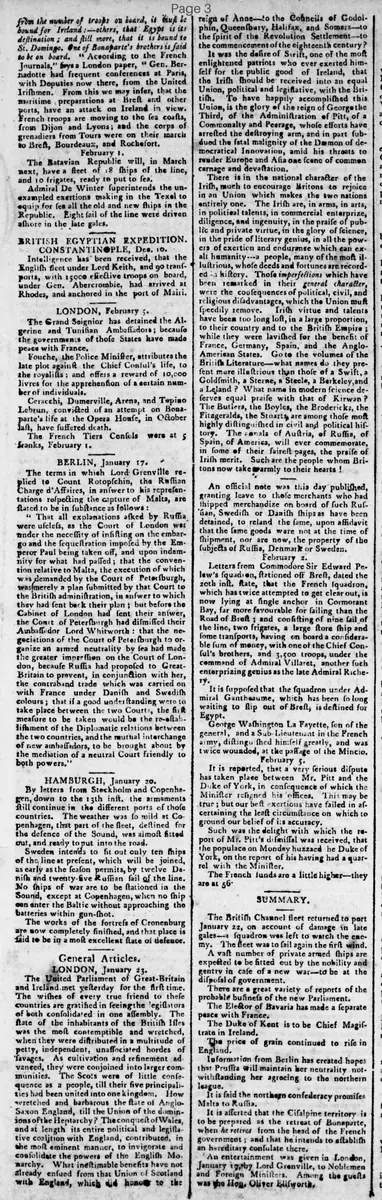
LONDON, January 23.
The United Parliament of Great-Britain and Ireland met yesterday for the first time. The wishes of every true friend to these countries are gratified in seeing the legislators of both consolidated in one assembly. The state of the inhabitants of the British Isles was the most contemptible and wretched, when they were distributed in a multitude of petty, independent, unassociated hordes of Savages. As cultivation and refinement advanced, they were conjoined into larger communities. The Scots were of little consequence as a people, till their five principalities had been united into one kingdom. How wretched and barbarous the state of Anglo-Saxon England, till the Union of the dominions of the Heptarchy? The conquest of Wales and at length its entire political and legislative coalition with England, contributed, in the most eminent manner, to invigorate and consolidate the powers of the English Monarchy. What inestimable benefits have not already ensued from that Union of Scotland with England, which did honor to the reign of Anne—to the Councils of Godolphin, Queenberry, Halifax, and Somers—to the spirit of the Revolution Settlement—to the commencement of the eighteenth century?
It was the desire of Swift, one of the most enlightened patriots who ever exerted himself for the public good of Ireland, that the Irish should be received into an equal Union, political and legislative, with the British. To have happily accomplished this Union, is the glory of the reign of George the Third, of the Administration of Pitt, of a Commonalty and Peerage, whose efforts have arrested the destroying arm, and in part subdued the fatal malignity of the Demon of democratical Innovation, amid his threats to render Europe and Asia one scene of common carnage and devastation.
There is in the national character of the Irish, much to encourage Britons to rejoice in an Union which makes the two nations entirely one. The Irish are, in arms, in arts, in political talents, in commercial enterprise, diligence, and ingenuity, in the praise of public and private virtue, in the glory of science, in the pride of literary genius, in all the powers of exertion and endurance which can exalt humanity.—a people, many of the most illustrious, whose deeds and fortunes are recorded in history. Those imperfections which have been remarked in their general character, were the consequences of political, civil, and religious disadvantages, which the Union must speedily remove. Irish virtue and talents have been too long lost, in a large proportion, to their country and to the British Empire; while they were lavished for the benefit of France, Germany, Spain, and the Anglo-American States. Go to the volumes of the British Literature—what names do they present more illustrious than those of a Swift, a Goldsmith, a Sterne, a Steele, a Berkeley, and a Leland? What name in modern science deserves equal praise with that of Kirwan? The Butlers, the Boyles, the Brodericks, the Fitzgeralds, the Stuarts are among those most highly distinguished in civil and political history. The annals of Austria, of Russia, of Spain, of America, will ever commemorate, in some of their fairest pages, the praise of Irish merit. Such are the people whom Britons now take warmly to their hearts!
LONDON, January 23.
The United Parliament of Great-Britain and Ireland met yesterday for the first time. The wishes of every true friend to these countries are gratified in seeing the legislators of both consolidated in one assembly. The state of the inhabitants of the British Isles was the most contemptible and wretched, when they were distributed in a multitude of petty, independent, unassociated hordes of Savages. As cultivation and refinement advanced, they were conjoined into larger communities. The Scots were of little consequence as a people, till their five principalities had been united into one kingdom. How wretched and barbarous the state of Anglo-Saxon England, till the Union of the dominions of the Heptarchy? The conquest of Wales and at length its entire political and legislative coalition with England, contributed, in the most eminent manner, to invigorate and consolidate the powers of the English Monarchy. What inestimable benefits have not already ensued from that Union of Scotland with England, which did honor to the reign of Anne—to the Councils of Godolphin, Queenberry, Halifax, and Somers—to the spirit of the Revolution Settlement—to the commencement of the eighteenth century?
It was the desire of Swift, one of the most enlightened patriots who ever exerted himself for the public good of Ireland, that the Irish should be received into an equal Union, political and legislative, with the British. To have happily accomplished this Union, is the glory of the reign of George the Third, of the Administration of Pitt, of a Commonalty and Peerage, whose efforts have arrested the destroying arm, and in part subdued the fatal malignity of the Demon of democratical Innovation, amid his threats to render Europe and Asia one scene of common carnage and devastation.
There is in the national character of the Irish, much to encourage Britons to rejoice in an Union which makes the two nations entirely one. The Irish are, in arms, in arts, in political talents, in commercial enterprise, diligence, and ingenuity, in the praise of public and private virtue, in the glory of science, in the pride of literary genius, in all the powers of exertion and endurance which can exalt humanity.—a people, many of the most illustrious, whose deeds and fortunes are recorded in history. Those imperfections which have been remarked in their general character, were the consequences of political, civil, and religious disadvantages, which the Union must speedily remove. Irish virtue and talents have been too long lost, in a large proportion, to their country and to the British Empire; while they were lavished for the benefit of France, Germany, Spain, and the Anglo-American States. Go to the volumes of the British Literature—what names do they present more illustrious than those of a Swift, a Goldsmith, a Sterne, a Steele, a Berkeley, and a Leland? What name in modern science deserves equal praise with that of Kirwan? The Butlers, the Boyles, the Brodericks, the Fitzgeralds, the Stuarts are among those most highly distinguished in civil and political history. The annals of Austria, of Russia, of Spain, of America, will ever commemorate, in some of their fairest pages, the praise of Irish merit. Such are the people whom Britons now take warmly to their hearts!
What sub-type of article is it?
Constitutional
Partisan Politics
What keywords are associated?
Union Of Britain And Ireland
Political Union
Irish Character
Historical Unions
George Iii
Pitt Administration
Irish Contributions
What entities or persons were involved?
George The Third
Pitt
Swift
Anne
Godolphin
Queenberry
Halifax
Somers
Goldsmith
Sterne
Steele
Berkeley
Leland
Kirwan
Editorial Details
Primary Topic
Celebration Of The Union Of Great Britain And Ireland
Stance / Tone
Strongly Supportive And Celebratory
Key Figures
George The Third
Pitt
Swift
Anne
Godolphin
Queenberry
Halifax
Somers
Goldsmith
Sterne
Steele
Berkeley
Leland
Kirwan
Key Arguments
Historical Unions Strengthened Britain And Scotland
Union With Wales Invigorated English Monarchy
Scottish Union Under Anne Brought Inestimable Benefits
Swift Desired Equal Political Union For Ireland
Union Accomplished Under George Iii And Pitt Counters Democratic Innovation
Irish Excel In Arms, Arts, Talents, Enterprise, Virtue, Science, Literature
Past Irish Imperfections Due To Disadvantages Now Removed By Union
Irish Talents Previously Benefited Other Nations But Now Integrated Into British Empire
Illustrious Irish Names In British Literature And History