Thank you for visiting SNEWPapers!
Sign up free
Letter to Editor
October 23, 1844
Morning Star
Limerick, York County, Maine
What is this article about?
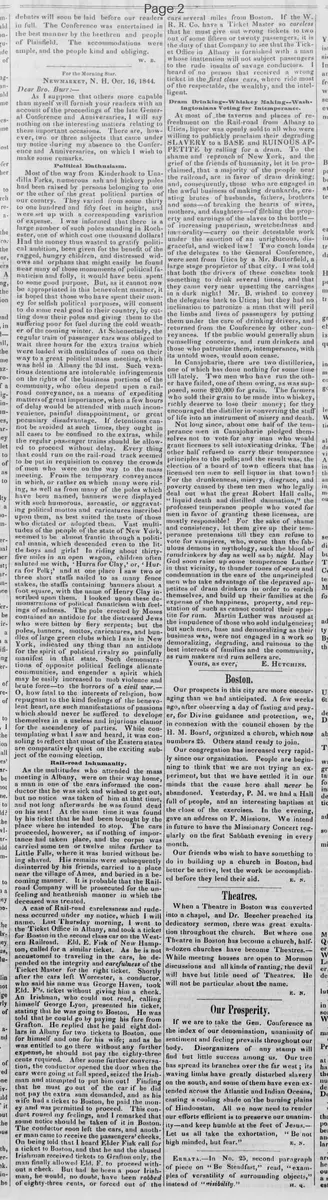
E. Hutchins writes from Newmarket, NH, on Oct. 16, 1844, critiquing excessive political enthusiasm during the 1844 US election (Clay vs. Polk), incidents of railroad inhumanity and carelessness, and the persistence of dram drinking despite temperance efforts in New York.
Clipping
OCR Quality
98%
Excellent
Full Text
W.B.
For the Morning Star.
Newmarket, N. H. Oct. 16, 1844.
Dear Bro. Burr:—
As I suppose that others more capable
than myself will furnish your readers with an
account of the proceedings of the late General
Conference and Anniversaries, I will say
nothing on the interesting matters relating to
these important occasions. There are, however,
two or three subjects that came under
my notice during my absence to the Conference
and Anniversaries, on which I wish to
make some remarks.
Political Enthusiasm.
Most of the way from Kinderhook to Unadilla
Forks, numerous ash and hickory poles
had been raised by persons belonging to one
or the other of the great political parties of
our country. They varied from some thirty
to one hundred and fifty feet in height, and
were set up with a corresponding variation
of expense. I was informed that there is a
large number of such poles standing in Rochester,
one of which cost one thousand dollars!
Had the money thus wasted to gratify political
ambition, been given for the benefit of the
ragged, hungry children, and distressed widows
and orphans that might easily be found
near many of those monuments of political fanaticism
and folly, it would have been spent
to some good purpose. But, as it cannot now
be appropriated in this benevolent manner, it
is hoped that those who have spent their money
for selfish political purposes, will consent
to do some real good to their country, by cutting
down their poles and giving them to the
suffering poor for fuel during the cold weather
of the coming winter. At Schenectady, the
regular train of passenger cars was obliged to
wait three hours for the extra trains which
were loaded with multitudes of men on their
way to a great political mass meeting, which
was held in Albany the 2d inst. Such vexatious
detentions are intolerable infringements
on the rights of the business portions of the
community, who often depend upon a railroad
conveyance, as a means of expediting
matters of great importance, when a few hours
of delay would be attended with much inconvenience,
painful disappointment, or great
pecuniary disadvantage. If detentions cannot
be avoided at such times, they ought in
all cases to be confined to the extras, while
the regular passenger trains should be allowed
to proceed without delay. Every thing
that could run on the rail-road track seemed
to be put in requisition to convey the crowds
of men who were on the way to the mass
meeting. From the temporary conveyances
in which, or rather on which many were riding,
as well as from many of the poles which
have been named, banners were displayed
with such humorous, sarcastic, or aggravating
political mottos and caricatures inscribed
upon them, as best suited the taste of those
who dictated or adopted them. Vast multitudes
of the people of the state of New York,
seemed to be almost frantic through a political
mania, which descended even to the little
boys and girls! In riding about thirty
five miles in an open wagon, children often
saluted me with, 'Hurra for Clay,' or, 'Hurra
for Polk;' and at one place I saw two or
three short staffs nailed to as many fence
stakes, the staffs containing banners about a
foot square, with the name of Henry Clay inscribed
upon them. I looked upon these demonstrations
of political fanaticism with feelings
of sadness. The pole erected by Moses
contained an antidote for the distressed Jews
who were bitten by fiery serpents; but the
poles, banners, mottos, caricatures, and bundles
of large green clubs which I saw in New
York, indicated any thing but an antidote
for the spirit of political rivalry so painfully
manifest in that state. Such demonstrations
of opposite political feelings alienate
communities, and engender a spirit which
may be easily increased to mob violence and
brute force—to the horrors of a civil war.—
O. how fatal to the interests of religion, how
repugnant to the kind feelings of the benevolent
heart, are such manifestations of passions
which should never be suffered to develope
themselves in a useless and injurious clamor
for the ascendency of parties. While contemplating
what I saw and heard, it was consoling
to reflect that most of the Eastern states
are comparatively quiet on the exciting subject
of the coming election.
Rail-road Inhumanity
As the multitudes who attended the mass
meeting in Albany, were on their way home.
a man in one of the cars informed the conductor
that he was sick and wished to get out,
but no notice was taken of him at that time,
and not long afterwards he was found dead
on his seat! At the same time it was found
by his ticket that he had been brought by the
place where he intended to stop. The cars
proceeded, however, as if nothing of importance
had taken place, and the corpse was
carried some ten or twelve miles farther to
Little Falls, where it was buried without being
shaved. His remains were subsequently
disinterred by his friends, carried to a place
near the village of Ames, and buried in a becoming
manner. It is probable that the Railroad
Company will be prosecuted for the unfeeling
and heathenish manner in which the
deceased was treated.
A case of Rail-road carelessness and rudeness
occurred under my notice, which I will
name. Last Thursday morning, I went to
the Ticket Office in Albany, and took a ticket
for Boston in the second class car on the Western
Railroad. Eld. E. Fisk of New Hampton,
called for a similar ticket. As he is not
accustomed to traveling in the cars, he depended
on the integrity and carefulness of the
Ticket Master for the right ticket. Shortly
after the cars left Worcester, a conductor,
who said his name was George Haven, took
Eld. F's. ticket without giving him a check.
An Irishman, who could not read, calling
himself George Lyon, presented his ticket,
stating that he was going to Boston. He was
told that he could go by paying his fare from
Grafton. He replied that he paid eight dollars
in Albany for two tickets to Boston, one
for himself and one for his wife; and as he
was entitled to go there without any further
expense, he should not pay the eighty-three
cents required. After some further conversation,
the conductor opened the door when the
cars were going at full speed, seized the Irishman
and attempted to put him out! Finding
that he must go out of the car if he did
not pay the extra sum demanded, and as his
wife had a ticket to Boston, he paid the money
and was permitted to proceed. This conduct
roused my feelings, and I remarked that
some notice should be taken of it in Boston.
The conductor soon left the cars, and another
man came to receive the passengers' checks.
On being told that I heard Elder Fisk call for
a ticket to Boston, and that he and the abused
Irishman received tickets to Grafton only, the
man finally allowed Eld. F. to proceed without
a check. But had he been a poor Irishman,
he would, no doubt, have been robbed
of eighty-three cents, or forced out of the
cars several miles from Boston. If the W.
R. R. Co. have a 'Ticket Master so careless
that he must give out wrong tickets to two
out of some fifteen or twenty passengers, it is
the duty of that Company to see that the Ticket
Office in Albany is furnished with a man
whose inattention will not subject passengers
to the rude insults of savage conductors. I
heard of no person that received a wrong
ticket in the first class cars, where ride most
of the respectable, the wealthy, and the intelligent.
Dram Drinking—Whiskey Making—Washingtonians Voting for Intemperance.
At most of the taverns and places of refreshment
on the Rail-road from Albany to
Utica, liquor was openly sold to all who were
willing to publicly proclaim their degrading
SLAVERY to A BASE and RUINOUS APPETITE
by calling for a dram. To the
shame and reproach of New York, and the
grief of the friends of humanity, let it be proclaimed,
that a majority of the people near
the railroad, are in favor of dram drinking:
and, consequently, those who are engaged in
the awful business of making drunkards, creating
brutes of husbands, fathers, brothers
and sons—of breaking the hearts of wives,
mothers, and daughters—of filching the property
and earnings of the slaves to the bottle—
of increasing pauperism, wretchedness and
immorality—carry on their detestable work
under the sanction of an unrighteous, disgraceful,
and wicked law! Two coach loads
of the delegates to the General Conference,
were sent from Utica by a Mr. Butterfield, a
large stage proprietor of that city. I was told
that both the drivers of these coaches took
something to drink several times, and that
they came very near upsetting the carriages
in a dark night! Mr. B. wished to convey
the delegates back to Utica; but they had no
inclination to patronize a man that will peril
the limbs and lives of passengers by putting
them under the care of drinking drivers, and
returned from the Conference by other conveyances.
If the public would generally shun
rumselling concerns, and rum drinkers and
those who patronize them, intemperance, with
its untold woes, would soon cease.
In Canajoharie, there are two distilleries,
one of which has done nothing for some time
till lately. Two men who have run the other
have failed, one of them owing, as was supposed,
some $20,000 for grain. The farmers
who sold their grain to be made into whiskey.
richly deserve to lose their money; for they
encouraged the distiller in converting the staff
of life into an instrument of misery and death.
Not long since, about one half of the temperance
men in Canajoharie pledged themselves
not to vote for any man who would
grant licenses to sell intoxicating drinks. The
other half refused to carry their temperance
principles to the polls; and the result was, the
election of a board of town officers that has
licensed ten men to sell liquor in that town!
For the drunkenness, misery, disgrace, and
poverty caused by these ten men who legally
deal out what the great Robert Hall calls,
"liquid death and distilled damnation," the
professed temperance people who voted for
men in favor of granting these licenses, are
mostly responsible! For the sake of shame
and consistency, let them give up their temperance
pretensions till they can refuse to
vote for vampires, who, worse than the fabulous
demons in mythology, suck the blood of
rumdrinkers by day as well as by night. May
God soon raise up some temperance Luther
in that vicinity, to thunder tones of scorn and
condemnation in the ears of the unprincipled
men who take advantage of the depraved appetites
of dram drinkers in order to enrich
themselves, and build up their families at the
expense of the happiness, property, and reputation
of such as cannot control their appetite
for rum. Martin Luther was aroused at
the impudence of those who sold indulgences:
but such men, base and demoralizing as their
business was, were not engaged in a work so
demoralizing, degrading, and ruinous to the
best interests of families and the community,
as rum makers and rum sellers are.
Yours, as ever,
E. HUTCHINS.
For the Morning Star.
Newmarket, N. H. Oct. 16, 1844.
Dear Bro. Burr:—
As I suppose that others more capable
than myself will furnish your readers with an
account of the proceedings of the late General
Conference and Anniversaries, I will say
nothing on the interesting matters relating to
these important occasions. There are, however,
two or three subjects that came under
my notice during my absence to the Conference
and Anniversaries, on which I wish to
make some remarks.
Political Enthusiasm.
Most of the way from Kinderhook to Unadilla
Forks, numerous ash and hickory poles
had been raised by persons belonging to one
or the other of the great political parties of
our country. They varied from some thirty
to one hundred and fifty feet in height, and
were set up with a corresponding variation
of expense. I was informed that there is a
large number of such poles standing in Rochester,
one of which cost one thousand dollars!
Had the money thus wasted to gratify political
ambition, been given for the benefit of the
ragged, hungry children, and distressed widows
and orphans that might easily be found
near many of those monuments of political fanaticism
and folly, it would have been spent
to some good purpose. But, as it cannot now
be appropriated in this benevolent manner, it
is hoped that those who have spent their money
for selfish political purposes, will consent
to do some real good to their country, by cutting
down their poles and giving them to the
suffering poor for fuel during the cold weather
of the coming winter. At Schenectady, the
regular train of passenger cars was obliged to
wait three hours for the extra trains which
were loaded with multitudes of men on their
way to a great political mass meeting, which
was held in Albany the 2d inst. Such vexatious
detentions are intolerable infringements
on the rights of the business portions of the
community, who often depend upon a railroad
conveyance, as a means of expediting
matters of great importance, when a few hours
of delay would be attended with much inconvenience,
painful disappointment, or great
pecuniary disadvantage. If detentions cannot
be avoided at such times, they ought in
all cases to be confined to the extras, while
the regular passenger trains should be allowed
to proceed without delay. Every thing
that could run on the rail-road track seemed
to be put in requisition to convey the crowds
of men who were on the way to the mass
meeting. From the temporary conveyances
in which, or rather on which many were riding,
as well as from many of the poles which
have been named, banners were displayed
with such humorous, sarcastic, or aggravating
political mottos and caricatures inscribed
upon them, as best suited the taste of those
who dictated or adopted them. Vast multitudes
of the people of the state of New York,
seemed to be almost frantic through a political
mania, which descended even to the little
boys and girls! In riding about thirty
five miles in an open wagon, children often
saluted me with, 'Hurra for Clay,' or, 'Hurra
for Polk;' and at one place I saw two or
three short staffs nailed to as many fence
stakes, the staffs containing banners about a
foot square, with the name of Henry Clay inscribed
upon them. I looked upon these demonstrations
of political fanaticism with feelings
of sadness. The pole erected by Moses
contained an antidote for the distressed Jews
who were bitten by fiery serpents; but the
poles, banners, mottos, caricatures, and bundles
of large green clubs which I saw in New
York, indicated any thing but an antidote
for the spirit of political rivalry so painfully
manifest in that state. Such demonstrations
of opposite political feelings alienate
communities, and engender a spirit which
may be easily increased to mob violence and
brute force—to the horrors of a civil war.—
O. how fatal to the interests of religion, how
repugnant to the kind feelings of the benevolent
heart, are such manifestations of passions
which should never be suffered to develope
themselves in a useless and injurious clamor
for the ascendency of parties. While contemplating
what I saw and heard, it was consoling
to reflect that most of the Eastern states
are comparatively quiet on the exciting subject
of the coming election.
Rail-road Inhumanity
As the multitudes who attended the mass
meeting in Albany, were on their way home.
a man in one of the cars informed the conductor
that he was sick and wished to get out,
but no notice was taken of him at that time,
and not long afterwards he was found dead
on his seat! At the same time it was found
by his ticket that he had been brought by the
place where he intended to stop. The cars
proceeded, however, as if nothing of importance
had taken place, and the corpse was
carried some ten or twelve miles farther to
Little Falls, where it was buried without being
shaved. His remains were subsequently
disinterred by his friends, carried to a place
near the village of Ames, and buried in a becoming
manner. It is probable that the Railroad
Company will be prosecuted for the unfeeling
and heathenish manner in which the
deceased was treated.
A case of Rail-road carelessness and rudeness
occurred under my notice, which I will
name. Last Thursday morning, I went to
the Ticket Office in Albany, and took a ticket
for Boston in the second class car on the Western
Railroad. Eld. E. Fisk of New Hampton,
called for a similar ticket. As he is not
accustomed to traveling in the cars, he depended
on the integrity and carefulness of the
Ticket Master for the right ticket. Shortly
after the cars left Worcester, a conductor,
who said his name was George Haven, took
Eld. F's. ticket without giving him a check.
An Irishman, who could not read, calling
himself George Lyon, presented his ticket,
stating that he was going to Boston. He was
told that he could go by paying his fare from
Grafton. He replied that he paid eight dollars
in Albany for two tickets to Boston, one
for himself and one for his wife; and as he
was entitled to go there without any further
expense, he should not pay the eighty-three
cents required. After some further conversation,
the conductor opened the door when the
cars were going at full speed, seized the Irishman
and attempted to put him out! Finding
that he must go out of the car if he did
not pay the extra sum demanded, and as his
wife had a ticket to Boston, he paid the money
and was permitted to proceed. This conduct
roused my feelings, and I remarked that
some notice should be taken of it in Boston.
The conductor soon left the cars, and another
man came to receive the passengers' checks.
On being told that I heard Elder Fisk call for
a ticket to Boston, and that he and the abused
Irishman received tickets to Grafton only, the
man finally allowed Eld. F. to proceed without
a check. But had he been a poor Irishman,
he would, no doubt, have been robbed
of eighty-three cents, or forced out of the
cars several miles from Boston. If the W.
R. R. Co. have a 'Ticket Master so careless
that he must give out wrong tickets to two
out of some fifteen or twenty passengers, it is
the duty of that Company to see that the Ticket
Office in Albany is furnished with a man
whose inattention will not subject passengers
to the rude insults of savage conductors. I
heard of no person that received a wrong
ticket in the first class cars, where ride most
of the respectable, the wealthy, and the intelligent.
Dram Drinking—Whiskey Making—Washingtonians Voting for Intemperance.
At most of the taverns and places of refreshment
on the Rail-road from Albany to
Utica, liquor was openly sold to all who were
willing to publicly proclaim their degrading
SLAVERY to A BASE and RUINOUS APPETITE
by calling for a dram. To the
shame and reproach of New York, and the
grief of the friends of humanity, let it be proclaimed,
that a majority of the people near
the railroad, are in favor of dram drinking:
and, consequently, those who are engaged in
the awful business of making drunkards, creating
brutes of husbands, fathers, brothers
and sons—of breaking the hearts of wives,
mothers, and daughters—of filching the property
and earnings of the slaves to the bottle—
of increasing pauperism, wretchedness and
immorality—carry on their detestable work
under the sanction of an unrighteous, disgraceful,
and wicked law! Two coach loads
of the delegates to the General Conference,
were sent from Utica by a Mr. Butterfield, a
large stage proprietor of that city. I was told
that both the drivers of these coaches took
something to drink several times, and that
they came very near upsetting the carriages
in a dark night! Mr. B. wished to convey
the delegates back to Utica; but they had no
inclination to patronize a man that will peril
the limbs and lives of passengers by putting
them under the care of drinking drivers, and
returned from the Conference by other conveyances.
If the public would generally shun
rumselling concerns, and rum drinkers and
those who patronize them, intemperance, with
its untold woes, would soon cease.
In Canajoharie, there are two distilleries,
one of which has done nothing for some time
till lately. Two men who have run the other
have failed, one of them owing, as was supposed,
some $20,000 for grain. The farmers
who sold their grain to be made into whiskey.
richly deserve to lose their money; for they
encouraged the distiller in converting the staff
of life into an instrument of misery and death.
Not long since, about one half of the temperance
men in Canajoharie pledged themselves
not to vote for any man who would
grant licenses to sell intoxicating drinks. The
other half refused to carry their temperance
principles to the polls; and the result was, the
election of a board of town officers that has
licensed ten men to sell liquor in that town!
For the drunkenness, misery, disgrace, and
poverty caused by these ten men who legally
deal out what the great Robert Hall calls,
"liquid death and distilled damnation," the
professed temperance people who voted for
men in favor of granting these licenses, are
mostly responsible! For the sake of shame
and consistency, let them give up their temperance
pretensions till they can refuse to
vote for vampires, who, worse than the fabulous
demons in mythology, suck the blood of
rumdrinkers by day as well as by night. May
God soon raise up some temperance Luther
in that vicinity, to thunder tones of scorn and
condemnation in the ears of the unprincipled
men who take advantage of the depraved appetites
of dram drinkers in order to enrich
themselves, and build up their families at the
expense of the happiness, property, and reputation
of such as cannot control their appetite
for rum. Martin Luther was aroused at
the impudence of those who sold indulgences:
but such men, base and demoralizing as their
business was, were not engaged in a work so
demoralizing, degrading, and ruinous to the
best interests of families and the community,
as rum makers and rum sellers are.
Yours, as ever,
E. HUTCHINS.
What sub-type of article is it?
Persuasive
Social Critique
Reflective
What themes does it cover?
Politics
Temperance
Social Issues
What keywords are associated?
Political Enthusiasm
Clay Polk Election
Railroad Inhumanity
Dram Drinking
Temperance Voting
Canajoharie Distilleries
Albany Mass Meeting
What entities or persons were involved?
E. Hutchins
Bro. Burr
Letter to Editor Details
Author
E. Hutchins
Recipient
Bro. Burr
Main Argument
the letter condemns excessive political fervor in the 1844 election as wasteful and divisive, criticizes railroad companies for inhumanity and rudeness toward passengers, and urges stronger temperance action against dram drinking and inconsistent voting that enables liquor licensing.
Notable Details
Ash And Hickory Poles Up To 150 Feet For Political Parties
Mass Meeting In Albany On Oct 2, 1844
Dead Passenger Ignored On Train To Little Falls
Ticket Errors Affecting Elder E. Fisk And Irishman George Lyon
Distilleries In Canajoharie, Temperance Voters Split Leading To 10 Liquor Licenses
Reference To Robert Hall's 'Liquid Death And Distilled Damnation'
Comparison To Martin Luther Against Indulgences