Thank you for visiting SNEWPapers!
Sign up free
Editorial
February 24, 1914
The Monroe Journal
Monroe, Union County, North Carolina
What is this article about?
Editorial responds to Congressman R. N. Page's letter denying accusation of voting to prosecute Farmers' Union and labor organizations as trusts. It clarifies his 1910 vote against a protective amendment and 1913 vote for a similar one, accusing him of political opportunism and inconsistent 'myopia' on labor issues.
Clipping
OCR Quality
95%
Excellent
Full Text
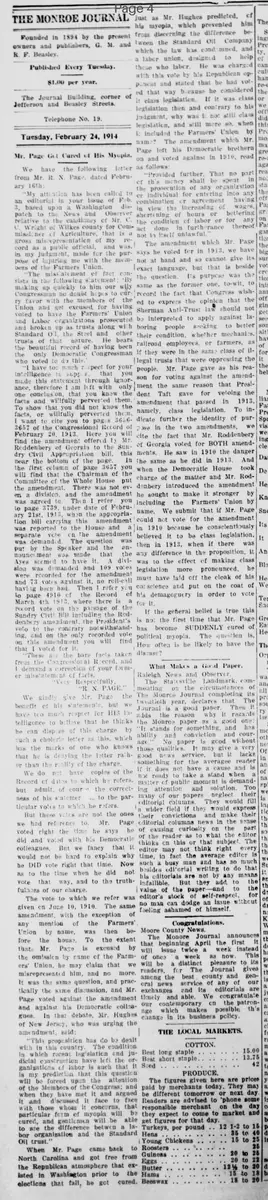
Mr. Page Got Cured of His Myopia.
We have the following letter from Mr. R. N. Page, dated February 16th:
"My attention has been called to an editorial in your issue of Feb. 3, based upon a Washington dispatch to the News and Observer relative to the candidacy of Mr. C. C. Wright of Wilkes county for Commissioner of Agriculture, that is a gross misrepresentation of my record as a public official, and was, in my judgment, made for the purpose of injuring me with the members of the Farmers Union.
The misstatement of fact consists in the following statement: 'By making up quickly to him our wily s Congressman no doubt hopes to curry favor with the members of the Union and get excused for having voted to have the Farmers' Union and Labor organizations prosecuted and broken up as trusts along with Standard Oil, the Steel and other trusts of that nature. He bears the beautiful record of having been the only Democratic Congressman who voted to do this.'
"I have too much respect for your intelligence to suppose that you made this statement through ignorance, therefore I am left with only one conclusion, that you knew the facts and willfully perverted them. To show that you did not know the facts, or willfully perverted them, I want to cite you to pages 3606-3657 of the Congressional Record of February 20, 1913. Here you will find the amendment offered by Mr. Roddenbery of Georgia to the Sundry Civil Appropriation bill, this near the bottom of the page. In the first column of page 3657 you will find that the Chairman of the Committee of the Whole House put the amendment. There was not even a division, and the amendment was agreed to. Then I refer you to page 3739, under date of February 21st, 1913, when the appropriation bill carrying this amendment was reported to the House and a separate vote on the amendment was demanded. The question was put by the Speaker and the announcement was made that the Ayes seemed to have it. A division was demanded and 107 votes were recorded for the amendment and 73 votes against it, no roll-call having been had. Then I refer you to page 4410 of the Record of March 4th 1913, where there is a record vote on the passage of the Sundry Civil Bill including the Roddenbery amendment, the President's veto to the contrary notwithstanding, and on the only recorded vote on this amendment you will find that I voted for it.
"These are the bare facts taken from the Congressional Record, and I demand a correction of your former misstatement of facts,
Very Respectfully,
"R. N. PAGE."
We gladly give Mr. Page the benefit of his statement, but we have too much respect for His Intelligence to believe that he thinks he can dispose of this charge by such a choleric letter as this, which has the marks of one who knows that he is denying the letter rather than the reality of the charge.
We do not have copies of the Record of dates to which he refers, but admit, of course, the correctness of his statement to the particular votes to which he refers. But these votes are not the ones we had reference to. Mr. Page voted right the time he says he did and voted with his Democratic colleagues. But we fancy that it would not be hard to explain why he DID vote right that time. Now as to the time when he did not vote that way, and to the truthfulness of our charge.
The vote to which we refer was given on June 10, 1910. The same amendment, with the exception of any mention of the Farmers' Union by name, was then before the house. To the extent that Mr. Page is excused by the omission by name of the Farmers' Union, he may claim that we misrepresented him, and no more. It was the same question, and practically the same discussion, and Mr. Page voted against the amendment and against his Democratic colleagues. In that debate, Mr. Hughes of New Jersey, who was urging the amendment, said:
"This proposition has to be dealt with in this country. The condition in which recent legislation and judicial construction have left the organizations of labor is such that it is my prediction that this question will be forced upon the attention of the Members of the Congress; and when they have met it and argued it and discussed it face to face with those whom it concerns, that particular form of myopia will be cured, and gentlemen will be able to see the difference between a labor organization and the Standard Oil trust."
When Mr. Page came back to North Carolina and got free from the Republican atmosphere that existed in Washington prior to the elections that fall, he got cured, just as Mr. Hughes predicted, of his myopia, which prevented him from discerning the difference between the Standard Oil Company which the law has condemned, and a labor union, designed to help those who labor. He was charged with this vote by his Republican opponent and stated that he had voted that way because he considered it class legislation. If it was class legislation then and contrary to his judgment, why was it not still class legislation, and still more so, when it included the Farmers' Union by name? The amendment which Mr. Page left his Democratic brethren on and voted against in 1910, read as follows:
"Provided further, That no part of this money shall be spent in the prosecution of any organization or individual for entering into any combination or agreement having in view the increasing of wages, shortening of hours or bettering the condition of labor or for any act done in furtherance thereof not in itself unlawful."
The amendment which Mr. Page says he voted for in 1913, we have not at hand and so cannot give its exact language, but that is beside the question. Its purpose was the same as the former one, to-wit, to record the fact that Congress wished to express the opinion that the Sherman Anti-Trust law should not be interpreted to apply against laboring people seeking to better their condition, whether mechanics, railroad employees, or farmers, as if they were in the same class of illegal trusts that were oppressing the people. Mr. Page gave as his reason for voting against the amendment the same reason that President Taft gave for vetoing the amendment that passed in 1913, namely, class legislation. To indicate further the identity of purpose in the two amendments, we cite the fact that Mr. Roddenbery of Georgia voted for BOTH amendments. He saw in 1910 the danger the same as he did in 1913. And when the Democratic House took charge of the matter and Mr. Roddenbery introduced the amendment he sought to make it stronger by including the Farmers' Union by name. We submit that if Mr. Page could not vote for the amendment in 1910 because he conscientiously believed it to be class legislation, then in 1913, when if there was any difference in the proposition, it was to the effect of making class legislation more pronounced, he must have laid off the cloak of his conscience and put on the coat of his demagoguery in order to vote for it.
If the general belief is true this is not the first time that Mr. Page has become SUDDENLY cured of political myopia.
The question is, How often is he likely to have the disease?
We have the following letter from Mr. R. N. Page, dated February 16th:
"My attention has been called to an editorial in your issue of Feb. 3, based upon a Washington dispatch to the News and Observer relative to the candidacy of Mr. C. C. Wright of Wilkes county for Commissioner of Agriculture, that is a gross misrepresentation of my record as a public official, and was, in my judgment, made for the purpose of injuring me with the members of the Farmers Union.
The misstatement of fact consists in the following statement: 'By making up quickly to him our wily s Congressman no doubt hopes to curry favor with the members of the Union and get excused for having voted to have the Farmers' Union and Labor organizations prosecuted and broken up as trusts along with Standard Oil, the Steel and other trusts of that nature. He bears the beautiful record of having been the only Democratic Congressman who voted to do this.'
"I have too much respect for your intelligence to suppose that you made this statement through ignorance, therefore I am left with only one conclusion, that you knew the facts and willfully perverted them. To show that you did not know the facts, or willfully perverted them, I want to cite you to pages 3606-3657 of the Congressional Record of February 20, 1913. Here you will find the amendment offered by Mr. Roddenbery of Georgia to the Sundry Civil Appropriation bill, this near the bottom of the page. In the first column of page 3657 you will find that the Chairman of the Committee of the Whole House put the amendment. There was not even a division, and the amendment was agreed to. Then I refer you to page 3739, under date of February 21st, 1913, when the appropriation bill carrying this amendment was reported to the House and a separate vote on the amendment was demanded. The question was put by the Speaker and the announcement was made that the Ayes seemed to have it. A division was demanded and 107 votes were recorded for the amendment and 73 votes against it, no roll-call having been had. Then I refer you to page 4410 of the Record of March 4th 1913, where there is a record vote on the passage of the Sundry Civil Bill including the Roddenbery amendment, the President's veto to the contrary notwithstanding, and on the only recorded vote on this amendment you will find that I voted for it.
"These are the bare facts taken from the Congressional Record, and I demand a correction of your former misstatement of facts,
Very Respectfully,
"R. N. PAGE."
We gladly give Mr. Page the benefit of his statement, but we have too much respect for His Intelligence to believe that he thinks he can dispose of this charge by such a choleric letter as this, which has the marks of one who knows that he is denying the letter rather than the reality of the charge.
We do not have copies of the Record of dates to which he refers, but admit, of course, the correctness of his statement to the particular votes to which he refers. But these votes are not the ones we had reference to. Mr. Page voted right the time he says he did and voted with his Democratic colleagues. But we fancy that it would not be hard to explain why he DID vote right that time. Now as to the time when he did not vote that way, and to the truthfulness of our charge.
The vote to which we refer was given on June 10, 1910. The same amendment, with the exception of any mention of the Farmers' Union by name, was then before the house. To the extent that Mr. Page is excused by the omission by name of the Farmers' Union, he may claim that we misrepresented him, and no more. It was the same question, and practically the same discussion, and Mr. Page voted against the amendment and against his Democratic colleagues. In that debate, Mr. Hughes of New Jersey, who was urging the amendment, said:
"This proposition has to be dealt with in this country. The condition in which recent legislation and judicial construction have left the organizations of labor is such that it is my prediction that this question will be forced upon the attention of the Members of the Congress; and when they have met it and argued it and discussed it face to face with those whom it concerns, that particular form of myopia will be cured, and gentlemen will be able to see the difference between a labor organization and the Standard Oil trust."
When Mr. Page came back to North Carolina and got free from the Republican atmosphere that existed in Washington prior to the elections that fall, he got cured, just as Mr. Hughes predicted, of his myopia, which prevented him from discerning the difference between the Standard Oil Company which the law has condemned, and a labor union, designed to help those who labor. He was charged with this vote by his Republican opponent and stated that he had voted that way because he considered it class legislation. If it was class legislation then and contrary to his judgment, why was it not still class legislation, and still more so, when it included the Farmers' Union by name? The amendment which Mr. Page left his Democratic brethren on and voted against in 1910, read as follows:
"Provided further, That no part of this money shall be spent in the prosecution of any organization or individual for entering into any combination or agreement having in view the increasing of wages, shortening of hours or bettering the condition of labor or for any act done in furtherance thereof not in itself unlawful."
The amendment which Mr. Page says he voted for in 1913, we have not at hand and so cannot give its exact language, but that is beside the question. Its purpose was the same as the former one, to-wit, to record the fact that Congress wished to express the opinion that the Sherman Anti-Trust law should not be interpreted to apply against laboring people seeking to better their condition, whether mechanics, railroad employees, or farmers, as if they were in the same class of illegal trusts that were oppressing the people. Mr. Page gave as his reason for voting against the amendment the same reason that President Taft gave for vetoing the amendment that passed in 1913, namely, class legislation. To indicate further the identity of purpose in the two amendments, we cite the fact that Mr. Roddenbery of Georgia voted for BOTH amendments. He saw in 1910 the danger the same as he did in 1913. And when the Democratic House took charge of the matter and Mr. Roddenbery introduced the amendment he sought to make it stronger by including the Farmers' Union by name. We submit that if Mr. Page could not vote for the amendment in 1910 because he conscientiously believed it to be class legislation, then in 1913, when if there was any difference in the proposition, it was to the effect of making class legislation more pronounced, he must have laid off the cloak of his conscience and put on the coat of his demagoguery in order to vote for it.
If the general belief is true this is not the first time that Mr. Page has become SUDDENLY cured of political myopia.
The question is, How often is he likely to have the disease?
What sub-type of article is it?
Partisan Politics
Labor
Economic Policy
What keywords are associated?
Congressional Voting Record
Labor Unions
Farmers Union
Anti Trust Amendment
Political Myopia
Class Legislation
Demagoguery
What entities or persons were involved?
R. N. Page
C. C. Wright
Mr. Roddenbery Of Georgia
Mr. Hughes Of New Jersey
President Taft
Farmers Union
Democratic Colleagues
Editorial Details
Primary Topic
Critique Of Congressman Page's Inconsistent Voting On Labor Protection Amendments
Stance / Tone
Critical Accusation Of Political Opportunism And Inconsistency
Key Figures
R. N. Page
C. C. Wright
Mr. Roddenbery Of Georgia
Mr. Hughes Of New Jersey
President Taft
Farmers Union
Democratic Colleagues
Key Arguments
Page's 1910 Vote Against Amendment Protecting Labor From Anti Trust Prosecution Was Against Democratic Line
Page's 1913 Vote For Similar Amendment Including Farmers' Union Shows Sudden Change After Republican Atmosphere In Washington
Both Amendments Aimed To Exempt Labor Organizations From Sherman Anti Trust Law Like Standard Oil
Page's Reason For 1910 Vote (Class Legislation) Mirrors Taft's Veto Reason For 1913, Yet He Voted For It Later
Roddenbery Voted For Both Amendments, Strengthening 1913 Version By Naming Farmers' Union
Page's 'Myopia' On Distinguishing Labor Unions From Trusts Was Cured Politically Conveniently