Thank you for visiting SNEWPapers!
Sign up free
The Brattleboro Daily Reformer
Brattleboro, Windham County, Vermont
What is this article about?
On December 6, 1916, German, Bulgarian, and Turkish forces under Field Marshal von Mackensen captured Bucharest, Ploesci, and Sinaia, completing the conquest of southern Rumania 14 weeks after its entry into World War I. The Romanian army is largely cut off, with 6,000 prisoners taken, and key oil fields seized.
Clipping
OCR Quality
Full Text
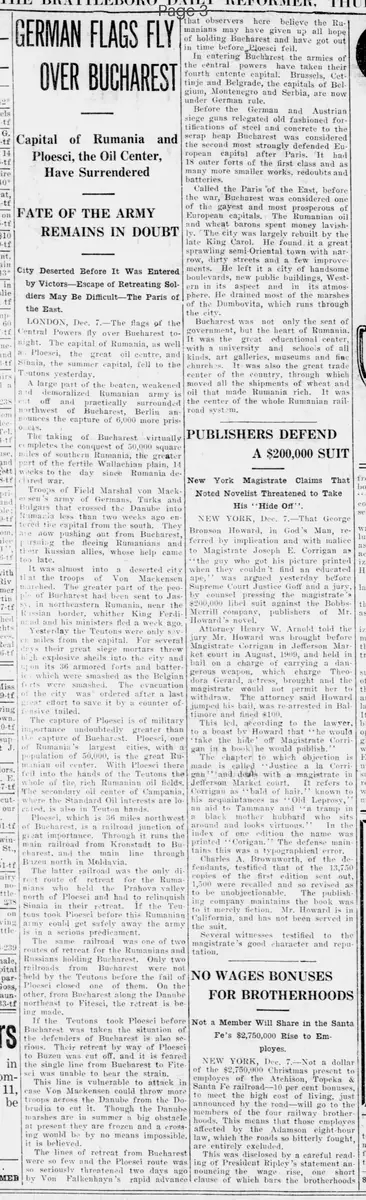
LONDON, Dec. 7.—The flags of the Central Powers fly over Bucharest tonight. The capital of Rumania, as well as Ploesci, the great oil centre, and Sinaia, the summer capital, fell to the Teutons yesterday.
A large part of the beaten, weakened and demoralized Rumanian army is cut off and practically surrounded northwest of Bucharest, Berlin announces the capture of 6,000 more prisoners.
The taking of Bucharest virtually completes the conquest of 50,000 square miles of southern Rumania, the greater part of the fertile Wallachian plain, 14 weeks to the day since Rumania declared war.
Troops of Field Marshal von Mackensen's army of Germans, Turks and Bulgars that crossed the Danube into Rumania less than two weeks ago entered the capital from the south. They are now pushing out from Bucharest, pursuing the fleeing Rumanians and Russian allies, whose help came too late.
It was almost into a deserted city that the troops of Von Mackensen marched. The greater part of the people of Bucharest had been sent to Jassy, in northeastern Rumania, near the Russian border, whither King Ferdinand and his ministers fled a week ago.
Yesterday the Teutons were only 50 miles from the capital. For several days their great siege mortars threw high explosive shells into the city and on its 36 armored forts and batteries which were smashed as the Belgian forts were smashed. The evacuation of the city was ordered after a last great effort to save it by a counter offensive failed.
The capture of Ploesci is of military importance undoubtedly greater than the capture of Bucharest. Ploesci, one of Rumania's largest cities, with a population of 50,000, is the great Rumanian oil center. With Ploesci there fell into the hands of the Teutons the whole of the rich Rumanian oil fields.
The secondary oil center of Campina, where the Standard Oil interests are located, is also in Teuton hands.
Ploesci, which is 36 miles northwest of Bucharest, is a railroad junction of great importance. Through it runs the main railroad from Kronstadt to Bucharest, and the main line through Buzeu north in Moldavia.
The latter railroad was the only direct route of retreat for the Rumanians who held the Prahova valley north of Ploesci and had to relinquish Sinaia in their retreat. If the Teutons took Ploesci before this Rumanian army could get safely away the army is in a serious predicament.
The same railroad was one of two routes of retreat for the Rumanians and Russians holding Bucharest. Only two railroads from Bucharest were not held by the Teutons before the fall of Ploesci closed one of them. On the other, from Bucharest along the Danube northeast to Fitesci, the retreat is being made.
If the Teutons took Ploesci before Bucharest was taken the situation of the defenders of Bucharest is also serious. Their retreat by way of Ploesci to Buzeu was cut off, and it is feared the single line from Bucharest to Fitesci was unable to bear the strain.
This line is vulnerable to attack in case Von Mackensen could throw more troops across the Danube from the Dobrudja to cut it. Though the Danube marshes are in summer a big obstacle at present they are frozen and a crossing would be by no means impossible, it is believed.
The lines of retreat from Bucharest were so few and the Ploesci route was so seriously threatened two days ago by Von Falkenhayn's rapid advance that observers here believe the Rumanians may have given up all hope of holding Bucharest and have got out in time before Ploesci fell.
In entering Bucharest the armies of the central powers have taken their fourth entente capital. Brussels, Cettinje and Belgrade, the capitals of Belgium, Montenegro and Serbia, are now under German rule.
Before the German and Austrian siege guns relegated old fashioned fortifications of steel and concrete to the scrap heap Bucharest was considered the second most strongly defended European capital after Paris. It had 18 outer forts of the first class and as many more smaller works, redoubts and batteries.
Called the Paris of the East, before the war, Bucharest was considered one of the gayest and most prosperous of European capitals. The Rumanian oil and wheat barons spent money lavishly. The city was largely rebuilt by the late King Carol. He found it a great sprawling semi-Oriental town with narrow, dirty streets and a few improvements. He left it a city of handsome boulevards, new public buildings, Western in its aspect and in its atmosphere. He drained most of the marshes of the Dumbovita, which runs through the city.
Bucharest was not only the seat of government, but the heart of Rumania. It was the great educational center, with a university and schools of all kinds, art galleries, museums and fine churches. It was also the great trade center of the country, through which moved all the shipments of wheat and oil that made Rumania rich. It was the center of the whole Rumanian rail road system.
What sub-type of article is it?
What keywords are associated?
What entities or persons were involved?
Where did it happen?
Foreign News Details
Primary Location
Bucharest, Rumania
Event Date
Yesterday (Dec. 6) From London, Dec. 7
Key Persons
Outcome
capture of 6,000 prisoners; conquest of 50,000 square miles of southern rumania including bucharest, ploesci, and sinaia; seizure of rumanian oil fields and campina; rumanian army cut off and surrounded
Event Details
Troops of the Central Powers under Field Marshal von Mackensen entered the deserted city of Bucharest after bombarding its forts, completing the conquest of southern Rumania 14 weeks after its declaration of war. Ploesci, the key oil center, and Sinaia also fell, cutting off retreat routes for the demoralized Rumanian army and late-arriving Russian allies. King Ferdinand and ministers fled to Jassy.