Thank you for visiting SNEWPapers!
Sign up free
Story
August 31, 1917
The Holt County Sentinel
Oregon, Holt County, Missouri
What is this article about?
USDA article on benefits of diversified farming: multiple income sources reduce risks, provide year-round work via livestock, and boost profits over single-crop vulnerabilities.
Clipping
OCR Quality
98%
Excellent
Full Text
Scientific Farming
DIVERSITY AND PROFITS.
Successful Farmers, as a Rule, Have Several Irons In the Fire.
[Prepared by United States Department of Agriculture.]
The diversity of enterprises making up the farm unit shows an important relation to profit. The successful farm usually has from three to five important sources of income.
There are some extraordinary circumstances under which a farmer may find it more profitable to raise only a single crop and even to buy feed to supply his live stock than to change in diversified farming. These conditions are exceptional, however, and such a farm is always subject to disaster through the failure of that single crop as well as through failure of market conditions.
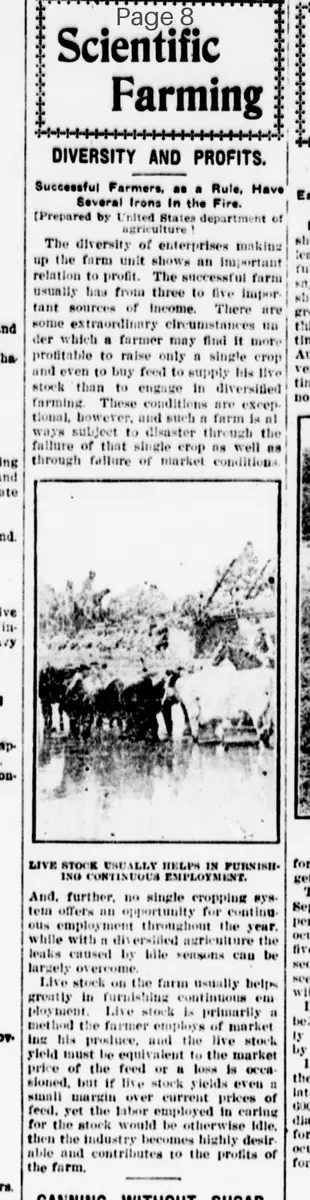
LIVE STOCK USUALLY HELPS IN FURNISHING CONTINUOUS EMPLOYMENT.
And, further, no single cropping system offers an opportunity for continuous employment throughout the year, while with a diversified agriculture the leaks caused by idle seasons can be largely overcome.
Live stock on the farm usually helps greatly in furnishing continuous employment. Live stock is primarily a method the farmer employs of marketing his produce, and the live stock sold must be equivalent to the market price of the feed or a loss is occasioned, but if live stock yields even a small margin over current prices of feed, yet the labor employed in caring for the stock would be otherwise idle, then the industry becomes highly desirable and contributes to the profits of the farm.
DIVERSITY AND PROFITS.
Successful Farmers, as a Rule, Have Several Irons In the Fire.
[Prepared by United States Department of Agriculture.]
The diversity of enterprises making up the farm unit shows an important relation to profit. The successful farm usually has from three to five important sources of income.
There are some extraordinary circumstances under which a farmer may find it more profitable to raise only a single crop and even to buy feed to supply his live stock than to change in diversified farming. These conditions are exceptional, however, and such a farm is always subject to disaster through the failure of that single crop as well as through failure of market conditions.
LIVE STOCK USUALLY HELPS IN FURNISHING CONTINUOUS EMPLOYMENT.
And, further, no single cropping system offers an opportunity for continuous employment throughout the year, while with a diversified agriculture the leaks caused by idle seasons can be largely overcome.
Live stock on the farm usually helps greatly in furnishing continuous employment. Live stock is primarily a method the farmer employs of marketing his produce, and the live stock sold must be equivalent to the market price of the feed or a loss is occasioned, but if live stock yields even a small margin over current prices of feed, yet the labor employed in caring for the stock would be otherwise idle, then the industry becomes highly desirable and contributes to the profits of the farm.
What sub-type of article is it?
Agricultural Advice
Farming Practices
What keywords are associated?
Diversified Farming
Livestock
Farm Profits
Continuous Employment
Single Crop Risks
Where did it happen?
Farms (General)
Story Details
Location
Farms (General)
Story Details
Successful farms diversify with 3-5 income sources for profit and stability, avoiding risks of single-crop failure. Livestock provides continuous employment and markets produce effectively, yielding margins over feed costs.