Thank you for visiting SNEWPapers!
Sign up free
Story
October 16, 1930
Askov American
Askov, Pine County, Minnesota
What is this article about?
Public health bulletin from Minnesota State Medical Association warns against sending children to school with colds, as they can spread infections and may signal serious diseases like measles or diphtheria, emphasizing parental responsibility and cooperation with schools to aid recovery and prevent epidemics.
Clipping
OCR Quality
98%
Excellent
Full Text
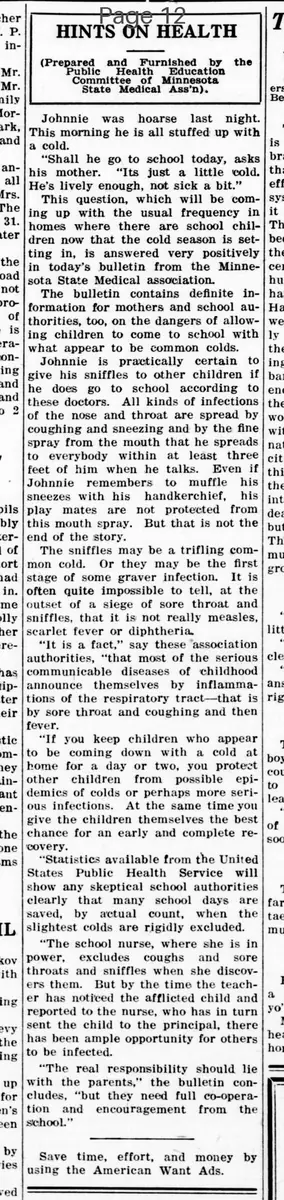
HINTS ON HEALTH
(Prepared and Furnished by the Public Health Education Committee of Minnesota State Medical Ass'n).
Johnnie was hoarse last night. This morning he is all stuffed up with a cold.
"Shall he go to school today," asks his mother. "It's just a little cold. He's lively enough, not sick a bit."
This question, which will be coming up with the usual frequency in homes where there are school children now that the cold season is setting in, is answered very positively in today's bulletin from the Minnesota State Medical association.
The bulletin contains definite information for mothers and school authorities, too, on the dangers of allowing children to come to school with what appear to be common colds.
Johnnie is practically certain to give his sniffles to other children if he does go to school according to these doctors. All kinds of infections of the nose and throat are spread by coughing and sneezing and by the fine spray from the mouth that he spreads to everybody within at least three feet of him when he talks. Even if Johnnie remembers to muffle his sneezes with his handkerchief, his play mates are not protected from this mouth spray. But that is not the end of the story.
The sniffles may be a trifling common cold. Or they may be the first stage of some graver infection. It is often quite impossible to tell, at the outset of a siege of sore throat and sniffles, that it is not really measles, scarlet fever or diphtheria.
"It is a fact," say these association authorities, "that most of the serious communicable diseases of childhood announce themselves by inflammations of the respiratory tract-that is by sore throat and coughing and then fever.
"If you keep children who appear to be coming down with a cold at home for a day or two, you protect other children from possible epidemics of colds or perhaps more serious infections. At the same time you give the children themselves the best chance for an early and complete recovery.
"Statistics available from the United States Public Health Service will show any skeptical school authorities clearly that many school days are saved, by actual count, when the slightest colds are rigidly excluded.
"The school nurse, where she is in power, excludes coughs and sore throats and sniffles when she discovers them. But by the time the teacher has noticed the afflicted child and reported to the nurse, who has in turn sent the child to the principal, there has been ample opportunity for others to be infected.
"The real responsibility should lie with the parents," the bulletin concludes, "but they need full co-operation and encouragement from the school."
Save time, effort, and money by using the American Want Ads.
(Prepared and Furnished by the Public Health Education Committee of Minnesota State Medical Ass'n).
Johnnie was hoarse last night. This morning he is all stuffed up with a cold.
"Shall he go to school today," asks his mother. "It's just a little cold. He's lively enough, not sick a bit."
This question, which will be coming up with the usual frequency in homes where there are school children now that the cold season is setting in, is answered very positively in today's bulletin from the Minnesota State Medical association.
The bulletin contains definite information for mothers and school authorities, too, on the dangers of allowing children to come to school with what appear to be common colds.
Johnnie is practically certain to give his sniffles to other children if he does go to school according to these doctors. All kinds of infections of the nose and throat are spread by coughing and sneezing and by the fine spray from the mouth that he spreads to everybody within at least three feet of him when he talks. Even if Johnnie remembers to muffle his sneezes with his handkerchief, his play mates are not protected from this mouth spray. But that is not the end of the story.
The sniffles may be a trifling common cold. Or they may be the first stage of some graver infection. It is often quite impossible to tell, at the outset of a siege of sore throat and sniffles, that it is not really measles, scarlet fever or diphtheria.
"It is a fact," say these association authorities, "that most of the serious communicable diseases of childhood announce themselves by inflammations of the respiratory tract-that is by sore throat and coughing and then fever.
"If you keep children who appear to be coming down with a cold at home for a day or two, you protect other children from possible epidemics of colds or perhaps more serious infections. At the same time you give the children themselves the best chance for an early and complete recovery.
"Statistics available from the United States Public Health Service will show any skeptical school authorities clearly that many school days are saved, by actual count, when the slightest colds are rigidly excluded.
"The school nurse, where she is in power, excludes coughs and sore throats and sniffles when she discovers them. But by the time the teacher has noticed the afflicted child and reported to the nurse, who has in turn sent the child to the principal, there has been ample opportunity for others to be infected.
"The real responsibility should lie with the parents," the bulletin concludes, "but they need full co-operation and encouragement from the school."
Save time, effort, and money by using the American Want Ads.
What sub-type of article is it?
Medical Curiosity
What themes does it cover?
Recovery
Moral Virtue
What keywords are associated?
Child Colds
Infection Spread
School Exclusion
Public Health
Respiratory Infections
What entities or persons were involved?
Johnnie
Where did it happen?
Minnesota Schools
Story Details
Key Persons
Johnnie
Location
Minnesota Schools
Event Date
Cold Season
Story Details
Advises mothers and school authorities to keep children home if they show signs of a cold to prevent spreading infections, as colds may be early stages of serious diseases like measles, scarlet fever, or diphtheria, and statistics show it saves school days.