Thank you for visiting SNEWPapers!
Sign up free
Story
October 31, 1924
Rock Springs Miner
Rock Springs, Sweetwater County, Wyoming
What is this article about?
Biographical sketch of Charles E. Winter, born 1870 in Iowa, educated in Midwest, law practice and judgeship in Wyoming, author of novels and state song, elected to U.S. Congress in 1922, noted for oratory, legislative work on lands, mining, and reclamation.
Clipping
OCR Quality
100%
Excellent
Full Text
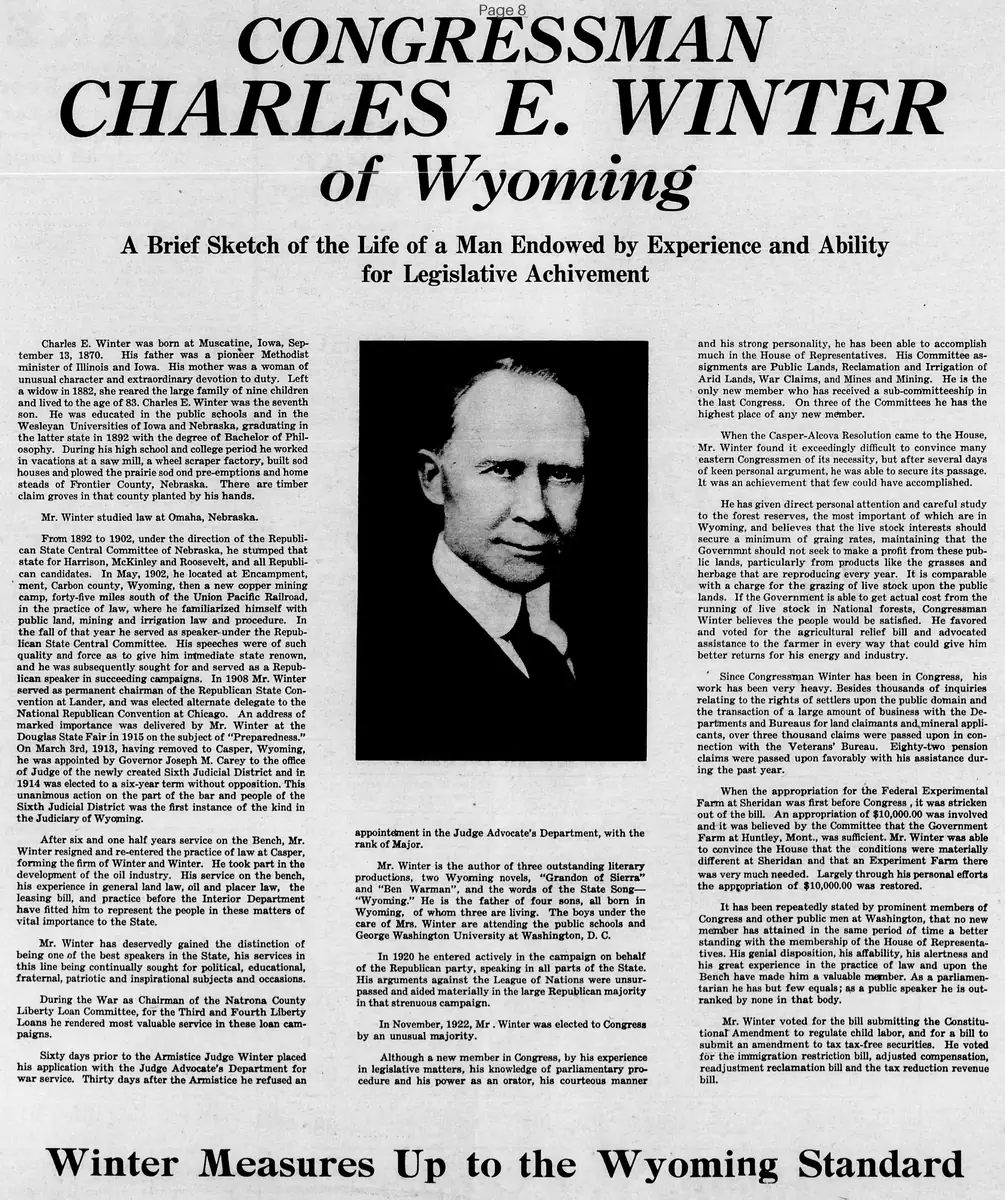
CONGRESSMAN
CHARLES E. WINTER
of Wyoming
A Brief Sketch of the Life of a Man Endowed by Experience and Ability
for Legislative Achievement
Charles E. Winter was born at Muscatine, Iowa, September 13, 1870. His father was a pioneer Methodist minister of Illinois and Iowa. His mother was a woman of unusual character and extraordinary devotion to duty. Left a widow in 1882, she reared the large family of nine children and lived to the age of 83. Charles E. Winter was the seventh son. He was educated in the public schools and in the Wesleyan Universities of Iowa and Nebraska, graduating in the latter state in 1892 with the degree of Bachelor of Philosophy. During his high school and college period he worked in vacations at a saw mill, a wheel scraper factory, built sod houses and plowed the prairie sod on pre-emptions and home steads of Frontier County, Nebraska. There are timber claim groves in that county planted by his hands.
Mr. Winter studied law at Omaha, Nebraska.
From 1892 to 1902, under the direction of the Republican State Central Committee of Nebraska, he stumped that state for Harrison, McKinley and Roosevelt, and all Republican candidates. In May, 1902, he located at Encampment, Carbon county, Wyoming, then a new copper mining camp, forty-five miles south of the Union Pacific Railroad, in the practice of law, where he familiarized himself with public land, mining and irrigation law and procedure. In the fall of that year he served as speaker under the Republican State Central Committee. His speeches were of such quality and force as to give him immediate state renown, and he was subsequently sought for and served as a Republican speaker in succeeding campaigns. In 1908 Mr. Winter served as permanent chairman of the Republican State Convention at Lander, and was elected alternate delegate to the National Republican Convention at Chicago. An address of marked importance was delivered by Mr. Winter at the Douglas State Fair in 1915 on the subject of "Preparedness."
On March 3rd, 1913, having removed to Casper, Wyoming, he was appointed by Governor Joseph M. Carey to the office of Judge of the newly created Sixth Judicial District and in 1914 was elected to a six-year term without opposition. This unanimous action on the part of the bar and people of the Sixth Judicial District was the first instance of the kind in the Judiciary of Wyoming.
After six and one half years service on the Bench, Mr. Winter resigned and re-entered the practice of law at Casper, forming the firm of Winter and Winter. He took part in the development of the oil industry. His service on the bench, his experience in general land law, oil and placer law, the leasing bill, and practice before the Interior Department have fitted him to represent the people in these matters of vital importance to the State.
Mr. Winter has deservedly gained the distinction of being one of the best speakers in the State, his services in this line being continually sought for political, educational, fraternal, patriotic and inspirational subjects and occasions.
During the War as Chairman of the Natrona County Liberty Loan Committee, for the Third and Fourth Liberty Loans he rendered most valuable service in these loan campaigns.
Sixty days prior to the Armistice Judge Winter placed his application with the Judge Advocate's Department for war service. Thirty days after the Armistice he refused an appointment in the Judge Advocate's Department, with the rank of Major.
Mr. Winter is the author of three outstanding literary productions, two Wyoming novels, "Grandon of Sierra" and "Ben Warman", and the words of the State Song "Wyoming." He is the father of four sons, all born in Wyoming, of whom three are living. The boys under the care of Mrs. Winter are attending the public schools and George Washington University at Washington, D. C.
In 1920 he entered actively in the campaign on behalf of the Republican party, speaking in all parts of the State. His arguments against the League of Nations were unsurpassed and aided materially in the large Republican majority in that strenuous campaign.
In November, 1922, Mr. Winter was elected to Congress by an unusual majority. Although a new member in Congress, by his experience in legislative matters, his knowledge of parliamentary procedure and his power as an orator, his courteous manner and his strong personality, he has been able to accomplish much in the House of Representatives. His Committee assignments are Public Lands, Reclamation and Irrigation of Arid Lands, War Claims, and Mines and Mining. He is the only new member who has received a sub-committeeship in the last Congress. On three of the Committees he has the highest place of any new member.
When the Casper-Alcova Resolution came to the House, Mr. Winter found it exceedingly difficult to convince many eastern Congressmen of its necessity, but after several days of keen personal argument, he was able to secure its passage. It was an achievement that few could have accomplished.
He has given direct personal attention and careful study to the forest reserves, the most important of which are in Wyoming, and believes that the live stock interests should secure a minimum of grazing rates, maintaining that the Government should not seek to make a profit from these public lands, particularly from products like the grasses and herbage that are reproducing every year. It is comparable with a charge for the grazing of live stock upon the public lands. If the Government is able to get actual cost from the running of live stock in National forests, Congressman Winter believes the people would be satisfied. He favored and voted for the agricultural relief bill and advocated assistance to the farmer in every way that could give him better returns for his energy and industry.
Since Congressman Winter has been in Congress, his work has been very heavy. Besides thousands of inquiries relating to the rights of settlers upon the public domain and the transaction of a large amount of business with the Departments and Bureaus for land claimants and mineral applicants, over three thousand claims were passed upon in connection with the Veterans' Bureau. Eighty-two pension claims were passed upon favorably with his assistance during the past year.
When the appropriation for the Federal Experimental Farm at Sheridan was first before Congress, it was stricken out of the bill. An appropriation of $10,000.00 was involved and it was believed by the Committee that the Government Farm at Huntley, Mont., was sufficient. Mr. Winter was able to convince the House that the conditions were materially different at Sheridan and that an Experiment Farm there was very much needed. Largely through his personal efforts the appropriation of $10,000.00 was restored.
It has been repeatedly stated by prominent members of Congress and other public men at Washington, that no new member has attained in the same period of time a better standing with the membership of the House of Representatives. His genial disposition, his affability, his alertness and his great experience in the practice of law and upon the Bench have made him a valuable member. As a parliamentarian he has but few equals; as a public speaker he is outranked by none in that body.
Mr. Winter voted for the bill submitting the Constitutional Amendment to regulate child labor, and for a bill to submit an amendment to tax tax-free securities. He voted for the immigration restriction bill, adjusted compensation, readjustment reclamation bill and the tax reduction revenue bill.
Winter Measures Up to the Wyoming Standard
CHARLES E. WINTER
of Wyoming
A Brief Sketch of the Life of a Man Endowed by Experience and Ability
for Legislative Achievement
Charles E. Winter was born at Muscatine, Iowa, September 13, 1870. His father was a pioneer Methodist minister of Illinois and Iowa. His mother was a woman of unusual character and extraordinary devotion to duty. Left a widow in 1882, she reared the large family of nine children and lived to the age of 83. Charles E. Winter was the seventh son. He was educated in the public schools and in the Wesleyan Universities of Iowa and Nebraska, graduating in the latter state in 1892 with the degree of Bachelor of Philosophy. During his high school and college period he worked in vacations at a saw mill, a wheel scraper factory, built sod houses and plowed the prairie sod on pre-emptions and home steads of Frontier County, Nebraska. There are timber claim groves in that county planted by his hands.
Mr. Winter studied law at Omaha, Nebraska.
From 1892 to 1902, under the direction of the Republican State Central Committee of Nebraska, he stumped that state for Harrison, McKinley and Roosevelt, and all Republican candidates. In May, 1902, he located at Encampment, Carbon county, Wyoming, then a new copper mining camp, forty-five miles south of the Union Pacific Railroad, in the practice of law, where he familiarized himself with public land, mining and irrigation law and procedure. In the fall of that year he served as speaker under the Republican State Central Committee. His speeches were of such quality and force as to give him immediate state renown, and he was subsequently sought for and served as a Republican speaker in succeeding campaigns. In 1908 Mr. Winter served as permanent chairman of the Republican State Convention at Lander, and was elected alternate delegate to the National Republican Convention at Chicago. An address of marked importance was delivered by Mr. Winter at the Douglas State Fair in 1915 on the subject of "Preparedness."
On March 3rd, 1913, having removed to Casper, Wyoming, he was appointed by Governor Joseph M. Carey to the office of Judge of the newly created Sixth Judicial District and in 1914 was elected to a six-year term without opposition. This unanimous action on the part of the bar and people of the Sixth Judicial District was the first instance of the kind in the Judiciary of Wyoming.
After six and one half years service on the Bench, Mr. Winter resigned and re-entered the practice of law at Casper, forming the firm of Winter and Winter. He took part in the development of the oil industry. His service on the bench, his experience in general land law, oil and placer law, the leasing bill, and practice before the Interior Department have fitted him to represent the people in these matters of vital importance to the State.
Mr. Winter has deservedly gained the distinction of being one of the best speakers in the State, his services in this line being continually sought for political, educational, fraternal, patriotic and inspirational subjects and occasions.
During the War as Chairman of the Natrona County Liberty Loan Committee, for the Third and Fourth Liberty Loans he rendered most valuable service in these loan campaigns.
Sixty days prior to the Armistice Judge Winter placed his application with the Judge Advocate's Department for war service. Thirty days after the Armistice he refused an appointment in the Judge Advocate's Department, with the rank of Major.
Mr. Winter is the author of three outstanding literary productions, two Wyoming novels, "Grandon of Sierra" and "Ben Warman", and the words of the State Song "Wyoming." He is the father of four sons, all born in Wyoming, of whom three are living. The boys under the care of Mrs. Winter are attending the public schools and George Washington University at Washington, D. C.
In 1920 he entered actively in the campaign on behalf of the Republican party, speaking in all parts of the State. His arguments against the League of Nations were unsurpassed and aided materially in the large Republican majority in that strenuous campaign.
In November, 1922, Mr. Winter was elected to Congress by an unusual majority. Although a new member in Congress, by his experience in legislative matters, his knowledge of parliamentary procedure and his power as an orator, his courteous manner and his strong personality, he has been able to accomplish much in the House of Representatives. His Committee assignments are Public Lands, Reclamation and Irrigation of Arid Lands, War Claims, and Mines and Mining. He is the only new member who has received a sub-committeeship in the last Congress. On three of the Committees he has the highest place of any new member.
When the Casper-Alcova Resolution came to the House, Mr. Winter found it exceedingly difficult to convince many eastern Congressmen of its necessity, but after several days of keen personal argument, he was able to secure its passage. It was an achievement that few could have accomplished.
He has given direct personal attention and careful study to the forest reserves, the most important of which are in Wyoming, and believes that the live stock interests should secure a minimum of grazing rates, maintaining that the Government should not seek to make a profit from these public lands, particularly from products like the grasses and herbage that are reproducing every year. It is comparable with a charge for the grazing of live stock upon the public lands. If the Government is able to get actual cost from the running of live stock in National forests, Congressman Winter believes the people would be satisfied. He favored and voted for the agricultural relief bill and advocated assistance to the farmer in every way that could give him better returns for his energy and industry.
Since Congressman Winter has been in Congress, his work has been very heavy. Besides thousands of inquiries relating to the rights of settlers upon the public domain and the transaction of a large amount of business with the Departments and Bureaus for land claimants and mineral applicants, over three thousand claims were passed upon in connection with the Veterans' Bureau. Eighty-two pension claims were passed upon favorably with his assistance during the past year.
When the appropriation for the Federal Experimental Farm at Sheridan was first before Congress, it was stricken out of the bill. An appropriation of $10,000.00 was involved and it was believed by the Committee that the Government Farm at Huntley, Mont., was sufficient. Mr. Winter was able to convince the House that the conditions were materially different at Sheridan and that an Experiment Farm there was very much needed. Largely through his personal efforts the appropriation of $10,000.00 was restored.
It has been repeatedly stated by prominent members of Congress and other public men at Washington, that no new member has attained in the same period of time a better standing with the membership of the House of Representatives. His genial disposition, his affability, his alertness and his great experience in the practice of law and upon the Bench have made him a valuable member. As a parliamentarian he has but few equals; as a public speaker he is outranked by none in that body.
Mr. Winter voted for the bill submitting the Constitutional Amendment to regulate child labor, and for a bill to submit an amendment to tax tax-free securities. He voted for the immigration restriction bill, adjusted compensation, readjustment reclamation bill and the tax reduction revenue bill.
Winter Measures Up to the Wyoming Standard
What sub-type of article is it?
Biography
What themes does it cover?
Triumph
Fortune Reversal
What keywords are associated?
Charles E Winter
Wyoming Congressman
Biographical Sketch
Legislative Career
Public Lands
Oil Industry
Wyoming State Song
What entities or persons were involved?
Charles E. Winter
Where did it happen?
Wyoming, Iowa, Nebraska
Story Details
Key Persons
Charles E. Winter
Location
Wyoming, Iowa, Nebraska
Event Date
September 13, 1870
Story Details
Charles E. Winter, born in Iowa in 1870, educated in Iowa and Nebraska, practiced law in Nebraska and Wyoming, served as judge in Wyoming, authored novels and state song, and elected to Congress in 1922, achieving legislative successes in public lands and reclamation.