Thank you for visiting SNEWPapers!
Sign up free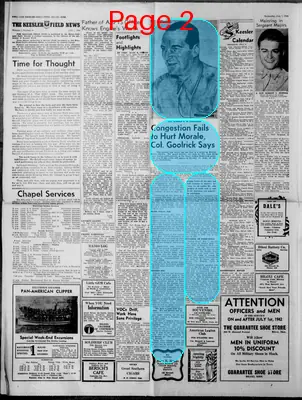
The Keesler Field News
Keesler Army Airfield, Biloxi, Harrison County, Mississippi
What is this article about?
Profile and interview with Col. Robert E. M. Goolrick, Commanding Officer at Keesler Field, discussing high morale despite congestion, soldiers' war seriousness, efficient training, and his extensive military background from WWI to WWII commands.
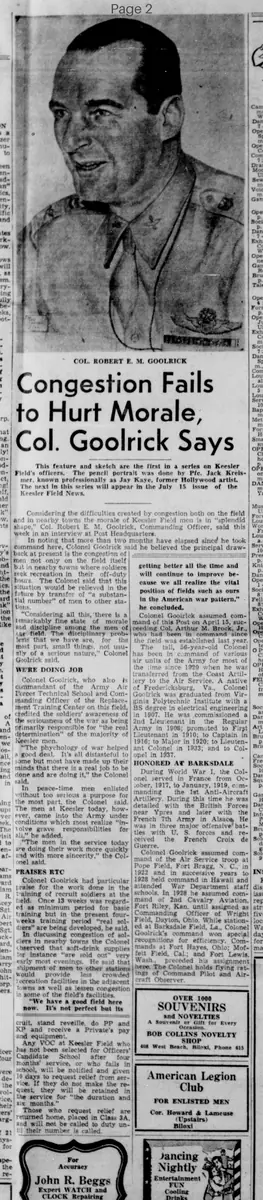
Merged-components note: Merged adjacent image (photo of the subject) with the feature story on Col. Robert E. M. Goolrick.
Clipping
OCR Quality
Full Text
Congestion Fails to Hurt Morale; Col. Goolrick Says
This feature and sketch are the first in a series on Keesler Field's officers. The pencil portrait was done by Pfc. Jack Kreis-mer, known professionally as Jay Kave, former Hollywood artist.
The next in this series will appear in the July 15 issue of the Keesler Field News.
Considering the difficulties created by congestion both on the field and in nearby towns the morale of Keesler Field men is in "splendid shape," Col. Robert E. M. Goolrick, Commanding Officer, said this week in an interview at Post Headquarters.
In noting that more than two months have elapsed since he took command here, Colonel Goolrick said the biggest drawback at present is the congestion of men not only on the field itself but in nearby towns where soldiers seek recreation in their off-duty hours. The Colonel said that this situation would be relieved in the future by transfer of "a substantial number" of men to other stations.
"Considering all this, there is a remarkably fine state of morale and discipline among the men of our field. The disciplinary problems that we have are, for the most part, small things, not usually of a serious nature," Colonel Goolrick said.
WE'RE DOING JOB
Colonel Goolrick, who also is commandant of the Army Air Forces Technical School and Commanding Officer of the Replacement Training Center on this field, credited the soldiers' awareness of the seriousness of the war as being primarily responsible for "the real determination" of the majority of Keesler men.
"The psychology of war helped a good deal. It's all distasteful to some but most have made up their minds that there is a real job to be done and are doing it." the Colonel said.
In peace-time men enlisted without too serious a purpose for the most part, the Colonel said.
The men at Keesler today, however, came into the Army under conditions which most realize "involve grave responsibilities for all," he added.
"The men in the service today are doing their work more quickly and with more sincerity." the Colonel said.
PRAISES RTO
Colonel Goolrick had particular praise for the work done in the training of recruit soldiers at the field. Once 13 weeks was regarded as minimum period for basic training but in the present four-weeks training period "real soldiers" are being developed, he said.
In discussing congestion of soldiers in nearby towns the Colonel observed that soft-drink supplies for instance "are sold out" very early most evenings. He said that shipment of men to other stations would provide less crowded recreation facilities in the adjacent towns as well as lessen congestion in some of the field's facilities.
"We have a good field here now. It's not perfect but its getting better all the time and will continue to improve because we all realize the vital position of fields such as ours in the American war pattern," he concluded.
Colonel Goolrick assumed command of this Post on April 15, succeeding Col. Arthur M. Brock, Jr., who had been in command since the field was established last year.
The tall, 56-year-old Colonel has been in command of various air units of the Army for most of the time since 1920 when he was transferred from the Coast Artillery to the Air Service. A native of Fredericksburg, Va., Colonel Goolrick was graduated from Virginia Polytechnic Institute with a BS degree in electrical engineering in 1907. He was commissioned a 2nd Lieutenant in the Regular Army in 1908; promoted to First Lieutenant in 1910; to Captain in 1916; to Major in 1920; to Lieutenant Colonel in 1933; and to Colonel in 1937.
HONORED AT BARKSDALE
During World War I, the Colonel served in France from October, 1917, to January, 1919, commanding the 1st Anti-Aircraft Artillery. During this time he was detailed with the British Forces near Ypres and later with the French 7th Army in Alsace. He was in three major offensive battles with U. S. forces and received the French Croix de Guerre.
Colonel Goolrick assumed command of the Air Service troop at Pope Field, Fort Bragg, N. C., in 1922 and in successive years to 1928 held command in Hawaii and attended War Department staff schools. In 1928 he assumed command of 2nd Cavalry Aviation, Fort Riley, Kan. until assigned as Commanding Officer of Wright Field, Dayton, Ohio. While stationed at Barksdale Field, La., Colonel Goolrick's command won special recognitions for efficiency. Commands at Fort Hayes, Ohio; Moffett Field, Cal.; and Fort Lewis, Wash., preceded his assignment here. The Colonel holds flying ratings of Command Pilot and Aircraft Observer.
What sub-type of article is it?
What themes does it cover?
What keywords are associated?
What entities or persons were involved?
Where did it happen?
Story Details
Key Persons
Location
Keesler Field
Event Date
April 15
Story Details
Col. Goolrick discusses high morale and discipline at Keesler Field despite congestion, credits soldiers' war awareness, praises shortened training producing real soldiers, and provides biographical details of his military career including WWI service and various commands.