Thank you for visiting SNEWPapers!
Sign up free
Editorial
February 1, 1799
Gazette Of The United States, & Philadelphia Daily Advertiser
Philadelphia, Philadelphia County, Pennsylvania
What is this article about?
David Jones, former chaplain, urges Congress to reform land sales policies in the North-Western Territory to prevent emigration to British Canada and Spanish Louisiana. He critiques the current law for favoring speculators, proposes agent-based sales of smaller tracts, development of salt springs, and treaties for Illinois settlements to promote U.S. expansion and retain citizens.
Clipping
OCR Quality
98%
Excellent
Full Text
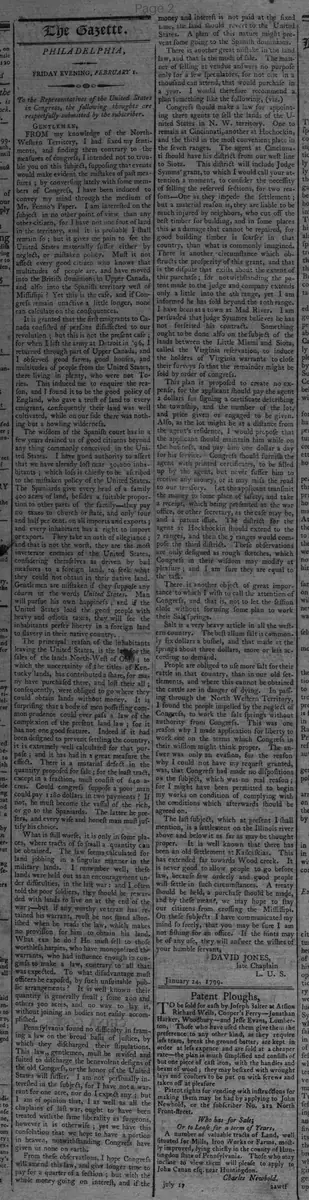
The Gazette.
PHILADELPHIA,
FRIDAY EVENING, FEBRUARY 1.
To the Representatives of the United States in Congress, the following thoughts are respectfully submitted by the subscriber
GENTLEMEN,
FROM my knowledge of the North-Western Territory, I had fixed my sentiments, and finding them contrary to the measures of congress, I intended not to trouble you on this subject, supposing that events would make evident the mistakes of past measures; by conversing lately with some members of Congress, I have been induced to convey my mind through the medium of Mr. Fenno's Paper. I am interested on the subject in no other point of view than any other citizen, for I have not one foot of land in the territory, and it is probable I shall remain so; but it gives me pain to see the United States materially suffer either by neglect, or mistaken policy. Must it not affect every good citizen who knows that multitudes of people are, and have moved into the British dominions in Upper Canada, and also into the Spanish territory west of Mississippi? Yet this is the case, and if Congress remain inactive a little longer, none can calculate on the consequences.
It is granted that the first emigrants to Canada consisted of persons disaffected to our revolution; but this is not the present case; for when I left the army at Detroit in '96, I returned through part of Upper Canada, and I observed good farms, good houses, and multitudes of people from the United States, there living in plenty, who were not Tories. This induced me to enquire the reason, and I found it to be the good policy of England, who gave a trust of land to every emigrant, consequently their land was well cultivated, while on our side there was nothing but a howling wilderness.
The wisdom of the Spanish court has in a few years drained us of good citizens beyond any thing commonly conceived in the United States. I have good authority to assert that we have already lost near 30,000 inhabitants; which loss is chiefly to be ascribed to the mistaken policy of the United States. The Spaniards give every head of a family 400 acres of land, besides a suitable proportion to other parts of the family—they pay no taxes to church or state, and only four and half per cent. on all imports and exports; and every inhabitant has a right to import or export. They take an oath of allegiance; and that is not the worst, they are the most inveterate enemies of the United States, considering themselves as driven by bad measures to a foreign land, to seek what they could not obtain in their native land.
Gentlemen are mistaken if they suppose any charm in the words United States. Man will pursue his own happiness; and if the United States load the good people with heavy and odious taxes, they will see the inhabitants prefer liberty in a foreign land to slavery in their native country.
The principal reason of the inhabitants leaving the United States, is the law for the sales of the lands North-West of Ohio; to which the uncertainty of the titles of Kentucky lands, has contributed a share, for many have purchased there, and lost their all; consequently, were obliged to go where they could obtain lands without money. It is surprising that a body of men possessing common prudence could ever pass a law of the complexion of the present land law; for it has not one good feature. Indeed if it had been designed to prevent settling the country, it is extremely well calculated for that purpose; and it has had in a great measure the effect. There is a material defect in the quantity proposed for sale; for the least tract, except in a fraction, must consist of 640 acres. Could congress suppose a poor man could pay 1 2/3 dollars per acre in two payments? If not, he must become the vassal of the rich, or go to the Spaniards. The latter he prefers, and every wise and honest man must justify his choice.
What is still worse, it is only in some places, where tracts of so small a quantity can be obtained. The law seems calculated for land jobbing in a singular manner in the military lands. I remember well, these lands were held out as an encouragement under difficulties, in the last war: and I often told the poor soldiers, they should be rewarded with lands to live on at the end of the war;—but if any worthy veteran has retained his warrant, must he not stand astonished when he reads the law, which makes no provision for him to obtain his land.
What can he do? He must sell to those worthless harpies, who have monopolized the warrants, who had influence enough in congress to make a law, contrary to all that was expected. To what disadvantage must officers be exposed, by such unsuitable public arrangements? It is well known their quantity is generally small; some 200 and others 300 acres, and no way to lay it, without joining in bodies not easily accomplished.
Pennsylvania found no difficulty in framing a law on the broad basis of justice, by which they discharged their stipulations. This law, gentlemen, must be revised and suited to discharge the benevolent designs of the old Congress, or the honor of the United States will suffer. I am not personally interested in the subject, for I have not a warrant for one acre, nor do I expect any; but I am of opinion that, I as well as all the chaplains of last war, ought to have been treated with the same liberality as surgeons, however it is otherwise; yet we have this consolation that we hope to have a portion in heaven, notwithstanding Congress have given us none on earth.
From these observations, I hope Congress will amend this law, and give longer time to pay for a quarter of a section; but with the whole money going on interest, and if the money and interest is not paid at the fixed time, the land should revert to the United States. A plan of this nature might prevent some going to the Spanish dominions.
There is another great mistake in the land law, and that is the mode of sale. The manner of selling at vendue answers no purpose only for a few speculators, for not one in a thousand can attend, that would purchase in a year. I would therefore recommend a plan something like the following, (viz.)
Congress should make a law for appointing three agents to sell the lands of the United States in N. W. territory. One to remain at Cincinnati, another at Hockhockin, and the third in the most convenient place in the seven ranges. The agent at Cincinnati should have his district from our west line to Sciota. This district will include Judge Symmes' grant, to which I would call your attention a moment, to consider the necessity of selling the reserved sections, for two reasons One as they impede the settlement; but a material reason is, they are liable to be much injured by neighbors, who cut off the best timber for building, and in some places this is a damage that cannot be repaired, for good building timber is scarcer in that country, than what is commonly imagined.
There is another circumstance which obstructs the prosperity of this grant, and that is the dispute that exists about the extent of this purchase; for notwithstanding the patent made to the judge and company extends only a little into the 4th range, yet I am informed he has sold beyond the 5th range. I have been at a town at Mad River. I am persuaded that judge Symmes believes he has not forfeited his contract. Something ought to be done also on the subject of the lands between the Little Miami and Sciota, called the Virginia reservation, to induce the holders of Virginia warrants to close their surveys so that the remainder might be sold by order of congress.
This plan is proposed to create no expense, for the applicant should pay the agent 2 dollars for signing a certificate describing the township, and the number of the lot, and price given or engaged to be given. Also, as the lot might be at a distance from the agent's residence, I would propose that the applicant should maintain him while on the business, and pay him one dollar a day for his service. Congress should furnish the agent with printed certificates, to be filled up by the agent, but never suffer him to receive any money, or it may miss the road to our treasury. Let the applicant transmit the money to some place of safety, and take a receipt, which being presented at the war office, or other secretary, as the case may be, and a patent issue. The district for the agent at Hockhockin should extend to the 7 ranges, and then the 7 ranges would compose the third district. These observations are only designed as rough sketches, which Congress in their wisdom may modify at pleasure; and I am sure they are equal to the task.
There is another object of great importance to which I wish to call the attention of Congress, and that is, not to let the session close without forming some plan to work their Salt springs.
Salt is a very heavy article in all the western country. The best allum salt is commonly six dollars a bushel, and that made at the springs about three dollars, more or less according to demand.
People are obliged to use more salt for their cattle in that country, than in our old settlements, and where this cannot be obtained the cattle are in danger of dying. In passing through the North Western Territory, I found the people impelled by the neglect of Congress, to work the salt springs without authority from Congress. This was one reason why I made application for liberty to work one on the terms which Congress in their wisdom might think proper. The answer was only an evasion, for the reason why I could not have my request granted, was, that Congress had made no dispositions on the subject, which was no real reason; for I might have been permitted to begin my works on condition of complying with the conditions which afterwards should be agreed on.
The last subject, which at present I shall mention, is a settlement on the Illinois river above and below it as far as may be thought proper. It is well known that there has been an old settlement at Kaskaskias. This has extended far towards Wood creek. It is never good to allow people to go before law, because few orderly and good people will settle in such circumstances. A treaty should be held, a purchase should be made, and by these means, we may hope to stay our citizens from crossing the Mississippi.
On these subjects I have communicated my mind so freely, that you may be sure I am not fishing for an office. If the hints may be of any use, they will answer the wishes of your humble servant,
DAVID JONES,
late Chaplain L. U. S.
January 24, 1799.
PHILADELPHIA,
FRIDAY EVENING, FEBRUARY 1.
To the Representatives of the United States in Congress, the following thoughts are respectfully submitted by the subscriber
GENTLEMEN,
FROM my knowledge of the North-Western Territory, I had fixed my sentiments, and finding them contrary to the measures of congress, I intended not to trouble you on this subject, supposing that events would make evident the mistakes of past measures; by conversing lately with some members of Congress, I have been induced to convey my mind through the medium of Mr. Fenno's Paper. I am interested on the subject in no other point of view than any other citizen, for I have not one foot of land in the territory, and it is probable I shall remain so; but it gives me pain to see the United States materially suffer either by neglect, or mistaken policy. Must it not affect every good citizen who knows that multitudes of people are, and have moved into the British dominions in Upper Canada, and also into the Spanish territory west of Mississippi? Yet this is the case, and if Congress remain inactive a little longer, none can calculate on the consequences.
It is granted that the first emigrants to Canada consisted of persons disaffected to our revolution; but this is not the present case; for when I left the army at Detroit in '96, I returned through part of Upper Canada, and I observed good farms, good houses, and multitudes of people from the United States, there living in plenty, who were not Tories. This induced me to enquire the reason, and I found it to be the good policy of England, who gave a trust of land to every emigrant, consequently their land was well cultivated, while on our side there was nothing but a howling wilderness.
The wisdom of the Spanish court has in a few years drained us of good citizens beyond any thing commonly conceived in the United States. I have good authority to assert that we have already lost near 30,000 inhabitants; which loss is chiefly to be ascribed to the mistaken policy of the United States. The Spaniards give every head of a family 400 acres of land, besides a suitable proportion to other parts of the family—they pay no taxes to church or state, and only four and half per cent. on all imports and exports; and every inhabitant has a right to import or export. They take an oath of allegiance; and that is not the worst, they are the most inveterate enemies of the United States, considering themselves as driven by bad measures to a foreign land, to seek what they could not obtain in their native land.
Gentlemen are mistaken if they suppose any charm in the words United States. Man will pursue his own happiness; and if the United States load the good people with heavy and odious taxes, they will see the inhabitants prefer liberty in a foreign land to slavery in their native country.
The principal reason of the inhabitants leaving the United States, is the law for the sales of the lands North-West of Ohio; to which the uncertainty of the titles of Kentucky lands, has contributed a share, for many have purchased there, and lost their all; consequently, were obliged to go where they could obtain lands without money. It is surprising that a body of men possessing common prudence could ever pass a law of the complexion of the present land law; for it has not one good feature. Indeed if it had been designed to prevent settling the country, it is extremely well calculated for that purpose; and it has had in a great measure the effect. There is a material defect in the quantity proposed for sale; for the least tract, except in a fraction, must consist of 640 acres. Could congress suppose a poor man could pay 1 2/3 dollars per acre in two payments? If not, he must become the vassal of the rich, or go to the Spaniards. The latter he prefers, and every wise and honest man must justify his choice.
What is still worse, it is only in some places, where tracts of so small a quantity can be obtained. The law seems calculated for land jobbing in a singular manner in the military lands. I remember well, these lands were held out as an encouragement under difficulties, in the last war: and I often told the poor soldiers, they should be rewarded with lands to live on at the end of the war;—but if any worthy veteran has retained his warrant, must he not stand astonished when he reads the law, which makes no provision for him to obtain his land.
What can he do? He must sell to those worthless harpies, who have monopolized the warrants, who had influence enough in congress to make a law, contrary to all that was expected. To what disadvantage must officers be exposed, by such unsuitable public arrangements? It is well known their quantity is generally small; some 200 and others 300 acres, and no way to lay it, without joining in bodies not easily accomplished.
Pennsylvania found no difficulty in framing a law on the broad basis of justice, by which they discharged their stipulations. This law, gentlemen, must be revised and suited to discharge the benevolent designs of the old Congress, or the honor of the United States will suffer. I am not personally interested in the subject, for I have not a warrant for one acre, nor do I expect any; but I am of opinion that, I as well as all the chaplains of last war, ought to have been treated with the same liberality as surgeons, however it is otherwise; yet we have this consolation that we hope to have a portion in heaven, notwithstanding Congress have given us none on earth.
From these observations, I hope Congress will amend this law, and give longer time to pay for a quarter of a section; but with the whole money going on interest, and if the money and interest is not paid at the fixed time, the land should revert to the United States. A plan of this nature might prevent some going to the Spanish dominions.
There is another great mistake in the land law, and that is the mode of sale. The manner of selling at vendue answers no purpose only for a few speculators, for not one in a thousand can attend, that would purchase in a year. I would therefore recommend a plan something like the following, (viz.)
Congress should make a law for appointing three agents to sell the lands of the United States in N. W. territory. One to remain at Cincinnati, another at Hockhockin, and the third in the most convenient place in the seven ranges. The agent at Cincinnati should have his district from our west line to Sciota. This district will include Judge Symmes' grant, to which I would call your attention a moment, to consider the necessity of selling the reserved sections, for two reasons One as they impede the settlement; but a material reason is, they are liable to be much injured by neighbors, who cut off the best timber for building, and in some places this is a damage that cannot be repaired, for good building timber is scarcer in that country, than what is commonly imagined.
There is another circumstance which obstructs the prosperity of this grant, and that is the dispute that exists about the extent of this purchase; for notwithstanding the patent made to the judge and company extends only a little into the 4th range, yet I am informed he has sold beyond the 5th range. I have been at a town at Mad River. I am persuaded that judge Symmes believes he has not forfeited his contract. Something ought to be done also on the subject of the lands between the Little Miami and Sciota, called the Virginia reservation, to induce the holders of Virginia warrants to close their surveys so that the remainder might be sold by order of congress.
This plan is proposed to create no expense, for the applicant should pay the agent 2 dollars for signing a certificate describing the township, and the number of the lot, and price given or engaged to be given. Also, as the lot might be at a distance from the agent's residence, I would propose that the applicant should maintain him while on the business, and pay him one dollar a day for his service. Congress should furnish the agent with printed certificates, to be filled up by the agent, but never suffer him to receive any money, or it may miss the road to our treasury. Let the applicant transmit the money to some place of safety, and take a receipt, which being presented at the war office, or other secretary, as the case may be, and a patent issue. The district for the agent at Hockhockin should extend to the 7 ranges, and then the 7 ranges would compose the third district. These observations are only designed as rough sketches, which Congress in their wisdom may modify at pleasure; and I am sure they are equal to the task.
There is another object of great importance to which I wish to call the attention of Congress, and that is, not to let the session close without forming some plan to work their Salt springs.
Salt is a very heavy article in all the western country. The best allum salt is commonly six dollars a bushel, and that made at the springs about three dollars, more or less according to demand.
People are obliged to use more salt for their cattle in that country, than in our old settlements, and where this cannot be obtained the cattle are in danger of dying. In passing through the North Western Territory, I found the people impelled by the neglect of Congress, to work the salt springs without authority from Congress. This was one reason why I made application for liberty to work one on the terms which Congress in their wisdom might think proper. The answer was only an evasion, for the reason why I could not have my request granted, was, that Congress had made no dispositions on the subject, which was no real reason; for I might have been permitted to begin my works on condition of complying with the conditions which afterwards should be agreed on.
The last subject, which at present I shall mention, is a settlement on the Illinois river above and below it as far as may be thought proper. It is well known that there has been an old settlement at Kaskaskias. This has extended far towards Wood creek. It is never good to allow people to go before law, because few orderly and good people will settle in such circumstances. A treaty should be held, a purchase should be made, and by these means, we may hope to stay our citizens from crossing the Mississippi.
On these subjects I have communicated my mind so freely, that you may be sure I am not fishing for an office. If the hints may be of any use, they will answer the wishes of your humble servant,
DAVID JONES,
late Chaplain L. U. S.
January 24, 1799.
What sub-type of article is it?
Economic Policy
Infrastructure
Immigration
What keywords are associated?
North Western Territory
Land Sales Law
Emigration To Canada
Spanish Land Grants
Salt Springs
Military Warrants
Settlement Policy
What entities or persons were involved?
Congress
David Jones
Judge Symmes
British In Upper Canada
Spaniards West Of Mississippi
Editorial Details
Primary Topic
Reform Of Land Sales Policy In North Western Territory To Prevent Emigration
Stance / Tone
Critical Of Current Policies, Urging Practical Reforms For Settlement And Retention Of Citizens
Key Figures
Congress
David Jones
Judge Symmes
British In Upper Canada
Spaniards West Of Mississippi
Key Arguments
Emigration To Canada And Spanish Territory Due To Generous Foreign Land Grants And U.S. Neglect
Current U.S. Land Law Requires Large Tracts (640 Acres) Unaffordable For Poor Settlers, Favoring Speculators
Military Land Warrants Inadequately Provided For Veterans, Leading To Sales To Monopolists
Propose Appointing Agents At Cincinnati, Hockhockin, And Seven Ranges For Smaller Lot Sales With Certificates
Develop Salt Springs To Reduce Costs And Support Western Settlements
Hold Treaties And Purchases For Illinois River Settlements To Legalize And Expand Occupancy