Thank you for visiting SNEWPapers!
Sign up free
Richmond Daily Times
Richmond, Virginia
What is this article about?
Report of a large anti-secession celebration in Greenville, South Carolina, on July 4th, attended by 4,000 people. Features speeches by Gen. Waddy Thompson, resolutions opposing separate state secession, and a letter from J.R. Poinsett urging unity with other Southern states to protect slavery and the Union.
Clipping
OCR Quality
Full Text
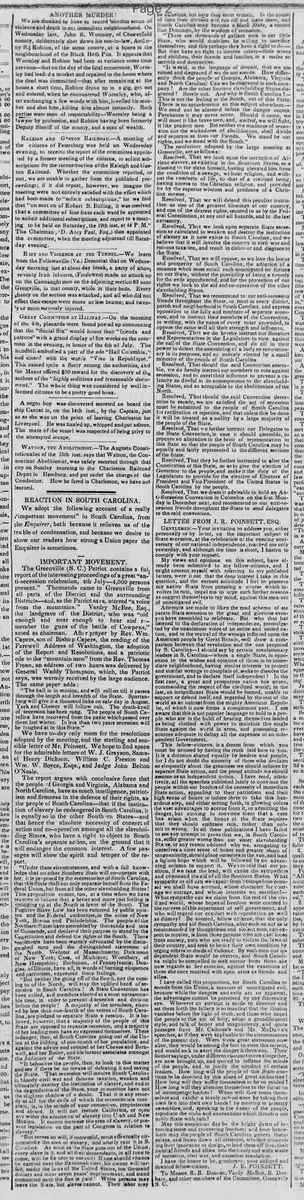
We adopt the following account of a really "important movement" in South Carolina, from the Enquirer, both because it relieves us of the trouble of condensation, and because we desire to show our readers how strong a Union paper the Enquirer is sometimes.
IMPORTANT MOVEMENT
The Greenville (S. C.) Patriot contains a full report of the interesting proceedings of a great "anti-secession celebration, 4th July—4,000 persons present." Thousands came to Greenville from all parts of the District and the surrounding Districts—and, as the Patriot says, uttered "a voice from the mountains." Vardry McBee, Esq., the landgrave of the District, who was "old enough and near enough to hear and remember the guns of the battle of Cowpens," acted as chairman. After prayer by Rev. Wm. Capers, son of Bishop Capers, the reading of the Farewell Address of Washington, the adoption of the Report and Resolutions, and a patriotic ode to the "mountain men" from the Rev. Thomas Frean, an address of two hours was delivered by General Waddy Thompson, which, the Patriot says, was warmly received by the large audience. The same paper adds:
"The ball is in motion, and will roll on till it passes through the length and breadth of the State. Spartanburg will give it a thousand licks on sale day in August. York and Chester will follow suit. The death-knell of secession has been rung. The people of South Carolina have recovered from the panic which passed over them last winter. In less than two years secession will be laughed at in this State."
We have to-day only room for the resolutions adopted by the meeting, and the sterling and sensible letter of Mr. Poinsett. We hope to find space for the admirable letters of W. J. Grayson, Samuel Henry Dickson, William C. Preston and Wm. W. Boyce, Esqs., and Judge John Belton O'Neale.
The report argues with conclusive force that the people of Georgia and Virginia, Alabama and North Carolina, have as much intelligence, patriotism and firmness in the defence of their rights, as the people of South Carolina—that if the institution of slavery be endangered in South Carolina, it is equally so in the other Southern States—and that hence the absolute necessity of concert of action and co-operation amongst all the slaveholding States, who have a right to object to South Carolina's separate action, on the ground that it will endanger the common interest. A few passages will show the spirit and temper of the report.
"Under these circumstances, and with a full knowledge that no other Southern State will co-operate with her, it is proposed by the secessionists of South Carolina, that this State shall not only separate herself from the Federal Union, but from all the other slaveholding States! This proposition comes, too, at a time when we have reasons to believe that a better and more just feeling is springing up at the North in favor of the South. The Fugitive Slave Law has been enforced by public opinion and the Federal authorities, in the cities of New York, Boston and Philadelphia. The people of the Northern States have assembled by thousands and tens of thousands, and declared their purpose to stand by the Constitution and defend the rights of the South. These sentiments have been warmly advocated by the distinguished men and the distinguished statesmen of The North. Webster of Massachusetts; Dickinson of New York; Cass, of Michigan; Woodbury, of New Hampshire; Buchanan, of Pennsylvania; Douglas, of Illinois, have all, in words of burning eloquence and patriotism, expressed those feelings.
"But neither the going off of the South, nor the coming to of the North, will stay the uplifted hand of secession in South Carolina! A State Convention has been called, and members elected at a most unreasonable time, in order to prevent discussion and division before the people! A majority of the members, elected by less than one-fourth of the voters of South Carolina, are pledged to separate State secession. It is believed, however, that a majority of the people of this State are opposed to separate secession, and a majority of her leading men have so expressed themselves. There is danger, then, of South Carolina going out of the Union at the bidding of one-fourth of her population, and against the advice and counsel of her Cheves and Barnwell, and her Butler, and his former associates amongst the Judiciary of the State.
"It behooves the people, then, to look to this matter and see if there be no means of defeating it and saving the State. That secession will involve South Carolina ultimately destroy the institution of slavery, and end in the degradation of the State, your committee have not the slightest shadow of a doubt. That it is any remedy at all for the evils of which the secessionists complain, is, to the minds of your committee, preposterous and absurd. It will not restore California, or open any wider the admission of slavery into Utah and New Mexico. It cannot increase the area of slavery, or prevent legislation on the part of Congress in relation to slavery."
But secession will, if successful, most effectually circumscribe the area of slavery, and utterly ruin it in S. Carolina. As soon as the State goes out of the Union, every slave in it, and all their descendants, in all time to come, will be fixtures to our soil: If one should chance be carried over the Savannah river, his owner will forfeit, under the laws of the United States, ten thousand dollars and incur seven years' imprisonment, and stand committed until the fine is paid! White persons may leave the State, but slaves cannot. Their labor may be valueless, but here they must remain. In the course of time their owners will run off and leave them, and South Carolina may become a black State, a second San Domingo, by the wisdom of secession.
"There are thousands of gallant men in our little State, who would doubtless be willing to sacrifice themselves; and this perhaps they have a right to do.—But they have no right to involve others—their wives and children, their friends and families, in a melee so terrible and destructive,
It is said, in the language of despair, that we are ruined and disgraced if we do not secede. How differently think the people of Georgia, Alabama, Virginia and North Carolina! Can we be disgraced in such company? Are the other fourteen slaveholding States disgraced? Surely not. And why is South Carolina?—This is not the feeling of the South, out of this State. There is no apprehension on this subject elsewhere.—We need not be alarmed before the danger occurs. Perchance it may never occur, Should it come, we will meet it like brave men, and, united, we will fight. it like prudent men But neither the madness of secession nor the wickedness of abolitionism, shall divide and separate us from our friends. We stand by our rights, and we stand with the South."
The resolutions adopted by the large meeting at Greenville, are as follows:
Resolved, That we look upon the institution of Africa slavery, as existing in the Southern States, as a blessing to the slave himself, having elevated him from the condition of a savage, without religion, and without the comforts of life, to that of a civilized being, having access to the Christian religion, and provided for by the superior wisdom and prudence of a Christian master.
Resolved, That we will defend this peculiar institution as one of the greatest blessings of our country, and one of the dearest rights, secured to us by the Federal Constitution, at any and all hazards, and to the last extremity.
Resolved, That we look upon separate State secession as calculated to weaken and destroy the institution of slavery as it now exists in South Carolina, and we believe that it will involve the country in civil war and ruinous taxation, and result in dishonor and disgrace to the State.
Resolved, That we will oppose, as we love the honor and prosperity of South Carolina, the adoption of a measure which must entail such unmitigated misfortunes on our State, without the possibility of being a remedy for the evils apprehended, and for the protection of our rights we look to the aid and co-operation of the other slaveholding States.
Resolved, That we recommend to our anti-secession friends throughout the State, to meet in every district, parish and neighborhood in South Carolina, and express opposition to the folly and madness of separate secession, and to instruct their members of the Convention, in writing, with the name of every voter appended, to oppose the same with all their strength and influence.
Resolved, That we do hereby instruct our Senators and Representatives in the Legislature to vote against the call of the State Convention, and do all in their power to defeat the assembling of a body so revolutionary in its purposes, and so unfairly elected by a small minority of the people of South Carolina
Resolved, That should the said Convention assemble, we do hereby instruct our members to vote against secession, and to exert their influence to prevent a calamity so direful in its consequences to the slaveholding States, and so acceptable to the abolitionists of the North.
Resolved. That should the said Convention determine to secede, we are satisfied the act of secession must be submitted to the people of South Carolina for ratification or rejection, and that unless this be done it will be treated as a nullity by a large majority of the people of the State.
Resolved, That we further instruct our Delegates to the State Convention, in case it should assemble, to procure an alteration in the basis of representation in this State so that the people of South Carolina may be equally and fairly represented in the different sections of the State.
Resolved, That they be further instructed to alter the Constitution of this State, so as to give the election of Governor to the people, and make it the duty of the Legislature to provide for the election of Electors of President and Vice President of the United States in South Carolina by the people.
Resolved. That we deem it advisable to hold an Anti-Secession Convention in Columbia on the first Monday in December next, and recommend to our anti-secession friends throughout the State to send delegates to the said convention.
LETTER FROM J. R. POINSETT, ESQ.
Gentlemen:—Your invitation to address you, either personally or by letter, on the important subject of State secession, at the celebration of the ensuing anniversary of our national independence, reached me only yesterday, and although the time is short, I hasten to comply with your request.
My views and opinions on this subject, have already been submitted to my fellow-citizens. and I might content myself with referring to my published letters. were it not that the deep interest I take in this question, and the earnest solicitude I feel to preserve my native State from pursuing a course which involves its ruin, impel me to urge such further reasons as suggest themselves to my mind, against this measure of unmitigated evil.
Attempts are made to liken the mad scheme of separate State secession to the great and glorious event you have assembled to celebrate. But who that has listened to the declaration of independence, promulgated by the unanimous voice of an entire and united nation, and to the recital of the wrongs inflicted upon the American people by Great Britain, will draw a comparison between that revolution and the one proposed by S. Carolina—I should say by certain revolutionary leaders in S. Carolina—where a single State, in opposition to the wishes and opinions of those in its immediate neighborhood, having similar interests to protect and similar wrongs to complain of, seeks to dissolve the government, and to declare itself independent? In the first case, a great and prosperous nation has arisen, commanding the respect of the civilized world; in the last, an insignificant State would be formed, unable to support or defend itself, and regarded by the rest of the world as an outcast from the mighty American Republic, of which it now forms a conspicuous part. I am aware that this is not popular language to hold to a people who are in the habit of hearing themselves lauded as being clothed with power to maintain this single State against the world in arms, and possessing resources adequate to defray all the expenses of an independent Government.
This fellow-citizens, is a dream from which you must be aroused by having the truth laid bare to you. It is a delusion shared equally by leaders and people, for I do not doubt the sincerity of those who declaim so eloquently about the greatness we should achieve by separate State action, and the proud attitude we should assume as an independent nation. I have read, attentively, all the speeches published lately to convince the people within our borders of the necessity of immediate State action, appealing to their patriotism and their high sense of honor to induce them to take this hazardous step, and either setting forth, in glowing colors the vast advantages to accrue from it, or admitting the danger, but striving to convince them that a case has arisen when the honor of the State requires that they should embrace ruin, rather than submit to wrong. In all these publications I have failed to see any attempt to prove that we, in South Carolina, suffer greater wrong than our sister slaveholding States, or any reason adduced why we, arrogating to ourselves a nicer sense of honor and greater share of magnanimity, should place ourselves in the van, and lead a forlorn hope which will be followed by no advancing column to support it. We are told that our position, if we take the lead, will excite the sympathies and command the aid of all the Southern States. What sympathy or aid can we expect from States whose counsel we shall have scorned, whose character for courage we outrage, and whose interests we sacrifice?—What sympathy can we claim from the rest of the civilized world, whose hopes of freedom were centred in the success of this experiment of self government, and who will regard our conduct with reprobation as well as dismay? Be assured, fellow citizens, that the only sympathy and aid South Carolina, after such an act as is recommended by thoughtless and violent men, can expect to receive, is from those persons who are cast loose from society, men who are ready to violate the laws of their country, and seek to better their own condition by urging others to deeds of violence By such men our independent State would be overrun, and South Carolina might be compelled to seek succor from those she now regards as her enemies, against the exactions of those she once received with open arms as friends and allies.
I have called this proposition, for South Carolina to secede from the Union, a measure of unmitigated evil, because while the dangers and evils are so apparent, the advantages cannot be perceived by any discerning eye.
Wherever an attempt is made to discover and set them forth the fallacy is so manifest that the illusion vanishes before the light of truth, and those who impel the people to this act of folly, adopt a grandiloquent style, and talk of honor and magnanimity, and quote passages from Mr. Calhoun's and Mr. McDuffie's speeches, as if they were applicable to the circumstances of the present day.
Were those great statesmen now alive, they would be among the first to stem this torrent, and would seek to avert the danger it threatens. Their former sayings, under different circumstances altogether, are now brought up, and quoted to inflame the minds of the people, and to justify the conduct of certain leaders. How long will the people of this State continue to be deceived by this abuse of great authorities? How long will they suffer themselves to be so misled ? How long will they abandon themselves to the dictation of incompetent leaders? When will they rouse themselves and exhibit a manly self-reliance by taking their own fate into their own hands? by meeting in primary assemblies, and, speaking in the name of the people, repudiate the clubs and conventions which threaten our noble State with ruin?
May this auspicious day be the bright dawn of returning sense and recovering freedom; and from henceforth may the people of South Carolina govern themselves, and frown down all attempts, whether proceeding from ignorance or design, to lead them off from their natural friends and allies, into the lonely and wide waste of secession, civil war, and causeless revolution.
I have the honor to be, gentlemen, your obliged and devoted fellow-citizen,
J. R. POINSETT.
To Messrs. R. B. Duncan, Vardry McBee, B. Dunham, and other members of the Committee, Greenville S.C.
What sub-type of article is it?
What keywords are associated?
What entities or persons were involved?
Where did it happen?
Domestic News Details
Primary Location
Greenville, S.C.
Event Date
4th July
Key Persons
Outcome
adoption of resolutions opposing separate state secession, calling for cooperation with other slaveholding states, and instructing delegates against secession; recommendation for an anti-secession convention in columbia on the first monday in december.
Event Details
A large anti-secession celebration attended by 4,000 people in Greenville, S.C., on July 4th, chaired by Vardry McBee, featuring prayer, reading of Washington's Farewell Address, adoption of report and resolutions, a patriotic ode, and a two-hour address by General Waddy Thompson. The event expressed opposition to separate state secession, emphasizing unity with other Southern states to protect slavery and the Union, and included a letter from J.R. Poinsett arguing against secession.