Thank you for visiting SNEWPapers!
Sign up free
Gazette Of The United States, & Philadelphia Daily Advertiser
Philadelphia, Philadelphia County, Pennsylvania
What is this article about?
A letter defending Phocion's critique of Thomas Jefferson's inconsistent views on black inferiority and equality, criticizing Jefferson's emancipation and colonization proposals as impractical, inhumane, and burdensome to Southern slaveholders.
Merged-components note: The text in the second component continues directly from the first, forming a single letter to the editor critiquing another writer's defense of Jefferson.
Clippings
1 of 2
OCR Quality
Full Text
19,10
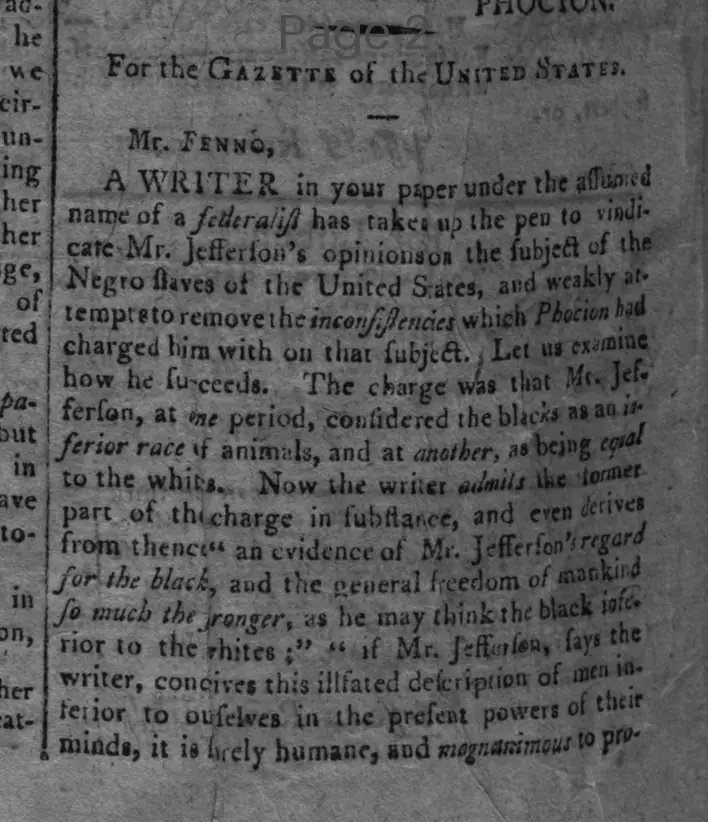
Mr. FENNO,
A WRITER in your paper under the assumed
name of a federalist has taken up the pen to vindi-
cate Mr. Jefferson's opinions on the subject of the
Negro slaves of the United States, and weakly at-
tempts to remove the inconsistencies which Phocion had
charged him with on that subject. Let us examine
how he succeeds.
The charge was that Mr. Jef-
feron, at one period, considered the blacks as an in-
ferior race of animals, and at another, as being equal
to the whites; the writer admits the former part of the charge in substance, and even derives
an evidence of Mr. Jefferson's regard for the black, and the general freedom of mankind
much the stronger as he may think the black infe-
rior to the whites;" if Mr. Jefferson, says the writer, conceives this ill-fated descrip-
tion of men in-
ferior to ourselves in the present powers of their
minds, it is surely humane, and magnanimous to pro-
vide for them the elevating condition of political freedom."
The writer evades the second part of the charge, which marks Mr. Jefferson's inconsistency, viz. his letter to Banneker, the Negro, wherein he asserts the equality of the natural genius of the blacks with the whites; he is totally silent in respect to that famous letter, which was a direct contradiction to his opinions, expressed in the notes on Virginia; but he proceeds to explain Mr. Jefferson's emancipation scheme, which he tells us was only to operate in favor of the posterity of the Negroes. This explanation makes the matter worse, as far as it would have affected the interests of the Southern states: the present holders of slaves would not thank Mr. Jefferson for leaving them all the old, superannuated, and useless Negroes, and liberating all the young and useful ones; such a scheme would be indeed an aggravation of the injury. What provision is a Southern planter, whose whole wealth is derived from slaves, to make for his children, if all the young Negroes are to be set free, as soon as born, or at the age, when they begin to be useful, and all the old Negroes are to be left on the estate as a burden? If Mr. Jefferson's scheme is to take place, much better to liberate them all at once, old and young.
The writer next attempts to apologize for Mr. Jefferson's transportation project, by asserting that there was to be no seizing and shipping and binding, but they were merely to be colonized, he does not say where, but thinks the interior part of Virginia or Kentucky: this, however, by no means agrees with Mr. Jefferson's views, for he expressly says in his Notes, p. 154, "the slave, when freed, must be removed beyond the reach of mixture;" and therefore colonizing them into the interior parts of Virginia would not prevent the evil apprehended, that of tainting the blood of the whites. It is evident then that his object was to ship them to some foreign country, that it was some project like that afterwards adopted by the Sierra Leone company, who sent a number of free persons to the coast of Africa, where many of them miserably perished.--The term Colonizing imports a sending to some remote country; and the other part of this wild project, namely, "the sending vessels, at the same time, to other parts of the world for an equal number of white inhabitants," clearly confirms it. The idea was, to send off these emancipated black children in the vessels which were to bring back an equal number of whites. This very extravagant project the apologist dwells on as an evidence of Mr. Jefferson's humanity and magnanimity. The black children, it is to be observed, were to be, against their consent, separated from their parents, and colonized to some distant region. Suppose they refused to go, must they not be seized, bound and compelled to go? If not, the project would fall through; and to complete the humanity and magnanimity of this noble scheme, the poor old parents, thus bereft of their children, were to remain in slavery, deprived of that which alone can render old age comfortable, the aid and company of their children.
Such was the project of this great philosopher, philanthropist and philonegrist!.
The writer attempts to retort the charge of inconsistency on Phocion, for accusing Mr. Jefferson at one time of degrading the blacks, and at another of befriending them: Phocion stated these facts, to show Mr. Jefferson's inconsistency; the truth is that Mr. Jefferson has injured his character with many of the friends of abolition by his degrading opinion of the blacks, and he has alarmed many of the Southern citizens by his project of emancipation; and thus it always is with inconsistent characters, who aim at pleasing every body-these half-way politicians must count upon perpetually entangling themselves in contradictions.
The writer is surprised that Mr. Jefferson should be censured for wishing to emancipate the blacks, when all the Southern states, except Georgia, have prohibited the slave trade. Does this writer suppose that the people of those states are so blind, as not to see the difference between prohibiting the importation of any more slaves, and emancipating those already in the country? Mr. Jefferson, he tells us, had proposed an article in the Declaration of Independence, censuring the kings of Great-Britain for annihilating the American laws to prohibit the slave-trade. Mr. Jefferson carried the first law in Virginia for abolishing the slave trade. Mr. Jefferson, in conformity with the equal birth rights of men, proposed in Virginia a plan for emancipating all slaves born after passing the act. Admit all this, yet the same Mr. Jefferson did propose that, when freed, they should be transported or colonized to some distant region, beyond the reach of mixture. Thus it appears from the very explanation given by the apologist himself that the scheme was rather worse than was stated by Phocion, not only as it regarded the master, but as it regarded the slave; for as to the former, all his young slaves were to be emancipated, without any compensation or equivalent, leaving the old ones as a burden on his estate, and, as to the latter, the children were to be torn from their parents, nolens volens, transported, shipped off or colonized to some distant region.
PHILO-PHOCION.
What sub-type of article is it?
What themes does it cover?
What keywords are associated?
What entities or persons were involved?
Letter to Editor Details
Author
Philo Phocion
Recipient
Mr. Fenno
Main Argument
the letter refutes a defense of jefferson's views on slavery, arguing that jefferson's opinions on black inferiority and his emancipation-colonization scheme reveal deep inconsistencies, impracticality for southern planters, and inhumanity toward slaves by separating families and forcing relocation.
Notable Details