Thank you for visiting SNEWPapers!
Sign up free
The New Orleans Daily Democrat
New Orleans, Orleans County, Louisiana
What is this article about?
In 1878 Paris Exposition, a correspondent tours the Trocadero's Historical Museum, detailing artifacts from stone age tools to 18th-century luxuries, illustrating civilization's advance, with highlights like ancient remains, knight armor, Henry III's watch, and Lafayette's sword. (248 characters)
Clipping
OCR Quality
Full Text
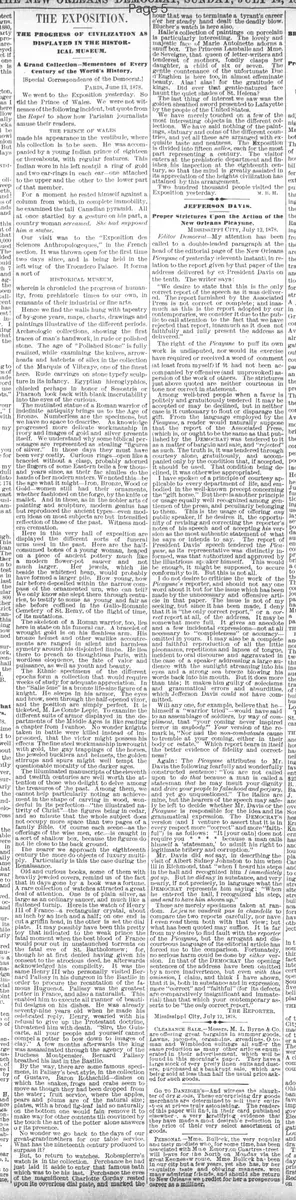
The Progress of Civilization as Displayed in the Historical Museum.
A Grand Collection—Mementoes of Every Century of the World's History.
[Special Correspondence of the Democrat.]
PARIS, June 13, 1878.
We went to the Exposition yesterday. So did the Prince of Wales. We were not witnesses of the following incident, but quote from the Rappel to show how Parisian journalists amuse their readers.
THE PRINCE OF WALES
made his appearance in the vestibule, where his collection is to be seen. He was accompanied by a young Indian prince of eighteen or thereabouts, with regular features. This Indian wore in his left nostril a ring of gold and two ear-rings in each ear—one attached to the upper and the other to the lower part of that member.
For a moment he rested himself against a column from which, in complete immobility, he examined the tall Canadian pyramid. All at once startled by a gesture on his part, a country woman screamed. She had supposed him a statue.
Our visit was to the "Exposition des Sciences Anthropologiques," in the French section. It was thrown open for the first time two days since, and is being held in the left wing of the Trocadero Palace. It forms a sort of
HISTORICAL MUSEUM
wherein is chronicled the progress of humanity, from prehistoric times to our own, in remnants of their industrial or fine arts. Hence we find the walls hung with tapestry of by-gone years, maps, charts, drawings and paintings illustrative of the different periods. Archeologic collections, showing the first traces of man's handwork, in rude or polished stone. The age of "Polished Stone" is fully realized, while examining the knives, arrow-heads and hatchets of silex in the collection of the Marquis of Vilbraye, one of the finest here. Rude carvings on stone typify sculpture in its infancy. Egyptian hieroglyphics chiseled perhaps in honor of Sesostris or Pharaoh look back with blank inscrutability into the eyes of the curious.
The mutilated statue of a Roman warrior of indefinite antiquity brings us to the Age of Bronze. Numberless are the specimens, but we have no space to describe. As knowledge progressed more delicate workmanship in Ivory and images of gold and silver presents itself. We understand why some biblical personages are represented as stealing "figures of silver." In those days they must have been very costly. Curious rings open like a bracelet without a clasp, probably adorned the fingers of some Eastern belle a few thousand years since, as their fac similes do the hands of her modern sisters. We noted this be the age what it might—Iron, Bronze, Wood or Gold—women still had their ornaments, whether fashioned on the forge, by the knife or mallet. And in these, as in the nobler arts of painting and sculpture, modern genius has but reproduced the ancient types even modern ideas on most subjects are but intensified reflection of those of the past. Witness modern cremation.
Here in this very hall of exposition are displayed the different sorts of funeral urns used in the past. Here are the half-consumed bones of a young woman, heaped on a piece of ancient pottery much like a modern flower-pot saucer and not much larger.
Her jewels, which lie beside the whitened heap, would probably have formed a larger pile. How young, how fair before deposited within the narrow compass of the ornamented urn, who can tell? We only know she slept there through centuries, to testify to some as young and fair as she, before coffined in the Gallo-Romanic Cemetery of St. Remy, of the flight of time, of its mutations.
The skeleton of a Roman warrior, too, lies here in state on his funeral car. A bracelet of wrought gold is on his fleshless arm. His bronze helmet and other warlike accoutrements are ranged in silent and harmless symmetry around his disjointed limbs. He lies there to preach to thoughtless Paris, with wordless eloquence, the fate of valor and puissance, as well as youth and beauty.
The Ethnic specimens of the different epochs form a collection that would require weeks of study for adequate appreciation. In the "Salle 5me" is a bronze life-size figure of a knight. He sleeps in his armor. The eyes and brow, seen through the half-opened vizor, and the position are simply perfect. It is ticketed, M. Le Comte Lépic. To examine the different suits of armor displayed in the departments of the Middle Ages is like reading a chapter from Ivanhoe. No wonder knights taken in battle were killed instead of imprisoned, that the victor might possess his effects. The fine steel workmanship inwrought with gold, the gay trappings of the horses, the jeweled bucklers and helmets, the golden stirrups and spurs might well tempt the questionable morality of the darker ages.
The illuminated manuscripts of the eleventh and twelfth centuries are well worth the attention of those who delight to delve among the treasures of the past. Among them, we cannot help particularly noting an achievement in the shape of carving in wood, wonderful in its perfection—the illustrated nativity of Christ—the figures being in cedar, and so minute that the whole subject does not occupy more space than two pages of a family Bible. Of course each scene—as the offerings of the wise men, etc.—is caught in a sort of shallow box, because the figures do not lie close to the back ground.
The nearer we approach the eighteenth century the more do objects of luxury multiply. Particularly is this the case during the Renaissance.
Old and curious books, some of them with heavily jeweled covers, remind us of the fact that in days gone by a book was a fortune.
A rare collection of watches attracted a great deal of attention. One is of plain silver, as large as an ordinary saucer, and much like a flattened turnip. Here is the watch of Henry III of France a rectangular crystal, about an inch by an inch and a half; on one end is cut a griffin head, in the other is set the dial plate. It may possibly have been this pretty toy that indicated to the weak prince the fatal moment when the best blood of France would pour out in unstaunched torrents on the fatal eve of St. Bartholomew; for, though he at first denied having given his consent to the atrocious deed, he afterwards acknowledged his complicity. It was the same Henry III who personally visited Bernard Palissy in his dungeon in the Bastile in order to procure the recantation of the famous Huguenot. Palissy was the greatest potter in France, and also a naturalist. This enabled him to execute all manner of beautiful designs on his dishes. He was already seventy-nine years old when he made his celebrated reply. Henry, wearied with his refusal to give up the Protestant doctrine, threatened him with death. "Sire, the Guis carts, all your people and yourself cannot compel a potter to bow down to images of clay." A few months afterwards the king was assassinated through the agency of the Duchess Montpensier. Bernard Palissy breathed his last in the Bastile.
By the way, there are some famous specimens, in Palissy's best style, in the collection of Gustave, Baron Rothschild—dishes on which the snakes, frogs and crabs seem to move as though they had been dropped from the water; fruit service, where the apples, pears and plums are of the natural size; plates, with a broad fig-leaf laid so naturally on the bottom one would fain remove it to make way for other contents till convinced by the touch the art of the potter alone answers for its presence.
No wonder we go back to the days of our great-grandmothers for our table service. What has the nineteenth century produced to surpass it?
But, to return to watches. Robespierre's watch is in the collection. Perchance he had just laid it aside to enter that famous bath which was to be his last. Perchance the eyes of the magnificent Charlotte Corday rested upon its coverless dial plate, and marked the hour that was to terminate a tyrant's career e'er her steady hand dealt the deadly blow.
Blucher's watch is here also.
Halle's collection of paintings on porcelain is particularly interesting. The lovely and majestic face of Marie Antoinette adorns a snuff box. The Princess Lamballe and Mme. de Sévigné, that queen of letter-writers and tenderest of mothers, fondly clasps her daughter, a child of six or seven. The gentle countenance of the unfortunate Duc d'Enghien is here too, in almost effeminate beauty. Alas! alas! for the gratitude of kings. Did ever that gentle-natured face haunt the quiet shades of St. Helena?
The last thing of interest we saw was the golden sheathed sword presented to Lafayette by the people of the United States.
We have merely touched on a few of the most interesting objects in the different collections. We have said nothing of the paintings, statuary and coins of the different countries, and yet all these are arranged with exquisite taste and neatness. The Exposition is divided into fifteen salles, each for the most part representing a century. The visitor enters at the prehistoric department and finishes his inspection at the eighteenth century, so that the mind is greatly assisted in its appreciation of the heights civilization has attained by this arrangement.
Two hundred thousand people visited the Exposition yesterday.
M. B. H.
What sub-type of article is it?
What themes does it cover?
What keywords are associated?
What entities or persons were involved?
Where did it happen?
Story Details
Key Persons
Location
Trocadero Palace, Paris
Event Date
June 12, 1878
Story Details
A journalist visits the Exposition des Sciences Anthropologiques in Paris, describing exhibits chronicling human progress from prehistoric times to the 18th century, including stone tools, bronze artifacts, ancient urns with remains, medieval armor, illuminated manuscripts, jeweled books, historical watches like Henry III's and Robespierre's, porcelain paintings of figures like Marie Antoinette, and Lafayette's sword.