Thank you for visiting SNEWPapers!
Sign up free
Vermont Phœnix
Brattleboro, Bellows Falls, Ludlow, Windham County, Windsor County, Vermont
What is this article about?
General Zachary Taylor responds to inquiries about his presidential candidacy, denying pledges on tariffs, sub-treasury, and the Mexican War, affirming Whig affiliation without ultra partisanship, and emphasizing constitutional adherence in letters dated April 20 and 22, 1848, from Baton Rouge, Louisiana.
Clipping
OCR Quality
Full Text
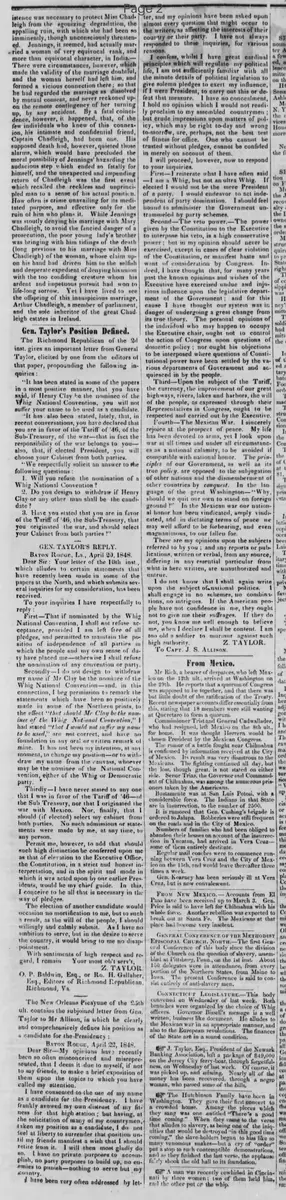
The Richmond Republican of the 2d inst. gives an important letter from General Taylor, elicited by one from the editors of that paper, propounding the following inquiries:
"It has been stated in some of the papers in a most positive manner, that you have said, if Henry Clay be the nominee of the Whig National Convention, you will not suffer your name to be used as a candidate.
"It has also been stated, lately, that, in recent conversations, you have declared that you are in favor of the Tariff of '46, of the Sub-Treasury, of the war—that in fact the responsibility of the war belongs to you—also, that, if elected President, you will choose your Cabinet from both parties.
"We respectfully solicit an answer to the following questions:
1. Will you refuse the nomination of Whig National Convention?
2. Do you design to withdraw if Henry Clay or any other man shall be the candidate?
3. Have you stated that you are in favor of the Tariff of '46, the Sub-Treasury, that you originated the war, and should select your Cabinet from both parties?"
GEN. TAYLOR'S REPLY.
Baton Rouge, La., April 20, 1848.
Dear Sir: Your letter of the 10th inst., which alludes to certain statements that have recently been made in some of the papers at the North, and which submits several inquiries for my consideration, has been received.
To your inquiries I have respectfully to reply:
First—That if nominated by the Whig National Convention, I shall not refuse acceptance, provided I am left free of all pledges, and permitted to maintain the position of independence of all parties in which the people and my own sense of duty have placed me—otherwise I shall refuse the nomination of any convention or party.
Secondly—I do not design to withdraw my name if Mr. Clay be the nominee of the Whig National Convention—and, in this connection, I beg permission to remark that the statements which have been so positively made in some of the Northern prints, to the effect "that should Mr. Clay be the nominee of the Whig National Convention," I had stated "that I would not suffer my name to be used," are not correct, and have no foundation in any oral or written remark of mine. It has not been my intention, at any moment, to change my position—or to withdraw my name from the canvass, whoever may be the nominee of the National Convention, either of the Whig or Democratic party.
Thirdly—I have never stated to any one that I was in favor of the Tariff of '46—of the Sub-Treasury, nor that I originated the war with Mexico. Nor, finally, that I should (if elected) select my cabinet from both parties. No such admissions or statements were made by me, at any time, to any person.
Permit me, however, to add that should such high distinction be conferred upon me as that of elevation to the Executive Office, the Constitution, in a strict and honest interpretation, and in the spirit and mode in which it was acted upon by our earlier Presidents, would be my chief guide. In this I conceive to be all that is necessary in the way of pledges.
The election of another candidate would occasion no mortification to me, but to such a result, as the will of the people, I should willingly and calmly submit. As I have no ambition to serve, but in the desire to serve the country, it would bring to me no disappointment.
With sentiments of high respect and regard, I remain Your most ob't serv't,
Z. TAYLOR
O. P. Baldwin, Esq., or Ro. H. Gallaher, Esq., Editors of Richmond Republican, Richmond, Va.
The New Orleans Picayune of the 25th ult. contains the subjoined letter from Gen. Taylor to Dr. Allison, in which he clearly and comprehensively defines his position as a candidate for the Presidency:
Baton Rouge, April 22, 1848.
Dear Sir—My opinions have recently been so often misconceived and misrepresented, that I deem it due to myself, if not to my friends, to make a brief exposition of them upon the topics to which you have called my attention.
I have consented to the use of my name as a candidate for the Presidency. I have frankly avowed my own distrust of my fitness or that high station; but having, at the solicitation of many of my countrymen, taken my position as a candidate, I do not feel at liberty to surrender that position until my friends manifest a wish that I should retire from it. I will then most gladly do so. I have no private purposes to accomplish, no party purposes to build up, no enemies to punish—nothing to serve but my country.
I have been very often addressed by letter, and my opinions have been asked upon almost every question that might occur to the writers, as affecting the interests of their country or their party. I have not always responded to these inquiries, for various reasons.
I confess, whilst I have great cardinal principles which will regulate my political life, I am not sufficiently familiar with all the minute details of political legislation to give solemn pledges to exert my influence, if I were President, to carry out this or defeat that measure. I have no concealment, I hold no opinion which I would not readily proclaim to my assembled countrymen; but crude impressions upon matters of policy, which may be right to-day and wrong to-morrow, are, perhaps, not the best test of fitness for office. One who cannot be trusted without pledges, cannot be confided in merely on account of them.
I will proceed, however, now to respond to your inquiries.
First—I reiterate what I have often said—I am a Whig, but not an ultra Whig. If elected I would not be the mere President of a party. I would endeavor to act independent of party domination. I should feel bound to administer the Government untrammelled by party schemes.
Second—The veto power.—The power given by the Constitution to the Executive to interpose his veto, is a high conservative power; but in my opinion should never be exercised, except in cases of clear violation of the Constitution, or manifest haste and want of consideration by Congress. Indeed, I have thought that, for many years past the known opinions and wishes of the Executive have exercised undue and injurious influence upon the legislative department of the Government; and for this cause I have thought our system was in danger of undergoing a great change from its true theory. The personal opinions of the individual who may happen to occupy the Executive chair, ought not to control the action of Congress upon questions of domestic policy: nor ought his objections to be interposed where questions of Constitutional power have been settled by the various departments of Government and acquiesced in by the people.
Third—Upon the subject of the Tariff, the currency, the improvement of our great highways, rivers, lakes and harbors, the will of the people, as expressed through their Representatives in Congress, ought to be respected and carried out by the Executive.
Fourth—The Mexican War. I sincerely rejoice at the prospect of peace. My life has been devoted to arms, yet I look upon war at all times and under all circumstances as a national calamity, to be avoided if compatible with national honor. The principles of our Government, as well as its true policy, are opposed to the subjugation of other nations and the dismemberment of other countries by conquest. In the language of the great Washington—"Why, should we quit our own to stand on foreign ground?" In the Mexican war our national honor has been vindicated, amply vindicated, and in dictating terms of peace we may well afford to be forbearing, and even magnanimous, to our fallen foe.
These are my opinions upon the subjects referred to by you; and any reports or publications, written or verbal, from any source, differing in any essential particular from what is here written, are unauthorized and untrue.
I do not know that I shall again write upon the subject of national politics. I shall engage in no schemes, no combinations, no intrigues. If the American people have not confidence in me, they ought not to give me their suffrages. If they do not, you know me well enough to believe me, when I declare I shall be content. I am too old a soldier to murmur against such high authority.
Z. TAYLOR.
To Capt. J. S. Allison.
What sub-type of article is it?
What keywords are associated?
What entities or persons were involved?
Where did it happen?
Domestic News Details
Primary Location
Baton Rouge, La.
Event Date
April 20, 1848 And April 22, 1848
Key Persons
Event Details
General Taylor responds to inquiries from Richmond Republican editors and Capt. J. S. Allison, clarifying he will accept Whig nomination without pledges, will not withdraw if Clay is nominee, denies favoring Tariff of '46, Sub-Treasury, originating the Mexican War, or selecting cabinet from both parties; affirms Whig but independent stance, limited veto use, respect for Congress on tariff and improvements, and views war as calamity while honoring national vindication.