Thank you for visiting SNEWPapers!
Sign up free
The Virginia Gazette
Richmond, Williamsburg, Richmond County, Virginia
What is this article about?
On September 29, 1775, London's Livery in Common Hall adopted an address to Great Britain's electors, criticizing the British ministers' war against the American colonies as arbitrary, unjust, and economically disastrous, urging opposition to the measures. Signed by Mayor John Wilkes and sheriffs.
Merged-components note: Continuation of the report on the London Livery's address to electors regarding American affairs, spanning page 2 to page 3; the second part was mislabeled as editorial but is part of the foreign news reporting.
Clippings
1 of 2
OCR Quality
Full Text
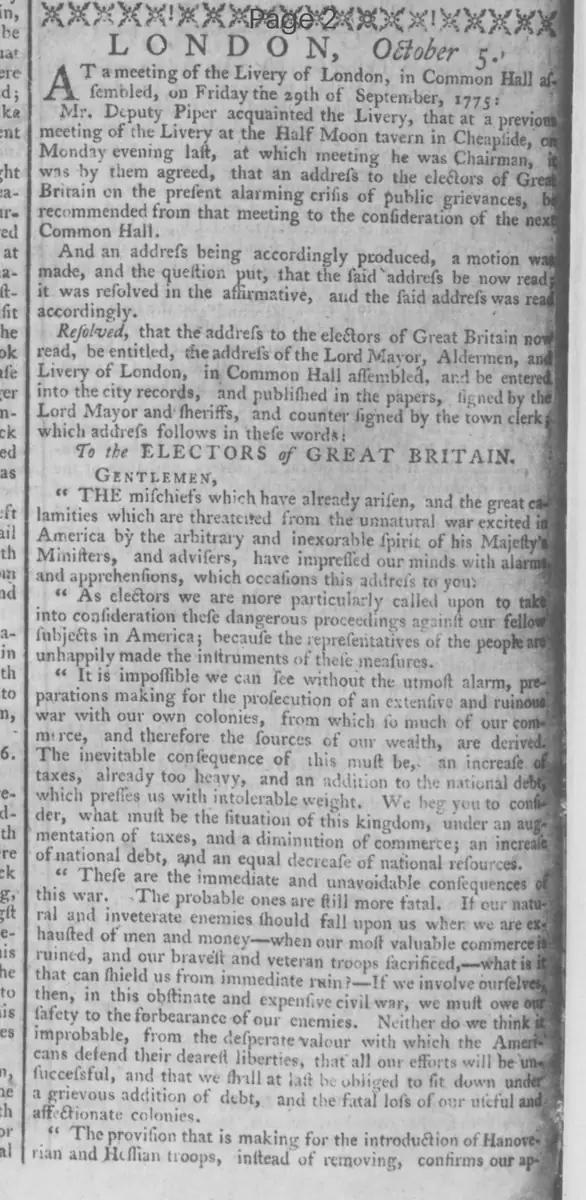
At a meeting of the Livery of London, in Common Hall assembled, on Friday the 29th of September, 1775:
Mr. Deputy Piper acquainted the Livery, that at a previous meeting of the Livery at the Half Moon tavern in Cheapside, on Monday evening last, at which meeting he was Chairman, it was by them agreed, that an address to the electors of Great Britain on the present alarming crisis of public grievances, be recommended from that meeting to the consideration of the next Common Hall.
And an address being accordingly produced, a motion was made, and the question put, that the said address be now read; it was resolved in the affirmative, and the said address was read accordingly.
Resolved, that the address to the electors of Great Britain now read, be entitled, the address of the Lord Mayor, Aldermen, and Livery of London, in Common Hall assembled, and be entered into the city records, and published in the papers, signed by the Lord Mayor and sheriffs, and countersigned by the town clerk; which address follows in these words:
To the ELECTORS of GREAT BRITAIN.
GENTLEMEN,
"THE mischiefs which have already arisen, and the great calamities which are threatened from the unnatural war excited in America by the arbitrary and inexorable spirit of his Majesty's Ministers, and advisers, have impressed our minds with alarm and apprehensions, which occasions this address to you.
"As electors we are more particularly called upon to take into consideration these dangerous proceedings against our fellow subjects in America; because the representatives of the people are unhappily made the instruments of these measures.
" It is impossible we can see without the utmost alarm, preparations making for the prosecution of an extensive and ruinous war with our own colonies, from which so much of our commerce, and therefore the sources of our wealth, are derived. The inevitable consequence of this must be, an increase of taxes, already too heavy, and an addition to the national debt, which presses us with intolerable weight. We beg you to consider, what must be the situation of this kingdom, under an augmentation of taxes, and a diminution of commerce; an increase of national debt, and an equal decrease of national resources.
" These are the immediate and unavoidable consequences of this war. The probable ones are still more fatal. If our natural and inveterate enemies should fall upon us when we are exhausted of men and money—when our most valuable commerce is ruined, and our bravest and veteran troops sacrificed,—what is it that can shield us from immediate ruin?—If we involve ourselves, then, in this obstinate and expensive civil war, we must owe our safety to the forbearance of our enemies. Neither do we think it improbable, from the desperate valour with which the Americans defend their dearest liberties. that all our efforts will be unsuccessful, and that we shall at last be obliged to sit down under a grievous addition of debt, and the fatal loss of our useful and affectionate colonies.
"The provision that is making for the introduction of Hanoverian and Hessian troops, instead of removing, confirms our apprehensions; because we cannot have any confidence in the protection of foreign mercenaries; and feel at once the shame and folly of that policy, which is to burthen us with taxes for the payment of foreign protectors, whilst our own brave troops are slaughtered in an unnatural, unnecessary, inglorious contest.
"For the certain expences of this war, we see no reparation, even in conquest. Desolated fields, and depopulated provinces, are little likely to contribute to our necessities, either by revenue of commerce. No complaint from the merchants and manufacturers in Great Britain, of illicit trade, and acts of navigation infringed, has called for these coercive measures. On the contrary, they have repeatedly petitioned against the principles upon which the war was founded. To secure commerce therefore, can neither be the aim nor issue of this war.
Neither can it be to settle a due subordination of the colonies upon the parent state, since they have repeatedly and solemnly acknowledged their subordination, and submitted to our controul.
"We cannot therefore discover any real object, or possible event of this dispute, should we be successful, but that of establishing the arbitrary power of the Crown over our fellow subjects in America, which must greatly endanger the constitution there, and increasing the number of placemen and pensioners, already so enormous, as to threaten the utter destruction of freedom and independence among us.
"The people of the colonies have appealed to their fellow subjects in Great Britain, for the justice and necessity of their conduct. We are convinced of their having been injured and oppressed. We sympathise in their griefs, and revere their fortitude; every motive of humanity, of justice, and of interest, call upon us to condemn the measures of which they complain, and to declare that we will never willingly contribute to urge their oppressions, or abridge their liberties.
"It has been our grief and our misfortune to see, that the repeated petitions from his Majesty's subjects in America, supported by many in this country, have not availed to prevent the dreadful extremities we now lament. The petitioners have been studiously driven to the last recourses of despair, by a denial of redress, and accumulation of grievances, too severe to be endured by a free people.
"In the united petition last year from all the colonies, to the King, they asked for peace, liberty, and safety. Did it become us to refuse such a request? Or to persist in violating the peace, liberty, and safety of any part of our fellow subjects? They pledged themselves that in the time of war, they will be ready and willing to demonstrate their loyalty to his Majesty, by exerting their most strenuous efforts, in granting supplies and raising forces. What can we in justice require more from a part of the empire, restrained, in points of commercial advantages, for our benefit; and labouring in consequence of that restraint, under a heavy and accumulating debt? Can we expect success from a war, founded in such flagrant injustice? Appealing, say they, "to that Being, who searches thoroughly the hearts of his creatures, we solemnly profess, that our councils have been influenced by no other motive, than a dread of impending destruction."
"That dread has been realized. Famine, fire, and sword, have answered their reasonable requests, and earnest applications. Utter destruction, or unconditional submission, is the only alternative left them, by this imperious and intemperate administration.
"Yet till they were determined to try the force of fresh supplication. This they have done in their late petition to the Throne, more humble, but still fruitless as the former. They say, "knowing to what violent resentments and incurable animosities, civil discords are apt to exasperate and enflame the contending parties, we think ourselves required by indispensable obligations to Almighty God, to your Majesty, to our fellow subjects, and ourselves, immediately to use all the means in our power, not incompatible with our safety, for stopping the further effusion of blood, and for averting the impending calamities which threaten the British empire."
"We feel these as the most amiable sentiments of men, cordially interested in our welfare, and earnestly aiming at peace and reconciliation.
"In pursuit of these laudable purposes, they solemnly declare their most ardent desire, that "the former harmony between the two countries may be restored, and a concord may be established between them, upon so firm a basis, as to perpetuate its blessings, uninterrupted by any future dissensions, to succeeding generations, in both countries." They declare that "they do not request such a reconciliation, as might, in any manner, be inconsistent with the dignity or welfare of Great Britain;" that "they are ready and willing, at all times, as they have ever been, with their lives and fortunes, to assert and maintain the rights and interests of his Majesty, and of their mother country." They therefore implore his Majesty, "to take measures for preventing the further destruction of the lives of his subjects; and that he will be pleased to direct some mode, by which the united applications of his faithful colonists to the Throne, in pursuance of their common councils, may be improved into a happy and permanent reconciliation; and that the wished for opportunity may soon be restored to them, of evincing the sincerity of their professions, by every testimony of devotion, becoming the most dutiful subjects, and the most affectionate colonists."
"To this petition an answer has been refused. The unhappy petitioners are left to deplore the prospect of inexorable war and desolation, and to seek protection in those fatal recourses, which self-preservation suggests against impending destruction.
"This, Gentlemen, is the alarming state of America, which fills us with anxiety and apprehensions.
"We lament the blood that has been already shed; we deplore the fate of those brave men, who are devoted to hazard their lives, not, against the enemies of the British nation, but against the friends of the prosperity and glory of Great Britain. We see for the honour of the British arms, sullied not by the misbehaviour of those who bore them, but by the misconduct of the Ministers, who employed them, to the oppression of their fellow subjects. We are alarmed at the immediate, insupportable expence, and the probable consequences of a war, which we are convinced originates in violence and injustice, and must end in ruin.
"These are the sentiments, Gentlemen, which we take the liberty of communicating to you, as the reasons upon which we have acted, trusting that, if they meet with your approbation, you will co-operate with us in endeavouring to bring the authors of these evils to the justice of their country.
Signed in obedience to the order of the Common Hall,
JOHN WILKES, Mayor.
GEO. HAYLEY,
NATH. NEWNHAM.
Sheriffs.
Counter signed by order,
WILLIAM RIX, Town Clerk.
What sub-type of article is it?
What keywords are associated?
What entities or persons were involved?
Where did it happen?
Foreign News Details
Primary Location
America
Event Date
Friday The 29th Of September, 1775
Key Persons
Outcome
warnings of increased taxes, national debt, loss of commerce, potential ruin from war, unsuccessful efforts leading to loss of colonies; blood already shed, no answer to american petition
Event Details
At a meeting of the Livery of London in Common Hall on September 29, 1775, chaired previously by Mr. Deputy Piper, an address to the electors of Great Britain was adopted and read, criticizing the war in America as unnatural and ruinous, sympathizing with the colonies, and calling for opposition to the ministers' measures. The address details grievances, petitions from America, economic consequences, and urges cooperation to bring authors of evils to justice. Signed by Mayor John Wilkes, Sheriffs Geo. Hayley and Nath. Newnham, countersigned by William Rix.