Thank you for visiting SNEWPapers!
Sign up free
Editorial
November 28, 1868
Springfield Weekly Republican
Springfield, Hampden County, Massachusetts
What is this article about?
This editorial critiques Wendell Phillips' suggestions in the Anti-Slavery Standard for reducing national debt interest to 4% and exempting labor from debt repayment. It argues for equitable taxation based on means, encouraging small-scale capital like homesteads over pure wage labor, while all citizens contribute to war debt costs.
Clipping
OCR Quality
98%
Excellent
Full Text
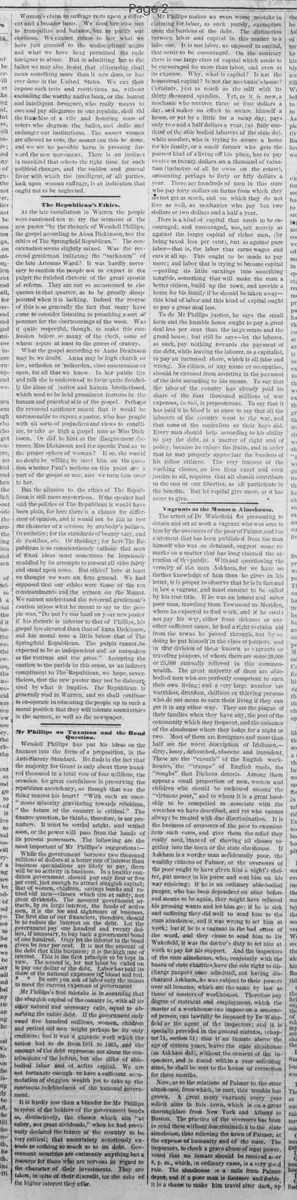
Mr. Phillips on Taxation and the Bond Question.
Wendell Phillips has put his ideas on the finances into the form of a proposition, in the Anti-Slavery Standard. He finds in the fact that the majority for Grant is only about three hundred thousand in a total vote of four millions, the occasion for great carefulness in preserving the republican ascendency, as though that was the thing nearest his heart! "With such an enormous minority gravitating towards rebeldom, the future of the country is critical." The finance question, he thinks, therefore, is not premature. It must be settled aright, and settled soon, or the power will pass from the hands of its present possessors. The following are the most important of Mr. Phillips's suggestions:—
While the government borrows two thousand millions of dollars at a better rate of interest than business speculations are likely to pay, there will be no activity in business. In a healthy condition government should pay only four or five per cent, just enough to attract sluggish capital; that of women, children, savings banks and retired old men—classes which aim at safety, not great dividends. The moment government attracts, by its large interest, the funds of active men, it is the foe and nightmare of business. The first aim of our financiers, therefore, should be to reduce the interest on the debt. Let the government pay one hundred and twenty dollars, if necessary, to buy back a government bond of one hundred. Only let the interest in the bond given be four per cent. It is not the amount of the debt that kills business; it is the high rate of interest. This is the first principle to be kept in view. The second is, let not labor be called on to pay one dollar of the debt. Labor has paid its share of the national expenses in blood and toil. Be sure you ask of labor only the means to meet the current expenses of government.
Mr. Phillips's first mistake is in assuming that the sluggish capital of the country is, with all its other natural and necessary calls, equal to absorbing the entire debt. If the government only owed five hundred millions, women, children and retired old men might perhaps be its only creditors; but it was a gigantic work which the nation had to do from 1861 to 1865, and the amount of the debt represents not alone the contributions of the infirm, but also alike of able-bodied labor and of active capital. We are not fortunate enough to have a sufficient accumulation of sluggish wealth yet to take up the enormous indebtedness of the national government. It is hardly less than a blunder for Mr. Phillips to speak of the holders of the government bonds as, distinctively, the classes which aim "at safety, not great dividends," when he had previously declared the future of the country to be very critical; that uncertainty notoriously extends to nothing so much as to its debt. Government securities are eminently anything but a resource for those who are nervous in regard to the character of their investments. They are taken, in spite of their discredit, for the sake of the higher interest they offer.
Mr. Phillips makes an even worse mistake in claiming for labor, as such purely, exemption from the burdens of the debt. The distinction between labor and capital in this matter is a false one. It is not labor, as opposed to capital, that needs to be encouraged. On the contrary there is one large class of capital which needs to be encouraged far more than labor, and even at its expense. Why, what is capital? Is not the homestead capital? Is not the mechanic's house? Certainly, just as much as the mill with its thirty thousand spindles. Yet, as it is now, a mechanic who receives three or four dollars a day, and makes no effort to secure himself a home, or put by a little for a rainy day, pays only two and a half dollars a year, (as fully one-third of the able bodied laborers of the state do), while another, who is trying to secure a home for his family, or a small farmer who gets the poorest kind of a living off his place, has to pay twelve to twenty dollars on a thousand of valuation (inclusive of all he owes on the estate), amounting perhaps to forty or fifty dollars a year. There are hundreds of men in this state who pay forty dollars on farms from which they do not get as much, and on which they do not live as well, as mechanics who pay but two and a half dollars a year. Here is a kind of capital that needs to be encouraged; and encouraged, too, not merely as against the larger capital of richer men, (by being taxed less per cent), but as against pure labor—that is, the labor that earns wages and eats it all up. This ought to be made to pay more; and labor that is trying to become capital—putting its little earnings into something tangible, something that will make the man a better citizen, build up the town, and provide a home for his family if he should be taken away—this kind of labor and this kind of capital ought to pay a great deal less. To do Mr. Phillips justice, he says the small farm and the humble home ought to pay a great deal less per cent than the large estate and the grand house: but still he says—let the laborer, as such, pay nothing towards the payment of the debt, while leaving the laborer, as a capitalist to pay an increased share, which is all false and wrong. No citizen, of any name or occupation, should be excused from assisting in the payment of the debt according to his means. To say that the labor of the country has already paid its share of the four thousand millions of war expenses, in toil, is preposterous. To say that it has paid it in blood is at once to say that all the laborers of the country went to the war, and that none of the capitalists or their boys did. Every man should help according to his ability to pay the debt, as a matter of right and of policy, because he enjoys the fruits, and in order that he may properly appreciate the burdens of his fellow citizens. The very interest of the working classes, no less than exact and even justice to all, requires that all should contribute to the cost of our liberties, as all participate in the benefits. But let capital give more, as it has more to give.
Wendell Phillips has put his ideas on the finances into the form of a proposition, in the Anti-Slavery Standard. He finds in the fact that the majority for Grant is only about three hundred thousand in a total vote of four millions, the occasion for great carefulness in preserving the republican ascendency, as though that was the thing nearest his heart! "With such an enormous minority gravitating towards rebeldom, the future of the country is critical." The finance question, he thinks, therefore, is not premature. It must be settled aright, and settled soon, or the power will pass from the hands of its present possessors. The following are the most important of Mr. Phillips's suggestions:—
While the government borrows two thousand millions of dollars at a better rate of interest than business speculations are likely to pay, there will be no activity in business. In a healthy condition government should pay only four or five per cent, just enough to attract sluggish capital; that of women, children, savings banks and retired old men—classes which aim at safety, not great dividends. The moment government attracts, by its large interest, the funds of active men, it is the foe and nightmare of business. The first aim of our financiers, therefore, should be to reduce the interest on the debt. Let the government pay one hundred and twenty dollars, if necessary, to buy back a government bond of one hundred. Only let the interest in the bond given be four per cent. It is not the amount of the debt that kills business; it is the high rate of interest. This is the first principle to be kept in view. The second is, let not labor be called on to pay one dollar of the debt. Labor has paid its share of the national expenses in blood and toil. Be sure you ask of labor only the means to meet the current expenses of government.
Mr. Phillips's first mistake is in assuming that the sluggish capital of the country is, with all its other natural and necessary calls, equal to absorbing the entire debt. If the government only owed five hundred millions, women, children and retired old men might perhaps be its only creditors; but it was a gigantic work which the nation had to do from 1861 to 1865, and the amount of the debt represents not alone the contributions of the infirm, but also alike of able-bodied labor and of active capital. We are not fortunate enough to have a sufficient accumulation of sluggish wealth yet to take up the enormous indebtedness of the national government. It is hardly less than a blunder for Mr. Phillips to speak of the holders of the government bonds as, distinctively, the classes which aim "at safety, not great dividends," when he had previously declared the future of the country to be very critical; that uncertainty notoriously extends to nothing so much as to its debt. Government securities are eminently anything but a resource for those who are nervous in regard to the character of their investments. They are taken, in spite of their discredit, for the sake of the higher interest they offer.
Mr. Phillips makes an even worse mistake in claiming for labor, as such purely, exemption from the burdens of the debt. The distinction between labor and capital in this matter is a false one. It is not labor, as opposed to capital, that needs to be encouraged. On the contrary there is one large class of capital which needs to be encouraged far more than labor, and even at its expense. Why, what is capital? Is not the homestead capital? Is not the mechanic's house? Certainly, just as much as the mill with its thirty thousand spindles. Yet, as it is now, a mechanic who receives three or four dollars a day, and makes no effort to secure himself a home, or put by a little for a rainy day, pays only two and a half dollars a year, (as fully one-third of the able bodied laborers of the state do), while another, who is trying to secure a home for his family, or a small farmer who gets the poorest kind of a living off his place, has to pay twelve to twenty dollars on a thousand of valuation (inclusive of all he owes on the estate), amounting perhaps to forty or fifty dollars a year. There are hundreds of men in this state who pay forty dollars on farms from which they do not get as much, and on which they do not live as well, as mechanics who pay but two and a half dollars a year. Here is a kind of capital that needs to be encouraged; and encouraged, too, not merely as against the larger capital of richer men, (by being taxed less per cent), but as against pure labor—that is, the labor that earns wages and eats it all up. This ought to be made to pay more; and labor that is trying to become capital—putting its little earnings into something tangible, something that will make the man a better citizen, build up the town, and provide a home for his family if he should be taken away—this kind of labor and this kind of capital ought to pay a great deal less. To do Mr. Phillips justice, he says the small farm and the humble home ought to pay a great deal less per cent than the large estate and the grand house: but still he says—let the laborer, as such, pay nothing towards the payment of the debt, while leaving the laborer, as a capitalist to pay an increased share, which is all false and wrong. No citizen, of any name or occupation, should be excused from assisting in the payment of the debt according to his means. To say that the labor of the country has already paid its share of the four thousand millions of war expenses, in toil, is preposterous. To say that it has paid it in blood is at once to say that all the laborers of the country went to the war, and that none of the capitalists or their boys did. Every man should help according to his ability to pay the debt, as a matter of right and of policy, because he enjoys the fruits, and in order that he may properly appreciate the burdens of his fellow citizens. The very interest of the working classes, no less than exact and even justice to all, requires that all should contribute to the cost of our liberties, as all participate in the benefits. But let capital give more, as it has more to give.
What sub-type of article is it?
Economic Policy
Taxation
What keywords are associated?
National Debt
Bond Interest
Taxation Equity
Labor Exemption
Small Capital
War Financing
Republican Ascendency
Financial Policy
What entities or persons were involved?
Wendell Phillips
Grant
Anti Slavery Standard
Editorial Details
Primary Topic
Critique Of Wendell Phillips' Financial Proposals On Debt And Taxation
Stance / Tone
Critical Of Labor Exemption, Advocates Equitable Taxation By Means
Key Figures
Wendell Phillips
Grant
Anti Slavery Standard
Key Arguments
Government Should Reduce Debt Interest To 4% To Attract Only Sluggish Capital And Stimulate Business
Labor Should Not Be Exempt From Debt Payment; All Should Contribute According To Means
Distinction Between Labor And Capital Is False; Encourage Small Capital Like Homesteads Over Pure Wage Labor
High Interest On Debt Hinders Business Activity
National Debt Requires Broad Based Funding, Not Just From Active Capital
Tax Small Farms And Homes Less To Promote Citizenship And Stability
War Expenses Paid In Blood And Toil By All, Not Just Labor
Capital Should Pay More As It Has More To Give