Thank you for visiting SNEWPapers!
Sign up free
The Virginia Gazette
Richmond, Williamsburg, Richmond County, Virginia
What is this article about?
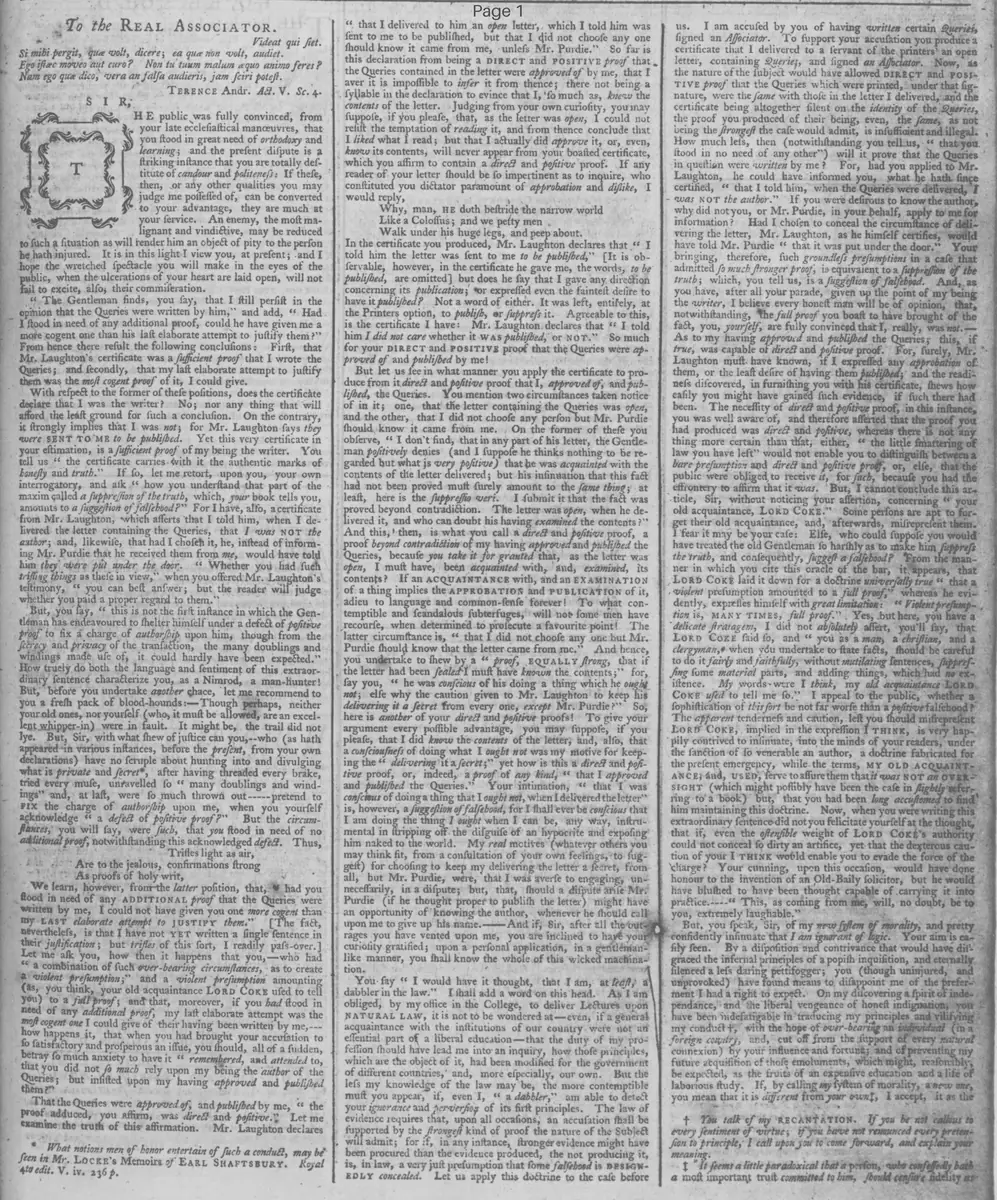
S. Henley rebuts 'The Real Associator's' accusations of authoring and publishing the 'Queries,' arguing the certificate provides no direct proof, exposes suppressions of truth, and critiques misrepresentations of legal authorities like Lord Coke in an ecclesiastical dispute.
Merged-components note: Merged the image with the letter_to_editor due to spatial overlap in bounding boxes and adjacent reading order; also merged the continuation on the next page as the text flows continuously from one component to the next, forming a single coherent letter signed by S. HENLEY.
Clippings
1 of 2
OCR Quality
Full Text
Videat qui iet.
Si mihi pergit, quæ volt, dicere; ea quæ non volt, audiet.
Ego itæc moveo aut curo? Non tu tuum malum æquo animo feres?
Nam ego quæ dico, vera an falsa audieris, jam cæri potest.
TERENCE Andr. ACT. V. Sc.4.
SIR,
The public was fully convinced, from your late ecclesiastical manoeuvres, that you stood in great need of orthodoxy and learning; and the present dispute is a striking instance that you are totally destitute of candour and politeness: If these, then, or any other qualities you may judge me possessed of, can be converted to your advantage, they are much at your service. An enemy, the most malignant and vindictive, may be reduced to such a situation as will render him an object of pity to the person he hath injured. It is in this light I view you, at present; and I hope the wretched spectacle you will make in the eyes of the public, when the ulcerations of your heart are laid open, will not fail to excite, also, their commiseration.
"The Gentleman finds, you say, that I still persist in the opinion that the Queries were written by him," and add, "Had I stood in need of any additional proof, could he have given me a more cogent one than his last elaborate attempt to justify them?"
From hence there result the following conclusions: First, that Mr. Laughton's certificate was a sufficient proof that I wrote the Queries; and secondly, that my last elaborate attempt to justify them was the most cogent proof of it, I could give.
With respect to the former of these positions, does the certificate declare that I was the writer? No; nor any thing that will afford the least ground for such a conclusion. On the contrary, it strongly implies that I was not; for Mr. Laughton says they were SENT TO ME to be published. Yet this very certificate in your estimation, is a sufficient proof of my being the writer. You tell us "the certificate carries with it the authentic marks of honesty and truth." If so, let me retort, upon you, your own interrogatory, and ask "how you understand that part of the maxim called a suppression of the truth, which, your book tells you, amounts to a suggestion of falsehood?" For I have, also, a certificate from Mr. Laughton, which asserts that I told him, when I delivered the letter containing the Queries, that I was NOT the author; and, likewise, that had I chosen it, he, instead of informing Mr. Purdie that he received them from me, would have told him they were put under the door. "Whether you had such trifling things as these in view," when you offered Mr. Laughton's testimony, "you can best answer; but the reader will judge whether you paid a proper regard to them."
But, you say, "this is not the first instance in which the Gentleman has endeavoured to shelter himself under a defect of positive proof to fix a charge of authorship upon him, though from the secrecy and privacy of the transaction, the many doublings and windings made use of, it could hardly have been expected."
How truly do both the language and sentiment of this extraordinary sentence characterize you, as a Nimrod, a man-hunter! But, before you undertake another chase, let me recommend to you a fresh pack of blood-hounds:-Though perhaps, neither your old ones, nor yourself (who, it must be allowed, are an excellent whipper-in) were in fault. It might be, the trail did not lie. But, Sir, with what show of justice can you,--who (as hath appeared in various instances, before the present, from your own declarations) have no scruple about hunting into and divulging what is private and secret*, after having threaded every brake, tried every muse, unravelled so many doublings and windings" and, at last, were so much thrown out-----pretend to fix the charge of authorship upon me, when you yourself acknowledge "a defect of positive proof?" But the circumstances, you will say, were such, that you stood in need of no additional proof, notwithstanding this acknowledged defect. Thus,
Trifles light as air,
Are to the jealous, confirmations strong
As proofs of holy writ,
We learn, however, from the latter position, that, had you stood in need of any ADDITIONAL proof that the Queries were written by me, I could not have given you one more cogent than my LAST elaborate attempt to JUSTIFY them." [The fact, nevertheless, is that I have not YET written a single sentence in their justification; but trifles of this sort, I readily pass-over.]
Let me ask you, how then it happens that you,-who had "a combination of such over-bearing circumstances, as to create a violent presumption;" and a violent presumption amounting (as, you think, your old acquaintance LORD COKE used to tell you) to a full proof; and that, moreover, if you had stood in need of any additional proof, my last elaborate attempt was the most cogent one I could give of their having been written by me,---how happens it, that when you had brought your accusation to so satisfactory and prosperous an issue, you should, all of a sudden, betray so much anxiety to have it" remembered, and attended to, that you did not so much rely upon my being the author of the Queries; but insisted upon my having approved and published them?"
That the Queries were approved of, and published by me, "the proof adduced, you affirm, was direct and positive." Let me examine the truth of this affirmation. Mr. Laughton declares
What notions men of honor entertain of such a conduct, may be seen in Mr. Locke's Memoirs of EARL SHAFTSBURY. Royal 4to edit. Vol. iv. p. 236.
"that I delivered to him an open letter, which I told him was sent to me to be published, but that I did not choose any one should know it came from me, unless Mr. Purdie." So far is this declaration from being a DIRECT and POSITIVE proof that the Queries contained in the letter were approved of by me, that I aver it is impossible to infer it from thence; there not being a syllable in the declaration to evince that I, 'so much as,' knew the contents of the letter. Judging from your own curiosity, you may suppose, if you please, that, as the letter was open, I could not resist the temptation of reading it, and from thence conclude that I liked what I read; but that I actually did approve it, or, even, know its contents, will never appear from your boasted certificate, which you affirm to contain a direct and positive proof. If any reader of your letter should be so impertinent as to inquire, who constituted you dictator paramount of approbation and dislike, I would reply,
Why, man, He doth bestride the narrow world
Like a Colossus; and we petty men.
Walk under his huge legs, and peep about.
In the certificate you produced, Mr. Laughton declares that" I told him the letter was sent to me to be published," [It is observable, however, in the certificate he gave me, the words, to be published, are omitted] but does he say that I gave any direction concerning its publication; or expressed even the faintest desire to have it published? Not a word of either. It was left, entirely, at the Printers option, to publish, or suppress it. Agreeable to this, is the certificate I have: Mr. Laughton declares that" I told him I did not care whether it WAS published,or NOT."So much for your DIRECT and POSITIVE proof that the Queries were approved of and published by me!
But let us see in what manner you apply the certificate to produce from it direct and positive proof that I, approved of, and published, the Queries. You mention two circumstances taken notice of in it; one, that the letter containing the Queries was open, and the other, that I did not choose any person but Mr. Purdie should know it came from me. On the former of these you observe, "I don't find, that in any part of his letter, the Gentleman positively denies (and I suppose he thinks nothing to be regarded but what is very positive) that he was acquainted with the contents of the letter delivered; but his insinuation that this fact had not been proved must surely amount to the same thing; at least, here is the suppressio veri. I submit it that the fact was proved beyond contradiction. The letter was open, when he delivered it, and who can doubt his having examined the contents ?" And this, then, is what you call a direct and positive proof, a proof beyond contradiction of my having approved and published the Queries, because you take it for granted that, as the letter was open, I must have, been acquainted with, and, examined, its contents? If an ACQUAINTANCE With, and an EXAMINATION of a thing implies the APPROBATION and PUBLICATION of it, adieu to language and common-sense forever! To what contemptible and scandalous subterfuges, will not some men have recourse, when determined to prosecute a favourite point!The latter circumstance is, "that I did not choose any one but Mr. Purdie should know that the letter came from me." And hence, you undertake to show by a "proof, EQUALLY strong, that if the letter had been sealed I must have known the contents;" for, say you," he was conscious of his doing a thing which he ought not; else why the caution given to Mr. Laughton to keep his delivering it a secret from every one, except Mr. Purdie?" So, here is another of your direct and positive proofs! To give your argument every possible advantage, you may suppose, if you please, that I did know the contents of the letter, and, also,that a consciousness of doing what I ought not was my motive for keeping the "delivering it a secret;"yet how is this a direct and positive proof, or, indeed, a proof of any kind, "that I approved and published the Queries." Your intimation, that I was conscious of doing a thing that I ought not, when I delivered the letter" is, however, a suggestion of falsehood, for I shall ever be conscious that I am doing the thing I ought when I can be, any way, instrumental in tripping off the disguise of an hypocrite and exposing him naked to the world. My real motives (whatever others you may think fit, from a consultation of your own feelings, to suggest) for choosing to keep my delivering the letter a secret, from all, but Mr. Purdie, were, that I was averse to engaging, unnecessarily, in a dispute; but, that, should a dispute arise Mr. Purdie (if he thought proper to publish the letter)might have an opportunityof knowing the author, whenever he should call upon me to give up his name. -And if, Sir, after all the outrages you have vented upon me, you are inclined to have your curiosity gratified;upon a personal application, in a gentleman-like manner, you shall know the whole of this wicked machination.
You say "I would have it thought, that I am, at least,a dabbler in the law." I shall add a word on this head. As I am obliged, by my office in theCollege, to deliver Lectures upon NATURAL LAW, it is not to be wondered at-even, if a general acquaintance with the institutions of our country were not an essential part of a liberal education-that the duty of my profession should have lead me into an inquiry, how those principles, which are the object of it, had been modified for the government of different countries,' and, more especially, our own. But the less myknowledge of the law may be, the more contemptible must you appear, if, even I, "a dabbler,"am able to detect your ignorance and perversion of its first principles. The law of evidence requires that, upon all occasions, an accusation shall be supported by thestrongest kind of proof the nature of the Subject will admit;for if, in any instance, stronger evidence might have been procured than the evidence produced, the not producing it, is, in law, a very just presumption that some falsehood is DESIGN-EDLY concealed. Let us apply this doctrine to the case before us. I am accused by you of having written certain Queries, signed an Associator. To support your accusation you produce a certificate that I delivered to a servant of the printers'an open letter, containing Queries, and signed an Associator. Now, as the nature of the subject would have allowed DIRECT and POSI-TIVE proof that the Queries which were printed, under that sig-nature, were the same with those in the letter I delivered, and the certificate being altogether silent on the identity of the Queries, the proof you produced of their being, even, the same, as not being the strongest the case would admit, is insufficient and illegal. Howmuch less, then (notwithstanding you tell us, "that you stood in no need of any other") will it prove that the Queries in question were written by me ? For, had you applied to Mr. Laughton, he could have informed you, what he hath since certified, "that I told him, when the Queries were delivered, I was NOT the author." If you were desirous to know the author, why did not you, or Mr. Purdie, in your behalf, apply to me for information? Had I chosen to conceal the circumstance of delivering the letter, Mr. Laughton,as he himself certifies, would have told Mr. Purdie "that it was put under the door."Your bringing, therefore, such groundless presumptions in a case that admittedof much stronger proof, is equivalent to a suppression of the truth; which, you tell us, is a suggestion of falsehood. And, as you have, after all your parade, given up the point of my being the writer, I believe every honest man will be of opinion, that, notwithstanding, the full proof you boast to have brought of the fact, you, yourself, are fully convinced that I, really, was not. — As to my having approved and published the Queries; this, if true, was capable of direct and positive proof. For, surely, Mr. Laughton must. have known, if I expressed any approbation of them, or the least desire of having them published; and the readi-ness discovered, in furnishing you with his certificate, shews how easily you might have gained such evidence, if such there had been. The necessity of direct and positive proof, in this instance, you was well aware of, and therefore asserted that the proof you had produced was direct and positive, whereas there is not any thing more certain than that, either, "the little mattering of law you have left" would not enable you to distinguish between a bare presumption and direct and positive proof, or, else, that the public were obliged to receive it, for such, because you had the effrontery to affirm that it was. But, I cannot conclude this ar-ticle, Sir, without noticing your assertion, concerning" your old acquaintance, LORD Coke." Some persons are apt to for-get their old acquaintance, and, afterwards, misrepresent them. I fear it may be your case: Else, who could suppose you would have treated the old Gentleman so harshly as to make him suppress the truth, and consequently, suggest a falsehood? From the man-ner in which you cite this oracle of the bar, it appears, that LORD Coke laid it down for a doctrine universally true" that a , violent presumption amounted to a full proof," whereas he evi-dently, expresses himself with great limitation: " Violent presump-tion is, MANY TIMES, full proof." Yes, but here, you have a delicate stratagem, I did not absolutely assert, you'll say, that LORD COKE said so, and "you as a man a christian, and a clergyman, when you undertake to state facts, should be careful to do it fairly and faithfully, without mutilating sentences, suppres-sing some material parts, and adding things, which had no ex-istence. My words·were I think, my old acquaintance LORD COKE used to tellme so." I appeal to the public, whether a sophistication of this sort be not far worse than a positive falsehood? The apparent tenderness and caution, lest you should misrepresent LORD COKE, implied in the expression I THINK, is very hap-pily contrived to insinuate, into the minds of your readers, under the sanction of so venerable an author, a doctrine fabricated for the present emergency, while. the terms, MY OLD ACQUAINT-ANCE; and,USED, serve toassure them thatit was NOT an OVER-SIGHT (which might possibly have been the case in slightly refer-ring to a book) but, that you had been long accustomed to find him maintaining this doctrine. Now, when you were writing this extraordinary sentence did not you felicitate yourself at the thought, that if, even the ostensible weight of LORD COKÉ's authority could not conceal so dirty an artifice, yet that the dexterous cau-tion of your I THINK would enable you to evade the force of the charge? Your cunning, upon this occasion, would have done honour to the invention of an Old-Baily solicitor, but he would have blushed to have been thought capable of carrying it into practice.--." This, as coming from me, will, no doubt, be to you, extremely laughable."
But, you speak, Sir, of my new system of morality, and pretty confidently insinuate that I am ignorant of logic. Your aim is ea-sily seen. By a disposition and contrivance that would have dis-graced the infernal principles of a popish inquisition, and eternally silenced a less daring pettifogger; you (though uninjured, and unprovoked) have found means to disappoint me of the prefer-ment I had a right to expect. On my discovering a spirit of inde-pendence, and the liberal vengeance of honest indignation, you have been indefatigable in traducing my principles and vilifying my conduct t, with the hope of over-bearing an individual (in a foreign country, and, cut off from the support of every natural connexion) by your influence and fortune; and of preventing my future acquisition of those emoluments, which might, reasonably, be expected, as the fruits of an expensive education and a life of laborious study. If, by calling my system of morality, another one, you mean that it is different from your own, I accept, it as the highest compliment you could pay me.
You talk of my RECANTATION. If you be not callous to every sentiment of virtue; if you have not renounced every preten-sion to principle, I call upon you to come forward, and explain your meaning.
It seems a little paradoxical that a person, who confessedly hath a most important trust committed to him, should censure fidelity as
best reparation you can make me for all the injuries you have done. As to my skill in logic, I leave that to the decision of such as are judges; for, it is not my custom to dispute about colours with the blind. The opinion formed of my qualifications for the office I hold, by several among the first of the age, is still upon record. To it, not to you, will the public appeal. Their candour and indulgence I have been greatly indebted to, and when they consider the treatment I have met with from you, I trust, it will not be withdrawn, upon the present occasion.
S. HENLEY.
P. S. I had forgotten to apologize for not answering you before; but I hope nothing unforeseen will interrupt the regularity of our future correspondence. You may expect, Sir, to hear from me soon on the substance of the Queries.
What sub-type of article is it?
What themes does it cover?
What keywords are associated?
What entities or persons were involved?
Letter to Editor Details
Author
S. Henley
Recipient
The Real Associator
Main Argument
denies authoring or approving the queries, arguing the accuser's certificate lacks direct proof, involves suppression of truth, and misrepresents legal principles like those of lord coke to falsely implicate him in an ecclesiastical dispute.
Notable Details